Principal Secretary Development Commissioner Y Kikheto Sema at the National Workshop on SDG Budgeting organised by NITI Aayog in in Kolkata on September 29. (DIPR Photo)
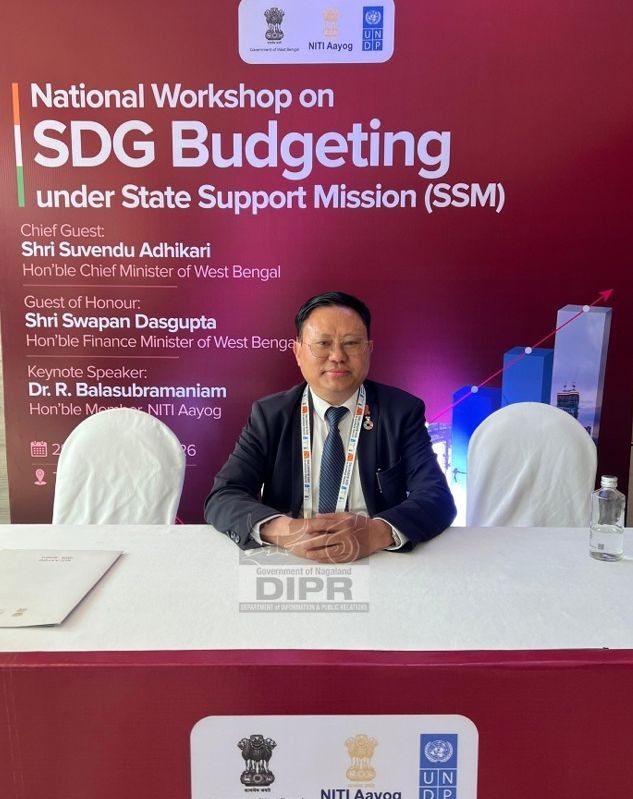
Kolkata, September 30 (MExN): Nagaland Principal Secretary and Development Commissioner Y Kikheto Sema has called for greater flexibility and regional contextualisation in the implementation and assessment of Sustainable Development Goals (SDGs), highlighting challenges specific to Nagaland and the North Eastern Region (NER).
According to a State DIPR release, Sema raised the issues during the National Workshop on SDG Budgeting organised by NITI Aayog and UNDP and hosted by the Government of West Bengal under the State Support Mission in Kolkata on September 29.
Sema highlighted financial inclusion as one of the challenges, noting that 14 of Nagaland’s 76 blocks remain unbanked. People in some remote areas have to travel 30–40 km to access banking services, he said, stressing that banking access is important for delivery of welfare benefits linked to bank accounts. He called for financial support and innovative mechanisms to improve banking access and viability in underserved areas.
He also sought contextual interpretation of indicators used in the SDG India Index, particularly those related to agriculture. Under SDG 2 (Zero Hunger), he noted that indicators measuring rice yield and fruit and vegetable productivity may not fully reflect Nagaland’s agricultural context, where jhum and shifting cultivation remain prevalent.
Sema said lower agricultural productivity should not by itself be interpreted as food insecurity or poor agricultural performance, and suggested that such indicators be considered alongside cropping patterns, nutritional outcomes, environmental sustainability, high-value crops and farm incomes.
He also raised concerns over the SDG 12 indicator on the area under jhum cultivation, for which the target is zero. He said jhum should be assessed in the context of the region’s ecological, cultural and livelihood realities rather than solely as a practice to be eliminated.
Sema further called for greater inclusion of indigenous farming systems, including jhum and shifting cultivation, in agricultural education curricula, noting a gap between formal agricultural education and the realities faced by farmers in the region.
On nutrition, he questioned whether a uniform BMI threshold for women aged 15–49 adequately captures nutritional status across populations with different demographic and socio-cultural characteristics, while acknowledging the WHO benchmark.
The Development Commissioner stressed that India’s geographical, cultural and socio-economic diversity requires region-sensitive policies, programmes and cost norms, with greater flexibility and State-level perspectives.
The workshop brought together officials from 36 States and Union Territories, Union ministries, UNDP and other stakeholders to discuss integrating SDG budgeting into State planning and budgeting processes.
The Nagaland delegation also included Finance Commissioner and Commissioner & Secretary to the Chief Minister Kesonyu Yhome and Assistant Planning Officer Loktimen Longchari.