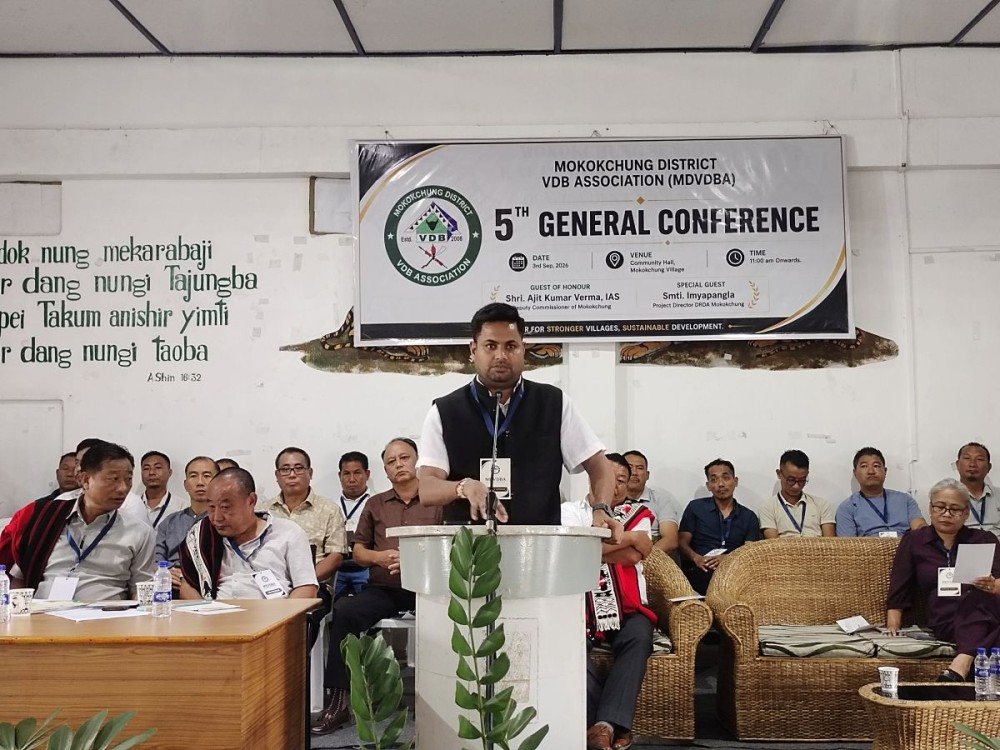
Mokokchung DC Ajit Kumar Verma, IAS, addressing the 5th General Conference of the Mokokchung District VDB Association at Mokokchung Village on September 3. (Morung Photo)
Morung Express News
Mokokchung | September 3
The need to reform Nagaland’s Village Development Board (VDB) system, improve accountability in rural development and make village institutions more inclusive dominated discussions at the 5th General Conference of the Mokokchung District VDB Association held at Mokokchung Village on Thursday.
With the VDB system completing 50 years since its establishment in 1976, the conference served as an opportunity to assess its achievements and examine the challenges confronting the institution. Speakers stressed that VDBs must be strengthened to meet the changing requirements of rural governance and development.
Deputy Commissioner of Mokokchung, Ajit Kumar Verma, IAS, said VDBs occupy a unique position in Nagaland’s administrative structure as institutions that link customary village governance with modern development programmes. He noted that the role of VDBs cannot be separated from the development history of rural Nagaland.
At the same time, he cautioned that the institution should not become complacent. He called for a comprehensive review of the existing VDB system, including its rules, functions and operational procedures.
According to the DC, the absence of clearly defined responsibilities and detailed guidelines has contributed to confusion and complaints regarding the functioning of VDBs. He therefore stressed the need to strengthen the legal and operational framework so that every VDB functions within a clearly defined mandate.
He also called for improved coordination between government departments, village councils and VDB management committees. Development programmes, he said, would have limited impact if they were planned and implemented without adequate consultation with local communities.
The issue of inclusivity also emerged as a major concern. Verma urged VDBs to ensure greater participation of women and youth in village development processes. He said VDBs should serve the entire village and should not be treated as the property of a particular group or section of the community.
The DC encouraged villages to identify their own strengths, products and suitable crops and build local enterprises around them. He said village-specific economic activities could create employment locally, encourage entrepreneurship and reduce the need for people to leave their villages in search of work. He also underlined the potential of Nagaland’s organic and locally produced goods in developing self-reliant village economies.
VDBs and village councils were urged to focus on investments that would provide long-term benefits rather than limiting development activities to short-term works.
Schools, anganwadi centres, health centres and other essential community institutions were identified as priority areas for investment. The DC said that the progress of a village should be measured not only by the funds utilised but also by the quality and usefulness of the assets created.
The conference also drew attention to implementation challenges affecting rural development schemes in Mokokchung district. Imyapangla, Project Director of the District Rural Development Agency (DRDA), stated that the district has nine Rural Development Blocks covering 88 recognised villages.
She urged VDBs to follow departmental instructions carefully to ensure that rural communities receive the full benefit of development funds and government schemes. She also appealed to village councils to extend complete support to VDB management committees and help residents understand the objectives and benefits of various programmes.
The conference included a welcome address by MDVDBA president Chutensangba, speeches by village council chairmen Mapuyanger of Mokokchung Village and I. Shashimeren Walling of Nokpu.
During the conference, Bendang Walling was appointed as the new president of the Mokokchung District VDB Association, while Obangonen Jamir was appointed general secretary. Other office-bearers were also appointed to various leadership positions for the next three-year tenure.