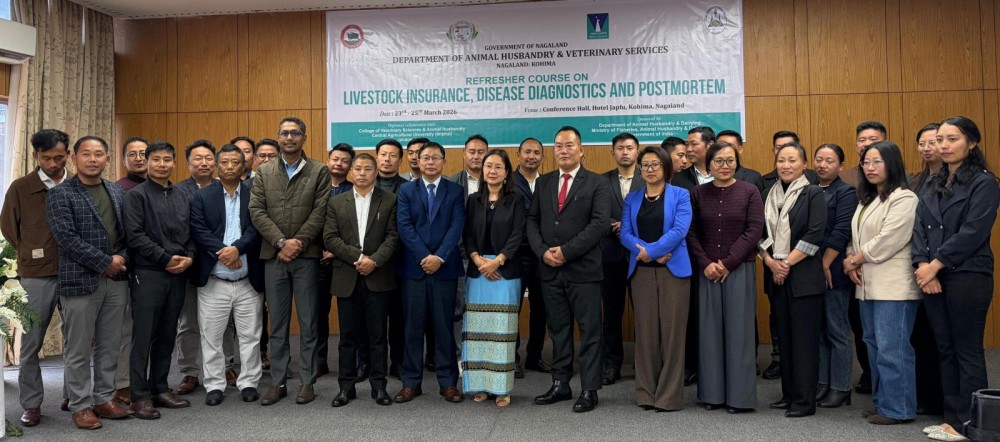
Angelina Tajen and Dr Imomanen Tzudir with others during the refresher course on livestock insurance, disease diagnostics and post-mortem in Kohima on March 23. (Morung Photo)
Our Correspondent
Kohima | March 23
A three-day refresher course on livestock insurance, disease diagnostics and post-mortem began at Hotel Japfu in Kohima on March 23. The programme, which will continue till March 25, is being organised by the Department of Animal Husbandry & Veterinary Services (AH&VS), Nagaland, in collaboration with the College of Veterinary Science & Animal Husbandry, Central Agricultural University, Jalukie, Peren, and sponsored by the Department of Animal Husbandry & Dairying under the Ministry of Fisheries, Animal Husbandry & Dairying.
Addressing the inaugural session, Angelina Tajen, IAS, Secretary to the Government of Nagaland, Department of AH&VS, said that in Nagaland, livestock is not merely an economic activity but a way of life. She noted that around 70 per cent of Naga households rear one or more species of livestock, with pigs forming the majority.
Citing the 2024–25 report, she said livestock contributes significantly to food supply, with meat production at 24.42 metric tonnes, milk at 52.79 metric tonnes and egg production at 443.38 lakh units. Despite this, she pointed out that the state continues to face a gap between demand and production.
Highlighting the importance of the National Livestock Mission (NLM), Tajen described it as a forward-looking and transformative initiative focused not only on increasing production but also on promoting entrepreneurship, enhancing productivity, strengthening value chains and reducing risks through livestock insurance.
Speaking on the occasion, AH&VS Director Imomanen Tzudir said that a majority of Nagaland’s rural population is engaged in farming, including agro-forestry, horticulture, livestock and poultry, often in integrated and interdependent systems.
Referring to the 21st Livestock Census (2024–25), he said Nagaland has around 80,000 bovines (including cattle, buffalo, mithun and goat), about 2,70,000 pigs and nearly 20,00,000 poultry. “These are the golden assets for most of our marginal farmers,” he said.
Tzudir noted that geo-climatic changes, natural disasters and emerging epidemics pose significant risks to livestock and poultry, leading to potential economic losses. He stressed the need to educate and encourage farmers to safeguard their assets by availing livestock and poultry insurance schemes offered by the government.
‘Livestock insurance crucial for protecting farmers’
Entrepreneur Penyiisielie Suokhrie, speaking on “Livestock insurance: Entrepreneur’s perspective and feedback,” said insurance provides protection against financial losses by transferring risk to an insurance provider. He emphasised that livestock insurance is crucial in protecting farmers from losses due to disease, accidents or natural calamities, thereby ensuring livelihood stability, enabling herd recovery and promoting better veterinary practices.
He noted that India’s livestock sector contributes approximately 5 per cent to the Gross Value Added (GVA) but highlighted that insurance penetration in the sector remains low at 0.98 per cent, despite initiatives like the National Livestock Mission.
Suokhrie said livestock insurance in India is offered through government programmes, cooperative ventures and private insurers, including the Centrally Sponsored Livestock Insurance Scheme, which subsidises premiums for farmers.
Sharing his personal experience as a dairy farmer, he said that after starting his farm in 2014, he insured his animals in 2015 through the National Livestock Development Board for three years. During this period, he faced two accidental animal deaths and successfully claimed Rs 50,000 each, which enabled him to replace the animals and continue operations without disruption.
He added that farmers often find private insurance unaffordable due to high premiums and expressed appreciation for the department’s efforts to reintroduce government-backed livestock insurance in the state.
The inaugural programme was chaired by Dr Kuokehebi Gwirie, Additional Director, Directorate of AH&VS, while Dr Hiabe, Joint Director, invoked blessings. The vote of thanks was delivered by Dr Chubasangla, Joint Director, Directorate of AH&VS.
Key benefits of livestock insurance include:
• Financial security by protecting farmers from significant economic losses
• Risk mitigation against disease outbreaks, natural disasters and wild animal attacks
• Business continuity by enabling quick herd recovery
• Improved access to credit through increased financial security