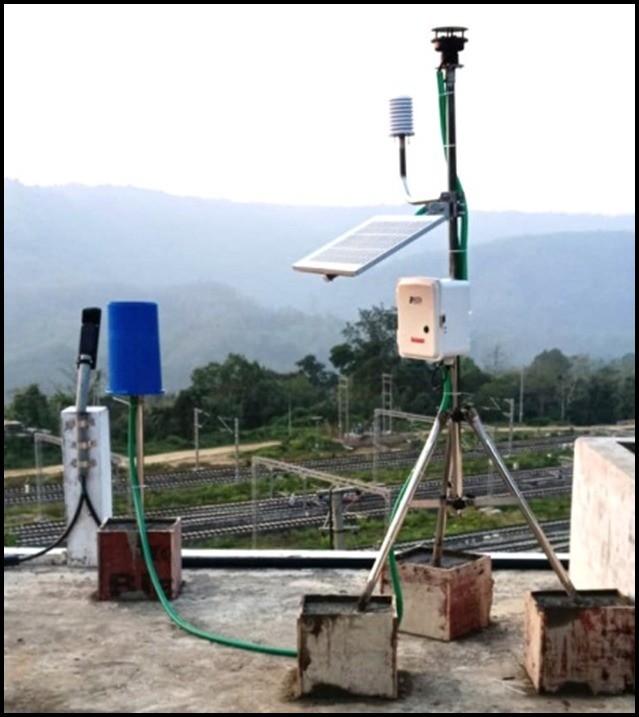
Maligaon, May 13 (MExN): In a major initiative aimed at strengthening railway safety and disaster preparedness during the monsoon season, the Northeast Frontier Railway (NFR) has begun installing Automatic Weather Stations (AWS) at vulnerable locations across its network to enable accurate and real-time weather forecasting.
According to an official statement, a total of nine Automatic Weather Stations are being set up at strategically identified locations under the NFR zone. The selected sites include the Lumding–Badarpur section in Assam, the Katakhal–Sairang section connecting Mizoram, and the Jiribam–Khongsang section in Manipur.
These regions are particularly prone to heavy rainfall, flooding and landslides during the rainy season, making continuous weather monitoring crucial for safe train operations.
So far, three Automatic Weather Stations have been successfully installed, while the remaining six are under various stages of installation and are expected to be completed by the end of May 2026.
The installation work is being carried out in coordination with the India Meteorological Department (IMD). The AWS network will provide precise and location-specific weather data, enabling railway authorities to take timely and informed decisions during emergencies and adverse weather conditions.
The initiative is expected to significantly enhance preparedness and response mechanisms, especially in flood-prone and landslide-sensitive sections of the railway network.
The Automatic Weather Stations are equipped with advanced sensors capable of monitoring multiple weather parameters with high accuracy. The rain gauge sensors can record rainfall intensity of up to 900 mm per hour, while temperature sensors can measure temperatures ranging from minus 40 degrees Celsius to plus 75 degrees Celsius.
Wind monitoring sensors can record wind speeds of up to 80 metres per second. In addition, the stations are fitted with humidity sensors covering a range from 0 to 100 per cent and pressure sensors capable of measuring atmospheric pressure up to 1200 hPa.