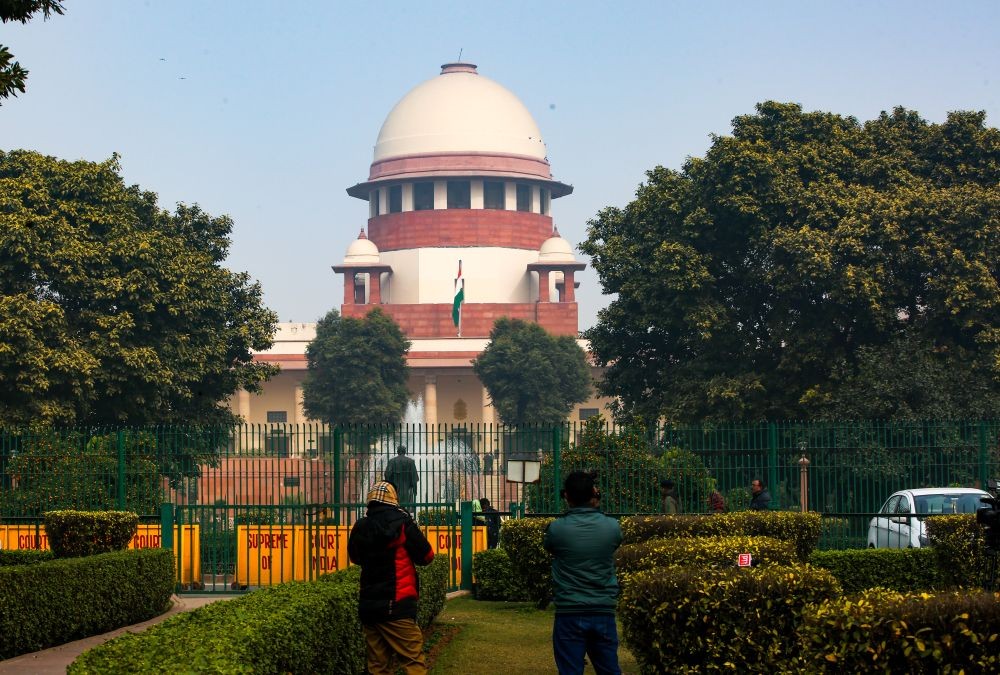
Supreme Court of India. (IANS Photo)
Morung Express News
Dimapur | October 6
The Supreme Court has dismissed a Special Leave Petition (SLP) challenging a Gauhati High Court Kohima Bench (GHCKB) judgment that set aside an order directing the Nagaland Government to provide compassionate appointment to the son of a deceased police personnel.
In its September 28, 2026 order, the Supreme Court found “no grounds to interfere” with the High Court judgment dated February 4, 2026 and dismissed the SLP.
The matter concerns son of the deceased, whose father, a Naik under the District Executive Force, Mokokchung, died in service on January 12, 2008. The son subsequently had sought appointment under the State’s die-in-harness scheme.
In its February 4judgment, the GHCKB Division Bench of Justice Unni Krishnan Nair and Justice Yarenjungla Longkumer had allowed the State Government’s appeal and set aside a November 12, 2024 order of the Single Judge directing his appointment.
In its ruling, the Court held that compassionate appointment is not a vested right, but a measure intended to provide immediate relief to the family of a deceased government employee facing financial hardship.
Where there is prolonged delay, the court observed, the “sense of immediacy” is diluted.
The Bench relied on the Supreme Court’s judgment in State of West Bengal versus Debabrata Tiwari, which held that a claim for compassionate appointment may lose its basis when considerable time has elapsed since the death of the employee.
Applying the principle, the High Court noted that 15 years had elapsed since Choudhury’s father’s death and that his family had been able to sustain itself during the intervening period. It held that the immediate crisis arising from the death could no longer be said to subsist.
The Bench consequently held that a writ of mandamus could not have been issued directing compassionate appointment as a matter of right and set aside the Single Judge’s order.
The Supreme Court’s latest order upheld the High Court’s judgment.