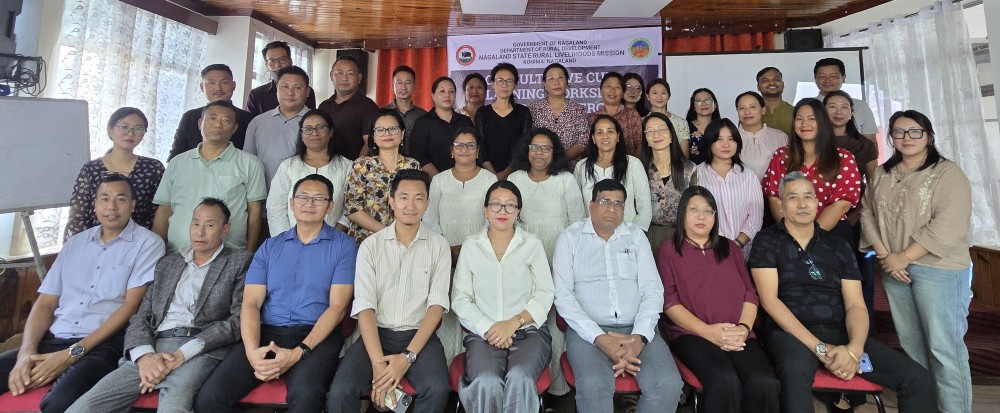
Participants of the Inter-department Consultative and Planning Workshop at Red Cross Conference Hall, Kohima on July 15.
Kohima, July 16 (MExN): The Nagaland State Rural Livelihoods Mission (NSRLM), Rural Development is organising a State Level Consultative Workshop on PRI–CBO Convergence Phase-I Extension Project from July 15 to 17.
Objective of the workshop is to develop Action Plans for effective implementation of the PRI-CBO convergence strategy which is integration of Village Councils and Community Based Organizations in rural areas, and to develop Immersion Sites in 4 RD Blocks namely Changtongya, Jakhama, Longleng and Wokha that are under the 1st Phase Implementation of the Project.
The introductory session involving stakeholder line departments was conducted on July 15 at the Red Cross Conference Hall, Kohima. Facilitated by the State Mission Management Unit (SMMU) along with Kudumbashree National Resource Organization (NRO), representatives from both organizations comprising of Community Cadres, staff and project functionaries will formulate strategies to strengthen institutional convergence for effective demand realization of Village Prosperity Resilience Plan (VPRP) and grassroots development.
The programme commenced with an introductory session and objective setting led by M Rollan Lotha, COO (Programs), NSRLM wherein he highlighted the importance of convergence between Panchayati Raj Institutions (PRIs), Community-Based Organisations (CBOs) and government departments to ensure inclusive, participatory and demand-driven rural development.
Participants shared field experiences and reviewed the progress of the PRI–CBO Convergence initiative. The discussions focused on strengthening implementation under the Phase-I Extension through coordinated planning and enhanced collaboration.
Technical sessions were presented by Samyak, Project Lead, and Elow D Mao, State Project Coordinator, both from the NRO. They made presentation on processes and importance of convergence for improving access to government schemes, avoiding duplication of efforts and ensuring timely delivery of services. The workshop also highlighted the integration of the Village Poverty Reduction Plan (VPRP) with the Gram Panchayat Development Plan (GPDP), stressing that community priorities identified through the VPRP should be incorporated into GPDPs to facilitate responsive and need-based development planning.
Areas of Inter-departmental support requirement were presented by Kenivole Richa, Program Manager and Nodal Person for PRI-CBO Convergence, NSRLM.
The interface with line departments formed a major component of the workshop with officials from the Departments of Public Health Engineering (PHED), Social Welfare, Health & Family Welfare, Rural Development, Veterinary & Animal Husbandry, Fisheries, and School Education discussing about departmental schemes and exploring ways to align community demands with available services through effective convergence to ensure no eligible beneficiary is left out of government welfare schemes and entitlements. The stakeholder department representatives urged the NSRLM to connect with the State Level Offices to ensure listing of eligible beneficiaries for availing of schemes and other entitlements, and for structured mapping for beneficiaries to meet criteria for availing entitlements.
The introductory session concluded with development of an outline for finalisation of action plan for development of Model Sites where intensive convergence will be focused. Participants reaffirmed their commitment to strengthening coordination among PRIs, CBOs and line departments to ensure sustainable, community-led rural development across Nagaland.