Ngaranmi Shimray
New Delhi
Blissfully unaware of how other people were living around the world and even in their own neighbourhood, the Naga tribes lived hunting heads in independent existence for ages under village republics. Their annual forays into the tea gardens of Assam disturbed the peace and prompted the British colonial power to tame and discipline them. To an extent, they succeeded, but it was the exposure to Europe in 1917–1918 under the Labour Corps that tamed the Nagas, opening up their eyes to the outside world for the first time. They realised they were not alone and that there were other Naga tribes like them living in the neighbouring mountains and hills. They realised that there were advanced and prosperous kingdoms and nations around the world wielding political power and military might. They realised that their existence in village republics, isolated from the outside world, had to change and that they also needed a nation. Their realisation became a Vision, giving birth to the Naga Club in 1918.
Phizo came along, transforming the Vision into a Dream for Naga nationhood under a political movement which transformed into an armed struggle. His dream suffered a setback as the succeeding Union of India, after the colonial British power left, did not agree with his proposal. In the throes of bloodshed, the Naga moderates emerged, dashing Phizo’s dream by negotiating a political arrangement within the Constitution of India. Debates continue even today whether the 16-Point Agreement amounts to betrayal and a setback for the Naga freedom movement, but every struggle has its own story, and the resultant outcome of the 16-Point Agreement saw the creation of something that never existed before; a new state called Nagaland with defined territorial jurisdiction in 1963, based on the first administrative unit of the Naga Hills Tuensang Area (NHTA) formed in 1957. It took just two years for moderate Naga leaders to work out a memorandum once they convened in 1957, after talks with hardliners had collapsed in 1952–53, and another four years from that proposal to actualise statehood under the 16-Point Agreement; a remarkably short period to secure a state for a political struggle.
The hardliners for Naga nationhood pushed ahead with their agenda and took the help of neighbouring countries, marching all the way to China and back only to find themselves walking into a trap engineered by their colleagues. The returnees found themselves in jails while the collaborators secured permanent employment under the Government of India in the Border Security Force, with some leaders adjusted against political positions. Could this be considered another betrayal and a setback?
Despite setbacks, the hardliner diehards continued with their feeble resistance as the backbone was broken by the mass transformation from a guerrilla force to permanent government employees with the trained fighters in jail. Being hunted, they thought they would have an honourable political settlement under the Constitution, but the Shillong Accord was called a betrayal.
A fresh set of hardcore diehards emerged from the Shillong Accord setback and rejuvenated the guerrilla movement under the banner called the NSCN (IM). There was much promise that this group was different and had the potential to negotiate an honourable political settlement from a position of strength. Prolonged negotiations since 1997 sapped away the strength of this group as they got accustomed to comfort and aged during the almost three decades of just talks and no action. They failed to realise that time is not on their side as their leaders and cadre aged. On the other hand, the Indian Union has an established political setup which has withstood the strains of politics since independence and does not have the problems of aging leadership, as they are renewed every election through a democratic process. While India gained strength under strong leaderships and stable governments in thirty years' time, the NSCN withered every passing year.
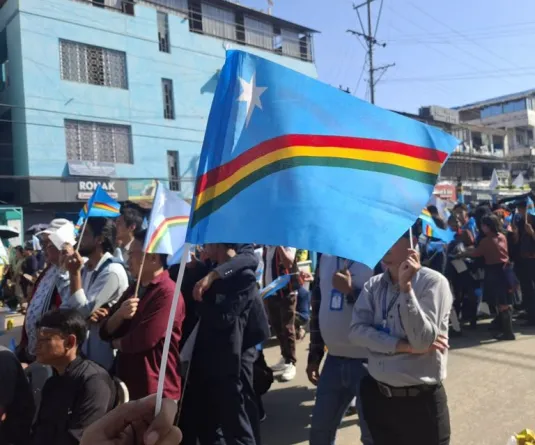
However, Hope is still alive, though to what extent it can be realised remains uncertain. Would a political settlement within the current framework of the Constitution of India be viewed by different armed groups and the younger generations as Betrayal? Is it the fear of being branded traitors that makes the negotiators insist on a Naga Flag and Constitution? Would a Flag and Constitution taken away from J&K under Article 370, yet granted to secure the Naga peace settlement under Article 371A be plausible and seen as bringing a fresh arrangement into the Constitution? Would the Government of India, in the interest of lasting peace, concede to these two demands or offer a watered-down version?
In the interest of securing lasting peace, such a concession is worth considering to uphold unity in diversity; after all, no one is breaking away from the Indian Union. Rather, it would make the nation stronger by winning the wholehearted support of a people who were never ruled by any mainland Indian Maharaja or kingdom, and whom even the colonial British administration largely kept at bay by designating their territories as "Excluded" and "unadministered" areas; an arrangement with few parallels anywhere in the country. Given the unique history of the Nagas, this exception deserves to be considered and granted. That recognition is all they seek.
The Reality is the sense of déjà vu, as the essence of the alleged leaked proposal sounds almost like the “Shillong Accord”; i.e., a political settlement within the framework of the current Indian Constitution. Already a dissent group has emerged with their main plank that the proposal of the Naga peace negotiators is all within the current framework of the Constitution of India and there is nothing different between their proposal and the disgraced Shillong Accord. They have positioned themselves to take over from the ceasefire group on the same plank the NSCN had done 46 years back, calling the Shillong Accord a betrayal. Will history repeat itself or will they walk away from the table? Will the Naga peace negotiators bite the bullet or risk being branded betrayers?
Naga history is filled with chapters often branded as betrayal; the 16-Point Agreement, the capture of China-trained fighters and the absorption of collaborators into the BSF, the Shillong Accord, and now any prospective settlement within the current framework of the Indian Constitution if concluded without a Naga Flag and Constitution. Will history repeat itself? Or will they bite the bullet and if so, to what avail? Or will India, prevailed by greater wisdom and maturity, grant the symbolic concessions in the greater interest of nurturing the diversity of the country with pride? The Nagas live on the hope that greater wisdom and maturity will prevail.