Dr Albert M Chawang with PCC Department of Education faculty and students. (Photo Courtesy: PCC Mass Comm)
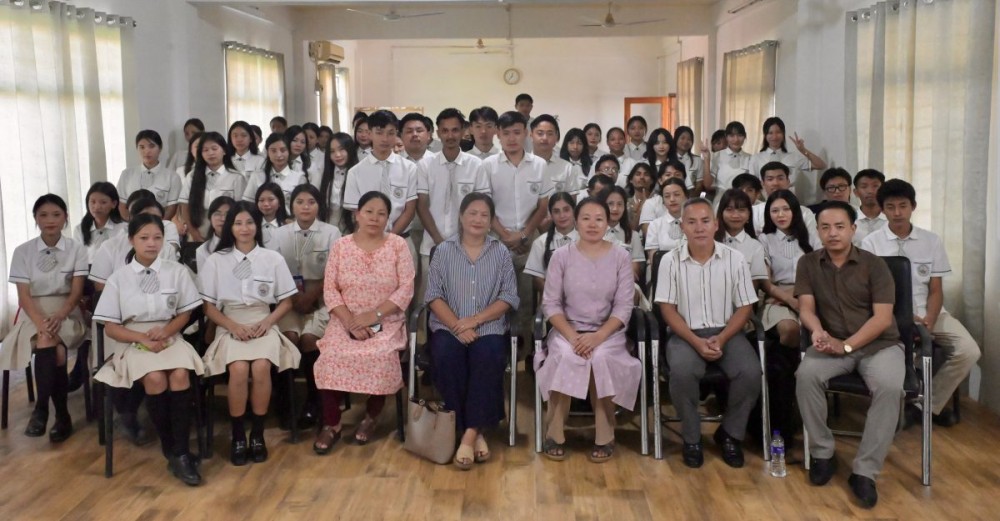
Chümoukedima, September 19 (MExN): Patkai Christian College (Autonomous), Chümoukedima organised two academic programmes on September 18, facilitating discussions among students and faculty on the contributions of Christian missionaries to education in India and recent developments in physics, mathematics and artificial intelligence.
The PCC Mass Comm in a press release stated that the Department of Education conducted a seminar titled “The Contribution of Christian Missionaries to Education in India” at the college's conference hall. Dr Albert M Chawang, Assistant Professor at the Centre for Advanced Religious Studies, North East Christian University, served as the resource person.
Dr Chawang outlined the progression of Christian educational initiatives in India, beginning with early Protestant missions and their impact on formal education, printing, literacy and teacher training. He highlighted the establishment of the Tranquebar Mission in 1706 and the Serampore Mission's contributions, particularly in founding schools and advancing the use of Indian languages in education.
The presentation then turned to Northeast India, covering regions such as Assam, the Khasi Hills, Manipur, Nagaland and Mizoram. Dr Chawang discussed the work of missionaries including Rev. Dr Nathan Brown in Assam, Rev Thomas Jones in the Khasi Hills, Rev. William Pettigrew in Manipur, and Dr Edward Winter Clark, Rev CD King and Rev Dr Sidney W Rivenburg in Nagaland.
The seminar further examined the development of literature and educational materials in local languages. In Nagaland, Rivenburg contributed by translating and publishing biblical texts, an Angami primer and an arithmetic book. Comparable initiatives in Khasi, Manipuri, Tangkhul and Mizo languages enhanced the availability of written resources for education and literacy.
Regarding Rev William Pettigrew's work in Manipur, Dr Chawang noted that education at the Ukhrul Mission School encompassed reading, writing, hygiene, vocational skills, knitting, sewing and modern agricultural techniques. Pettigrew also contributed to Manipuri and Tangkhul literature by producing grammars, dictionaries and textbooks, and by translating the New Testament into Tangkhul.
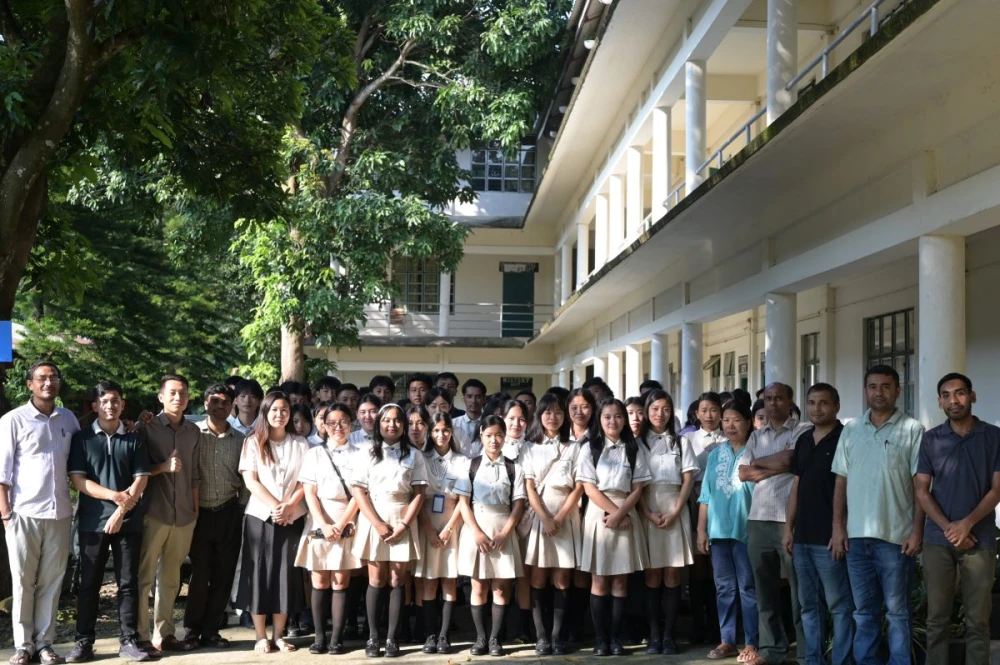
The presentation also addressed the role of missionary education in advancing women's education by establishing schools and boarding facilities for girls, and highlighted teacher-training initiatives that enabled local students to become educators in their communities.
In addition, the seminar considered the broader cultural implications of missionary education, including its effects on traditional oral knowledge systems, indigenous knowledge, folklore and local cultural practices.
Meanwhile, the Departments of Physics, Mathematics, and Computer Science and IT jointly organised the college's Interdepartmental Talk at the Conference Hall.
The programme included presentations by Najmina Begum (MSc, 2nd Year, Department of Physics) on “Time is Not Absolute”; Zuchano L Patton (BSc, Department of Mathematics) on “Calculus of Cosmos: How Differential Equations Run the Cosmos”; and Shanyo Ronra Shimray (BSc, 3rd Year, Department of Computer Science and IT) on “The Hidden Engine of AI.”
Patton's presentation explored how differential equations help explain planetary motion and the behaviour of stars and galaxies, explaining how mathematical principles describe various cosmic phenomena.
Begum's presentation focused on Albert Einstein and the Special Theory of Relativity. She discussed the interrelationship among space, time, motion and gravity, including concepts such as time dilation and how speed and gravity affect the passage of time. The presentation also addressed relativity's relevance to satellite timing and GPS technology.
Shimray's presentation examined the infrastructure supporting artificial intelligence, with particular emphasis on AI data centres. He discussed large-scale workloads, parallel processing, memory and network systems, and outlined the stages involved in processing an AI request, from user input and network routing to GPU computation and the final response.
The presentation also addressed parallel matrix processing and the function of GPUs in AI systems. Additionally, it examined the energy requirements of data centres and associated concerns regarding power consumption, air pollution, noise pollution and water usage.
Thokchom Devala Devi, Dean of Sciences, awarded certificates of acknowledgment to the presenters.
.jpg)