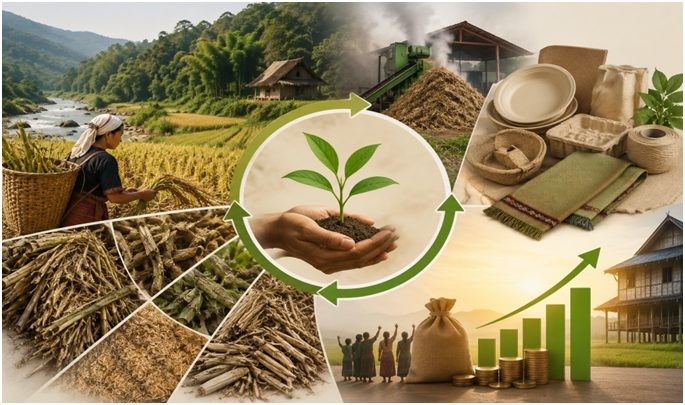
Image Credit AI-generated (OpenAI)
Kuldeep Singh and Ram Singh
[email protected]
Every year, across the lush hills of Meghalaya, the tea gardens of Assam, the bamboo groves of Tripura, and the spice farms of Nagaland, millions of tonnes of agricultural residue are burned, buried, or simply left to rot. Paddy straw, banana pseudo-stems, pineapple crowns, sugarcane bagasse, bamboo dust waste in name, treasure in potential. Northeast India sits atop a largely untapped goldmine of agricultural biomass, and the region's future may well depend on how intelligently it chooses to valorise it. Agro-waste valorisation the process of converting agricultural residues into value-added products such as bioenergy, bio-plastics, and organic fertilisers, animal feed and industrial bio-chemicals is no longer a fringe idea. It is a fast-maturing global industry, projected to exceed $70 billion worldwide by 2030. Yet, despite producing an estimated 20–25 million tonnes of agricultural waste annually across its eight states, Northeast India remains a marginal player in this emerging economy.
That is not a natural condition. It is a policy failure and one that can still be corrected. The region's agricultural profile is strikingly diverse. Assam alone generates enormous quantities of rice straw and tea waste. Manipur and Mizoram produce substantial volumes of maize stalks and bamboo offcuts. Meghalaya's thriving horticulture sector leaves behind mountains of fruit biomass. Each of these residues carries significant biochemical energy and material value. Pineapple leaf fibre, for instance, is already being woven into textiles in parts of Southeast Asia. Bamboo dust is a viable feedstock for activated carbon and bio-char. Rice husk can generate electricity and yield silica for industrial use. The raw materials are here. The ambition has been missing. What makes the valorisation imperative especially urgent for this region is the convergence of three crises: stubble burning that worsens air quality and degrades soil health, persistent rural unemployment among farming communities, and heavy dependence on subsidised energy. Agro-waste valorisation directly addresses all three. Decentralised biogas units can convert farm residues into cooking fuel and electricity for villages still off-grid. Compost and vermin-compost enterprises can replace chemical fertilisers, restoring degraded soils while generating income. Small-scale agro-processing clusters can absorb rural youth into skilled green jobs, reducing distress migration to cities. Governments, both at the Centre and in the states, have begun to take notice. The National Bioenergy Programme, extended under the Ministry of New and Renewable Energy, offers capital subsidies for biomass-based power projects. The MSME schemes under the North East Industrial Development Policy provide financial incentives for setting up agro-based industries. The Agri Infra Fund offers credit for post-harvest infrastructure. The architecture of support is there but uptake has been sluggish, choked by awareness gaps, difficult terrain, weak extension services, and the deeply entrenched habit of treating residue as refuse rather than resource. This is where a coordinated push from agricultural universities, state governments, civil society organisations, and start-ups becomes indispensable. Institutions like Assam Agricultural University, Central Agricultural University- Imphal and the North-Eastern Hill University have the research capacity to develop region-specific valorisation models suited to local crop varieties and geographic conditions. What they need is stronger industry linkage and more aggressive technology transfer. Entrepreneurs need simplified access to pilot funding. Farmer-producer organisations need training modules that make the economics of agro-waste collection and processing tangible and compelling.The Northeast's peripheral geography, long seen as a constraint, is increasingly an asset in a world pivoting toward circular, localised economies. Shorter supply chains, dense biomass coverage, rich biodiversity, and a growing culture of organic farming make this region naturally suited for high-value agro-waste enterprises from herbal extract processing to specialty bio-fertilisers to eco-friendly packaging materials. The fire in the paddy field is not just an environmental problem. It is a symbol of an opportunity going up in smoke. Northeast India does not need to import a green economy; it needs to harvest the one it already has. The waste is waiting. The question is whether the will to act is too.
@The authors are from College of Postgraduate studies in Agricultural Sciences, CAU-Imphal