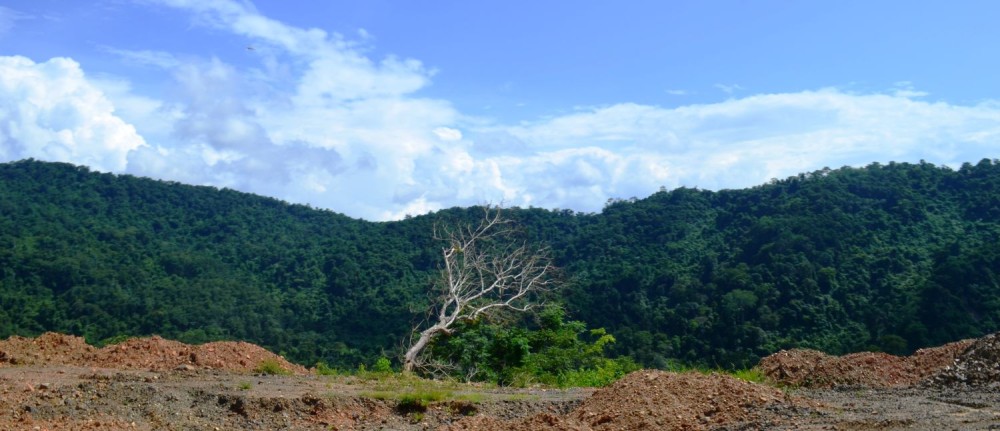
A green hillside might look like a successful restoration, but if it’s a monoculture plantation, it’s only a forest in appearance, not in function. (Morung Photo)
Tekameren I Jamir and Dr Krishnapriya Tamma
Nagaland’s natural forests, those cathedrals of green, are complex ecosystems dominated by trees and lianas forming a dense canopy that limits the amount of light coming through. Streams of light reach the ground, creating a dappled understorey where shade-loving plants thrive. In this complex vertical tapestry live several creatures ranging from those that live in the soil, those that thrive in the bushes to those that thrive in the upper tree canopy. This is a close-knit community; plants and animals are intricately connected to each other: plants need animals for pollination and seed-dispersal while animals rely on plants for food and shelter. Disrupting any one part affects the whole ecosystem, especially in terms of how it functions. After any disturbance (such as logging or jhum clearing), the forest has some capacity to recover its diversity and vertical structure. However, over several cycles of disturbance, it loses its ability to recover, and may just turn into an open meadow dominated by invasive or non-native species. While these may still be useful for some grazing or other activities, the reality is that these lands are degraded, with minimal soil fertility and ability to provide ecosystem services (such as clean water). Active intervention can help in bringing this land back to life.
One way to actively intervene is to engage in ecological restoration of the habitat. Many of us have come across terms like land restoration or ecological restoration. When you hear “land restoration,” you might picture neat rows of saplings planted by school children or well-meaning organisations during a tree-planting drive. You may have even participated in one yourself. Often these tree plantations are done on degraded lands, i.e., lands that have lost their natural vegetation and are currently in a degraded state. An example of a degraded land could be a forest that has been cleared and farmed for several years before being abandoned with tall grass and thorny shrubs taking over instead of native trees. Such a loss of the natural vegetation impacts the soil quality, biodiversity, water retention capacity, among other things. So could planting 2-3 economically important species of trees be considered an appropriate action to reverse this damage? No; and therein lies the difference between reforestation and restoration.
Let us illustrate this with an example: imagine that you inherit a piece of land from your grandparents in your village. The land has a small patch of forest, a winding stream, but is dominated by an open meadow as a consequence of years of farming, overgrazing, and poor drainage. As a consequence, the soil is thin and infertile, the stream is dry, and invasive weeds have taken over the plot. If you decided to grow selected species of trees in this patch, this would be considered reforestation as this was previously forested. This is very different from restoration. Restoring this land means re-creating the ecosystem that was once supported on the land, before it was degraded due to timber extraction and farming. What does this involve?
Ecological restoration is the process of assisting the recovery of an ecosystem that has been degraded, damaged, or destroyed. The goals of restoration can be wide: from restoring the ecosystem to its fully functional native state to restoring partial functionality to derive some ecosystem services from it (such as clean water, access to medicinal plants etc). Restoration is not a simple process: it involves intricate, long-term interventions that address soil fertility, hydrology, and composition of ecological communities. Restoring degraded ecosystems often takes decades, involving consistent care and management of the various components. Restoration needs careful thought and practice, afterall, it is not easy to regrow an entire ecosystem!
Take for instance, decisions on what trees to grow. Not all trees are the same. Native trees are the backbones of a forest ecosystem, supporting each other and also other species. They are often uniquely adapted to the local conditions, and are involved in intricate relationships with several other species, and these networks are important for the functioning and stability of ecosystems. On the other hand, non-native invasive species may cause more disruptions of these natural processes, and may not contribute to the stability of the ecosystem. For example, the non-native Eucalyptus leads to declines in groundwater levels, depletes soil nutrients, and generally does not support biodiversity. Yet, when we talk about restoration, most people assume that any tree will do. Plant it, water it, job done! Alas, that is not the case. It is always important to understand what trees are native to the landscape, in what proportion are they found in the undisturbed forests, and where do they like to grow etc. Armed with this information, one can then work to piece together the complex tapestry of life that is a forest.
Let’s go back to your patch of land. Perhaps you decide to restore this patch for your future generations. To restore this land, you will have to do several things: clear the weeds, improve the soil, restore the stream bed, re-establish native plants including shrubs and trees of various kinds, and encourage native wildlife as well. To do this, you will need to gather information on what the original or native ecosystem was like - what trees and plants grew, in what numbers, and what species of animals used to roam these forests. You can get this information by observing and studying relatively undisturbed forests close to your patch of land. With this information, you can start becoming a gardener of the forest.
Nagaland has seen a surge of restoration projects in the past few years, and rightly so! These initiatives reflect a growing awareness of environmental conservation and a collective effort to revive the region’s rich natural heritage. Ecological restoration is not easy, so it is heartwarming to see these initiatives take off in Nagaland. We were fortunate to observe one such initiative in Old Jalukie, Nagaland. Tucked away in the hills of Peren district, a group of enthusiastic and committed local youth from the Jalukie Student Union are engaging in restoring a degraded part of the forest. From seeking funding, planning the design and construction of a plant nursery, collecting seeds of native trees, to growing them, the team is engaged with various aspects of restoration. As they look to the future, they also learn from the past. They are involving their village elders in incorporating their traditional knowledge of the forests into their restoration work. By making space for community involvement in restoration planning and action, they not only acknowledge the important role of forests in their lives, but the important role for people in caring for these forests. We believe that such an inclusive approach, that blends the rigour of ecological restoration with the cultural and traditional knowledge of forests, is critical for the success of restoration projects.
Such initiatives are a much-needed effort that allows native trees, wildlife and humans to thrive, along with streams and rivers. But for this to happen, we should be mindful about how restoration is done. A green hillside might look like a successful restoration, but if it’s a monoculture plantation, it’s only a forest in appearance, not in function. In contrast, a modest patch of native shrubs may look unimpressive, yet it is the first chapter in a restoration story that is decades in the making.