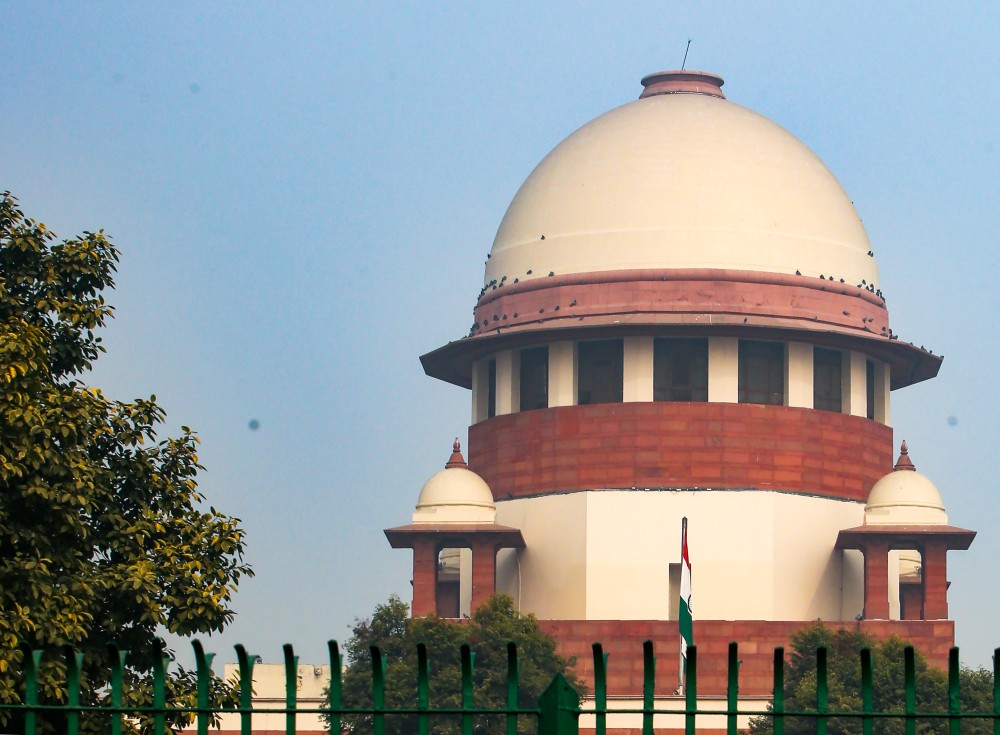
Supreme Court of India. (IANS Photo)
New Delhi, August 11 (IANS): The Supreme Court on Tuesday issued notice on a Public Interest Litigation (PIL) seeking safeguards against the alleged commercial exploitation and monetisation of oral observations made during judicial proceedings through social media campaigns and digital content.
A Bench of Chief Justice of India (CJI) Surya Kant and Justices Joymalya Bagchi and V. Mohana sought responses from the Union of India, the Ministry of Electronics and Information Technology, the Bar Council of India and the Central Bureau of Investigation (CBI), and posted the matter for further hearing on September 10.
The PIL, filed through advocate-on-record Rajesh Singh Chauhan, has raised concerns over the alleged transformation of courtroom exchanges and oral observations of constitutional courts into viral digital content, memes, political symbolism and monetised online campaigns detached from their judicial and procedural context.
The petition specifically refers to the rise of the satirical social media campaign titled "Cockroach Janta Party" (CJP), alleging that the controversy surrounding oral observations made during a Supreme Court hearing was converted into "digitally marketable content, political symbolism, viral commodities, and monetised spectacle".
According to the plea, the campaign rapidly developed into a large-scale digital movement, with courtroom remarks allegedly being selectively clipped, circulated and transformed into memes and viral content.
The PIL contends that the issue is not criticism of the judiciary or democratic dissent protected under Article 19(1)(a) of the Constitution, but the alleged organised commercial exploitation and monetisation of judicial proceedings.
It has sought safeguards against "organised commercial exploitation", trademark-commercialisation, monetised viral circulation, meme-based distortion and algorithmically amplified digital commodification of oral courtroom proceedings and institutional constitutional discourse.
The plea further seeks appropriate directions for an investigation into activities allegedly involving monetisation, branding and digital propagation of controversies arising from oral observations made during court proceedings.
The controversy traces back to oral observations made during a hearing on May 15, when expressions including references to "parasites" and "youngsters like cockroaches" were reportedly used in the context of persons allegedly entering professions on the basis of fake degrees.
The controversy subsequently triggered the CJP campaign on social media, which the petitioner claimed rapidly developed into a large-scale digital movement and a form of online branding and political symbolism.
The petition had alleged that the courtroom interaction was "selectively clipped, meme-ified, mimicked, commercially circulated, and transformed into viral digital content". The PIL had alleged that the campaign and subsequent branding activities reflected organised digital exploitation of a judicial controversy and raised concerns over the manner in which courtroom proceedings were being converted into online entertainment and monetised content.
Following the controversy, CJI Surya Kant had clarified that the remarks were directed specifically at persons obtaining "fake and bogus degrees" and were not aimed at the youth of the country.
The plea contends that constitutional courts derive legitimacy from "public confidence, institutional neutrality, constitutional trust, and procedural seriousness" rather than algorithmic popularity or approval.
It has further raised concerns over the growing influence of "outrage algorithms, trolling cultures, meme warfare, emotional mobilisation, and monetised virality" on public discourse surrounding judicial proceedings.
According to the petitioner, the increasing transformation of solemn courtroom interactions into viral spectacles could undermine the institutional dignity of constitutional courts and public confidence in the judicial process.
The PIL has urged the Supreme Court to formulate safeguards governing the commercial use and monetisation of judicial proceedings and to ensure that oral observations are not selectively distorted or commercially exploited in a manner detached from the context in which they were made.