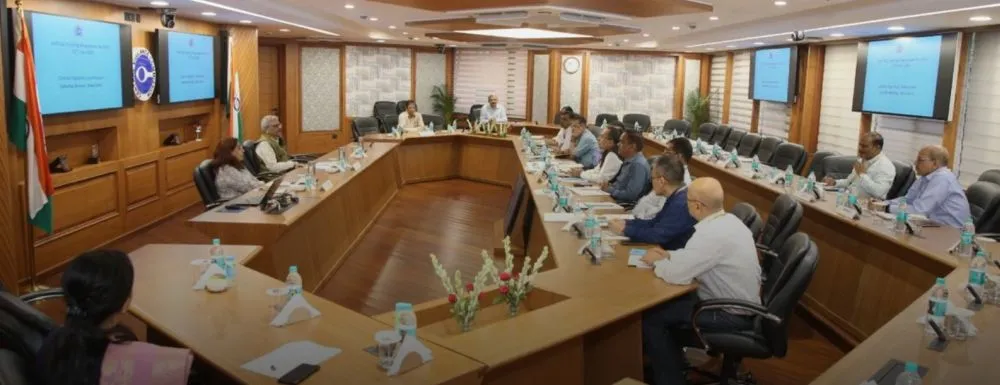
The CVC’s failure: Who will police the powerful bureaucrats? (File photo)
New Delhi, November 21 (IANS): India’s fight against corruption suffers from a fundamental contradiction. The country has an apex vigilance institution, an investigative agency, statutory provisions for disciplinary action, and laws to punish public servants who abuse their positions. Yet corruption cases involving senior bureaucrats, particularly officers of the Indian Administrative Service (IAS), often take years to conclude.
Investigations remain pending, prosecution sanctions are delayed, departmental proceedings drag on, and convictions may come decades after the alleged offence.
The Central Vigilance Commission (CVC), established to strengthen integrity in public administration, has not consistently converted its considerable supervisory role into timely and visible action, results, and accountability. The issue is not the complete absence of institutional action, but the failure to ensure that complaints, investigations, recommendations and prosecutions lead to credible outcomes.
The CVC was established in 1964 and received statutory status under the Central Vigilance Commission Act, 2003. It exercises superintendence over vigilance administration in central government organisations and has a supervisory role over the Central Bureau of Investigation (CBI) in corruption cases under the Prevention of Corruption Act, 1988 (PC Act). It advises on vigilance and disciplinary matters, monitors investigations and delays in prosecution sanctions, and performs functions relating to whistle-blower complaints and references from the Lokpal. Its jurisdiction includes All India Services officers serving in connection with the affairs of the Union, Group A central government officers and specified public-sector officials.
However, the Commission is not a universal anti-corruption authority: it generally advises and monitors rather than directly investigating every allegation or imposing disciplinary penalties. Final decisions often rest with competent government authorities. This division between oversight and enforcement is a central weakness of the existing framework.
The latest available figures from the CVC’s Annual Report 2025, made public in 2026, illustrate the scale of its workload and the need to distinguish disposal from accountability. The Commission received 34,153 complaints during 2025 and disposed of 35,193, including complaints pending from the previous year. Its reported year-end pendency fell to 220. Yet only 248 complaints were referred for inquiry or investigation by Chief Vigilance Officers (CVOs) or the CBI. The remaining complaints included matters outside the Commission’s jurisdiction, grievances forwarded to other organisations, vague or unverifiable allegations, and anonymous or pseudonymous complaints. Thus, the figures do not establish that the remaining complaints were ignored; many were appropriately screened or redirected. But they demonstrate why a high disposal rate cannot, by itself, be treated as proof of successful anti-corruption enforcement. The real test is what happens to credible allegations after they are identified.
The workload extends well beyond the Commission’s own complaint register. According to the CVC’s 2025 report, CVOs across government organisations received 70,584 complaints during the year. They disposed of 64,905, leaving 5,679 under process on 31 December 2025, including 2,002 pending for more than three months. CVOs are expected to complete investigations within three months, although complex cases may require further examination under the applicable procedures ( extension by CVC).
These figures reveal the enormous burden on departmental vigilance systems and the need for stronger monitoring. They also expose a structural problem: CVOs operate within the very departments whose officials and decisions they may have to scrutinise. Where a complaint concerns influential officers or senior departmental leadership, institutional proximity can create real or perceived conflicts of interest.
The problem becomes particularly sensitive in cases involving senior IAS officers. These officers may exercise significant authority over land administration, licensing, public procurement, infrastructure projects, public expenditure and the implementation of government schemes. Allegations concerning such decisions can involve complex relationships between officials, contractors and private interests. Yet the administrative system must investigate evidence, not reputations or political affiliations. The concern is not that IAS officers as a class are corrupt, but that seniority should never confer protection from scrutiny. According to the Department of Personnel and Training’s Annual Report 2024–25, 1,272 complaints against IAS officers were received between 1 April 2024 and 6 March 2025, of which 1,213 were reported as processed and finally disposed of during that period.
The report also recorded prosecution sanctions in 22 cases involving 22 IAS officers under the Prevention of Corruption Act between 1 April 2023 and 13 March 2025. These figures establish the scale of complaints and prosecution action, but do not reveal how many complaints were substantiated, how many officers were ultimately convicted, or how long each case took to conclude. That absence of a transparent, end-to-end account of outcomes makes it difficult to assess the system’s effectiveness.
The clearest evidence of the problem lies in the wider criminal justice process. The CVC’s 2025 annual report showed that 7,229 corruption cases investigated by the CBI were pending trial in courts at the end of 2025. Of these, 409 had remained pending for more than 20 years. Another 14,083 appeals, revisions and related proceedings were pending before higher courts, while 473 corruption cases remained under CBI investigation. During 2025, the CBI registered 615 corruption-related cases involving 855 public servants, including 237 gazetted officers. These figures do not mean that every case concerns an IAS officer, nor do they establish that the CVC alone is responsible for judicial delays. They nevertheless reveal a system in which the journey from allegation to final legal outcome can be extraordinarily prolonged. When punishment, acquittal or closure takes decades, the deterrent effect of the law is weakened, and public confidence suffers.
The first major weakness of the CVC is therefore the gap between advice and enforcement. The Commission can recommend disciplinary action, but the competent authority generally decides what action follows. Where a recommendation is not implemented promptly, the Commission’s practical influence becomes limited. This arrangement is especially problematic when the authority responsible for action belongs to the same administrative establishment as the officer under scrutiny. The CVC should require written reasons for departures from its advice, monitor implementation until the case reaches a conclusion, and escalate unexplained delays to the appropriate higher authority. Parliament should consider whether selected directions need stronger statutory force, while preserving natural justice, administrative autonomy and judicial review.
The second weakness is delay at every stage. Investigations may be prolonged by inadequate staffing, incomplete records, forensic backlogs, repeated requests for documents and delayed prosecution sanctions. Departmental inquiries can suffer from similar problems. The solution is a time-bound digital case-management system that records responsibility, progress and reasons for delay from preliminary scrutiny to final disposal. Extensions should require written justification, and long-pending cases should receive periodic senior-level review. The Commission should publish aggregate data on the time taken at each stage, rather than relying primarily on the number of complaints disposed of. Cases involving senior officials should receive the same procedural discipline as other cases, without presuming guilt or compromising the fairness of the investigation.
The third weakness is dependence on other institutions. The CVC relies substantially on the CBI, departmental CVOs and disciplinary authorities to conduct inquiries and implement decisions. The CBI has its own investigative responsibilities, while the Lokpal operates under a separate statutory framework. Overlapping responsibilities and weak coordination can result in duplication, referrals and uncertainty about who must act next. The CVC should establish clear coordination protocols, designated case officers and periodic joint reviews for complex matters. It also needs greater access to expertise in forensic accounting, digital evidence, public procurement, benami assets and sophisticated financial transactions. Modern corruption cannot be effectively investigated through paperwork and routine departmental scrutiny alone.
The fourth weakness concerns independence and whistle-blower protection. Appointments to the Commission should be timely, transparent and based on clearly stated criteria. Adequate staffing and specialised professional expertise are equally important. The presence of retired civil servants can provide valuable administrative experience, but institutional credibility also requires diversity of expertise and safeguards against conflicts of interest. Equally, officials who report credible wrongdoing must be protected against retaliation. Secure complaint channels, confidentiality safeguards and prompt action on allegations of victimisation would encourage genuine disclosures. At the same time, complaints should be screened carefully so that anonymous, unverifiable or malicious allegations do not become instruments for harassing honest officers.
The fifth reform should be a stronger emphasis on prevention. The CVC should identify departments and processes where complaints repeatedly arise and recommend changes in procurement, licensing, inspections, transfers and financial approvals. Risk-based audits, transparent tender evaluation, conflict-of-interest disclosures and data analytics can help detect suspicious patterns before public money is lost. The Commission should also distinguish corruption from administrative inefficiency or poor judgement. Not every bad decision is corrupt, but systematic disregard for controls can create opportunities for abuse. Effective coordination with departmental disciplinary mechanisms can ensure that serious misconduct is addressed even when the evidence does not establish a criminal offence. It is not a deniable fact that CVC is a relaxing ground for retired IAS.
Finally, the CVC must be judged by outcomes, not merely activity. Its annual reporting should connect complaints with investigations, disciplinary proceedings, prosecution sanctions, convictions, acquittals and case duration, using clear definitions and appropriate safeguards for ongoing proceedings. The government should also publish consolidated information on complaints against senior IAS officers, including their stage of processing and eventual outcomes. Such reporting would enable Parliament and citizens to assess whether the system treats senior and junior officials impartially. Conviction rates must be interpreted alongside the quality of investigations, the cases reaching judgment and the large number still pending.
India does not need another layer of vigilance paperwork. It needs an anti-corruption system that converts credible allegations into timely investigation, fair proceedings and meaningful consequences. The latest CVC figures show substantial complaint-processing activity, but the thousands of corruption trials pending in courts—including hundreds pending for more than two decades—demonstrate the scale of the wider accountability challenge. The CVC cannot independently resolve every investigation, departmental proceeding or court case. It can, however, demand transparency, monitor compliance, coordinate institutions and expose persistent delays. Its ultimate test is whether a powerful IAS officer and an ordinary public servant face the same standards of impartial scrutiny and accountability. Until that equality is visible in practice, India’s anti-corruption architecture will remain stronger on paper than in its results.
(The author is an RSS functionary and a columnist. Views are personal.)