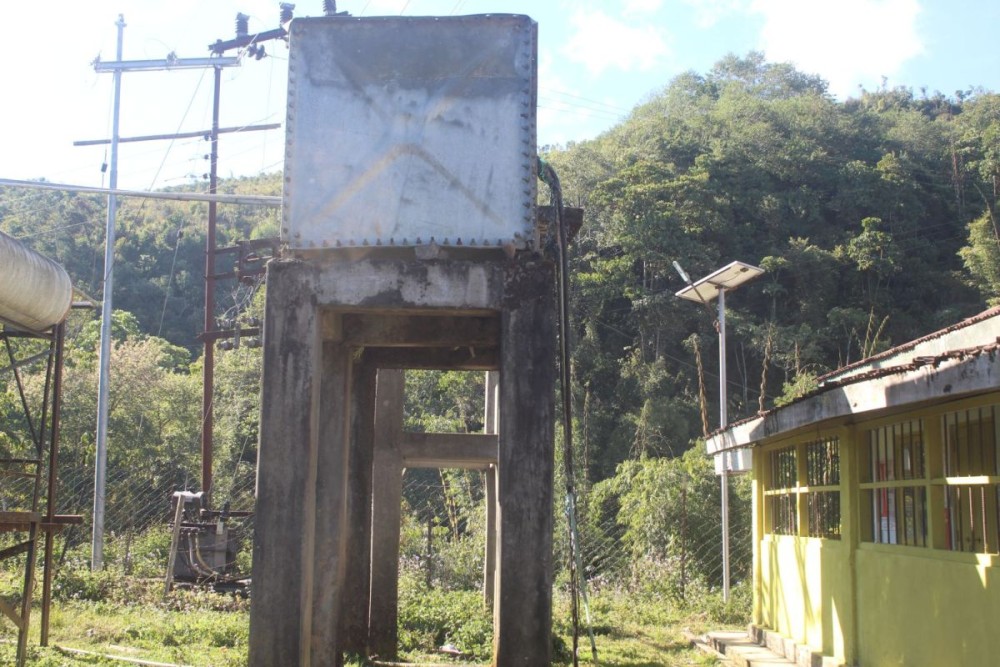
A water tank at Hezukhu Memorial District Hospital, Zunheboto. (Morung Photo)
Tokavi K Zhimo
Zunheboto | December 17
Water scarcity has become a persistent problem in Zunheboto town, severely affecting residents, businesses, and institutions. Many households lack a Public Health Engineering Department (PHED) water supply. Instead, they depend on water from streams, supplied by private individuals or on borewell water sold by local vendors.
Residents with PHED tap connections report receiving water only once a month, a supply that is grossly insufficient despite the monthly charge of Rs 100. As a result, they are forced to purchase water from private suppliers.
An independent survey conducted by The Morung Express in Zunheboto town during November–December revealed that water scarcity has significantly impacted local businesses, hotels, restaurants, government offices and even the district jail.
Risky water
A senior medical officer at Hezukhu Memorial District Hospital, Zunheboto has called for a reliable pipeline connection, stating the facility’s heavy dependence on a nearby natural stream for water poses contamination risks, particularly during summer months.
The hospital currently draws its supply from the stream and stores up to 100,000 liters in a water tank. While the water is reportedly cleaner in the dry season, it becomes “highly contaminated” in the summer, according to the officer.
He cautioned the public that consuming untreated water can lead to serious waterborne diseases like cholera, typhoid and diarrhea, with children especially vulnerable.
‘Water is the most essential necessity in a hospital, as almost every service depends on it,’ the officer said. He listed critical needs including sanitation, laundry, operation theatres, instrument sterilization and toilet facilities.
To bolster its supply, the hospital recently installed a borewell using funds from the Kayakalp Award, a national initiative to improve public health facilities. However, the officer emphasised that a permanent PHED pipeline is urgently needed for a consistent and safe supply.
He noted that PHED water in the area is often available only during the rainy season, highlighting systemic infrastructure gaps.
Addressing preventive measures for households, the officer advised boiling water for 5 to 10 minutes or using proper filtration, which can remove up to 99.9% of bacteria and viruses. He also stressed the importance of storing treated water safely to prevent recontamination.
Meager trickle
The District Jail in Zunheboto receives water through a PHED pipeline only once per month, providing roughly 5,000 liters, an amount, the jail official says falls far short of meeting the needs of inmates and staff.
To cover the daily shortage, the jail purchases water approximately three times a week from private borewell owners. The facility maintains a storage capacity of about 30,000 liters to help manage gaps in supply.
According to the jail Office Assistant, Atoka G Chophy, water bills are prepared every six months and submitted to the department. During the monsoon, the jail also uses rainwater harvesting to reduce reliance on bought water.
Chophy added that a proposal to install a borewell at the jail has been submitted and is expected to be implemented in the coming years.
Currently, water supply is connected to all essential areas, including kitchens and washrooms for both staff and inmates. However, frequent power outages have prompted another proposal for installing a separate transformer for the jail.
Hidden burden
A café in the town is spending heavily on privately hauled water, highlighting water scarcity as a chronic but overlooked problem for local businesses.
Inakali Chophy, owner of Main Street Café, said her restaurant orders four trips of a Bolero pickup truck for water every month, with each trip carrying more than 1000 liters. The café has a total storage capacity of only 1,000 liters but consumes roughly 4,000 liters monthly, depending on customer turnout.
Despite having a rainwater harvesting system at the building, the collected water is reserved only for washing dishes and sanitation. For cooking and drinking, the café procures stream water, while borewell water is used for cleaning.
“Water is the backbone of our business,” Chophy said. “We have been buying water for the last five years, and scarcity has become so common that we hardly notice it anymore.”
She said the café never opted for a pipeline connection from the PHED since the building is not owned by them and water is reportedly supplied only once a month.
Chophy appealed to the government and concerned departments to ensure adequate water supply in the town, especially during the dry season, and not limit distribution to once a month.
Nikupu, proprietor of NK Hotel, located near the Deputy Commissioner’s office, has been running the business for over 35 years. He explained that the hotel relies completely on purchased water. “We buy water through Tata mobile trucks, making about 10 to 15 trips a month. Our storage capacity is around 2,500 litres.”
The hotel pays Rs 200 for every 500 litres. Water consumption varies with the number of customers, and monthly revenue ranges between Rs 40,000 and Rs 50,000. “We cannot rely on PHED water,” he added. “Waiting for their supply would directly affect our business.”
He also noted that water prices drop during the rainy season but rise sharply in the dry months.
Tovi, a small-scale industry owner, faces constant water shortages despite having a 4,000-litre storage tank. “We still need to buy water every week during the dry season,” he said.
“Although we have a PHED pipeline connection, it is practically useless. We hardly receive water once every two or three months, mostly during the rainy season, and there is no fixed schedule. Often, the water arrives after we have already purchased it elsewhere.” Even with rainwater harvesting, shortages force constant planning and additional expenses. “It would be very helpful if PHED supplied water two or more times a month,” he added.
Hokaito V Achumi, owner of Good Day Chow Noodles, relies on his neighbour's borewell for water over ten times a month. Though they have a PHED connection, it supplies water only once a month, he explained. He maintains a 10,000-litre storage tank to manage both his factory operations and household needs.
Dried streams, empty taps
Residents of Zunheboto also reported of severe water scarcity, attributing it to climate change, deforestation and infrastructure gaps.
Hiloto S, a resident of DC Hill Colony originally from Sukahlu village, recounted relying on stream water transported by Bolero pickup until installing a borewell in 2015. Hiloto mentioned that implemented the borewell for personal uses and for commercializing it as he saw many households facing scarcity of water in the town. He noted that they have a water storage capacity of 7,000 to 8,000 liters of water. He attributed the water shortage during the dry season to climate change caused by deforestation.
Ghokivi Z Yeptho from Natha New village highlighted the community's dependence on a single water pump after their natural stream dried up. “Now since that stream water is slowly drying up, we don’t give much importance to it.” Yeptho added that the village has three colonies with water distributed only once in a week per colony.
A family member pointed to pollution exacerbating the crisis, saying a previously relied-upon pond is now unusable as colony members dump garbage into the stream, contaminating the water.
A colony leader from Zunheboto town noted that water scarcity complaints are the most frequent. “Almost every household is affected. PHED supply is irregular and unpredictable. Tanker water fills the gap, but not everyone can afford it,” he said, adding that tensions occasionally flare over shared limited supplies.
Another colony leader reported receiving water only once a month at his residence, forcing him to frequently purchase water from vendors using Bolero trucks. He urged authorities to ensure regular water supply to all households, emphasising that water is a fundamental daily necessity.