Meyu Changkiri
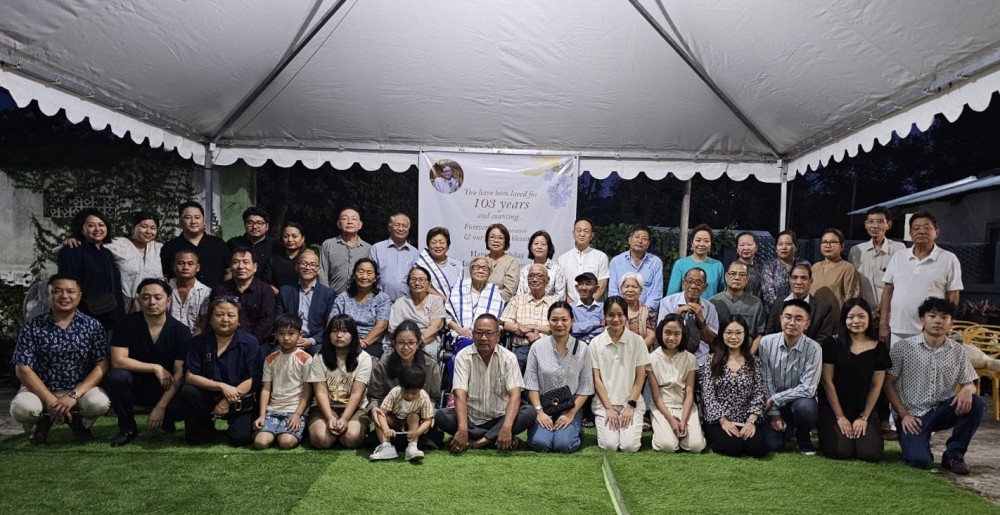
At 103, Mrs. Metongla still smiles warmly, laughs easily, and carries within her the story of an entire generation. When our family travelled from Shillong to Dimapur to pray with her on her birthday, we knew we were not merely visiting an elderly relative. We were sitting beside a living bridge to the past.
Her birthday was celebrated at the home of her second daughter, Narola, and her husband, Dr. Limawati Jamir. We felt it important to go. We did not want to postpone the visit and later live with regret.
As we sat around her and prayed, memories returned. Here was a woman who had lived through more than a century of change. She had seen the birth of modern Nagaland, watched generations come and go, experienced hardship and blessing, and remained steady in faith, humble in spirit, and deeply devoted to family and church.
As a pastor and a relative, I have been blessed to know many people whose lives have influenced others. Yet some of the most important people are not those who speak the loudest or receive the greatest attention. They are the quiet people whose lives strengthen families, steady churches, and leave values that continue long after they are gone.
Mrs. Metongla is one of those people.
Born at Impur, then the Mission Centre, to parents from Changki village, Mrs. Metongla belonged to a generation shaped by both strong family values and a deep Christian heritage. In many ways, her life would reflect both places throughout the years.
More Than a Birthday
Her 103rd birthday was more than a celebration of long life. It was a thanksgiving for the way she has lived.
There are people who live many years but leave little behind. Then there are those whose lives continue to speak because they have lived with kindness, courage, faithfulness, and love. Mrs. Metongla belongs to the second group.
As we prayed with her, I remembered another birthday many years earlier. In 2013, when she turned 90, I was asked to lead the prayer during the celebration at her home in Shillong. On that occasion I read from Psalm 92:14:
“They will still bear fruit in old age, they will stay fresh and green.”
We prayed then that God would bless her and perhaps even allow her to celebrate her 100th birthday. At that time, reaching one hundred seemed a distant hope.
Yet God was gracious. When she turned 100, the family gathered again in Dimapur at the home of her eldest daughter, Nokdila Khating, and her husband, Dr. Darland Khating, Vice Chancellor of North East Christian University. Friends, relatives, church members, and many who had known her through the years came together to honour her.
Now, three years later, at 103, the same truth remains. Some of the greatest people are not those who stand at the centre of attention, but those who quietly hold together the lives of others.
The Strength of Family
One of the most remarkable things about Mrs. Metongla is the way she has helped preserve the unity of her family.
As I was growing up, I often heard my parents speak about the closeness of our extended family. The older generation took family seriously. They stood by one another in difficult times, celebrated together in happy times, and made a deliberate effort to remain close.
Mrs. Metongla came from that kind of family, and she became one of the people who kept it strong.
Today many families are struggling. Distance, misunderstandings, busyness, pride, and poor communication have weakened relationships. Family members live under the same roof yet hardly speak. Brothers and sisters drift apart. Parents and children become strangers.
In such a time, the life of Mrs. Metongla speaks with unusual power.
She reminds us that family unity does not happen automatically. It requires patience, forgiveness, sacrifice, prayer, and genuine concern for one another.
For Christians, this is more than a social value. It is a spiritual responsibility. Scripture repeatedly calls us to honour one another, bear with one another, and love one another deeply.
Mrs. Metongla practised those values long before people began discussing them in seminars and books.
A Pioneer Before Her Time
Her story is remarkable not only because she was a devoted family member, but also because she was a pioneer.
After completing her studies, she served for five years as a teacher at Impur Mission School. Later, from 1949 to 1953, she became the first Women Evangelist of the Ao Baptist Convention.
That may sound ordinary today. It was not ordinary then.
At a time when very few women were given public responsibility in Christian ministry, Mrs. Metongla stepped forward in obedience to God’s call. She travelled on foot from village to village in the Ao and Sumi areas, teaching, preaching, encouraging women, praying with families, and sharing the Gospel.
Those journeys were not easy. She often had to walk through thick forests in darkness, where wild animals were a real danger and not every place was welcoming. There were no proper roads, no telephones, and no means of communication if something went wrong. The journeys were long, uncertain, and sometimes lonely. Yet she did not complain or draw back from her calling.
There was no public recognition and no comfort or convenience. There was only faith, conviction, and the willingness to serve the Lord with gladness.
In many ways, she opened the door for other women to serve more confidently in Christian ministry. Long before people spoke about women’s leadership, she was already living it.
What is most striking is that she never seemed interested in recognition. She simply served. Perhaps that is why her influence has lasted.
Her life still speaks to the present generation. In an age when people often expect comfort and quick results, she reminds us that anything done for the Lord is worthwhile. No act of service is wasted.
God sees every sacrifice, every difficult journey, and every quiet act of faithfulness done for Him and for His people.
Service in Shillong
After the family moved to Shillong, Mrs. Metongla and her family became deeply involved in the life of Ao Baptist Church Shillong.
As pastor of Ao Baptist Church Shillong for many years, I have seen that some families leave a deep mark on a church not through position or publicity, but through quiet faithfulness.
Mrs. Metongla’s family is one of those families.
From 1981 to 1983, she served as Women’s Pastor (Tesayula) of the church. She visited homes, prayed with women and families, encouraged those who were struggling, and continued the same ministry that had shaped her earlier years.
The family also became known for their generous hospitality. During the 1980s, they hosted one of the Christmas feasts of Ao Baptist Church Shillong. Years later, after I became pastor, Mrs. Metongla and her children again hosted the Christmas feast in a memorable way.
Those gatherings were about much more than food. They reflected something that is becoming rare today: the joy of opening one’s home, welcoming others, and strengthening fellowship.
Hospitality is one of the forgotten Christian virtues, yet people like Mrs. Metongla remind us that the church becomes stronger when homes are open and hearts are generous.
A Historic Marriage
In 1954, Mrs. Metongla married Sashimeren Aier at Impur Baptist Church.
Sashimeren Aier would later become widely known for his contribution to Nagaland and would be honoured as the “Architect of Modern Nagaland.” Yet behind that public figure stood a woman whose faith, wisdom, and strength supported the journey.
Their marriage became a partnership marked by service and shared purpose.
Their wedding itself entered local memory. The reception at Mopungchuket drew people from many villages and towns. It was remembered for one unusual reason: for the first time in the village, a wedding cake was cut during a marriage celebration.
That detail may seem small today, but it became one of those stories that people remembered for years.
A Bridge Between Generations
A person who lives beyond one hundred becomes, in many ways, a bridge between generations.
Mrs. Metongla carries memories that younger people know only through stories. She belongs to a generation that understood hardship, discipline, gratitude, respect, and faith.
She has lived through war, political change, social transformation, and the dramatic changes that have come to our homes and churches.
Yet through all these years she has remained gracious, dignified, and cheerful.
Even now, at 103, her sense of humour remains strong. She still knows how to make people smile.
In a world that is often hurried and divided, such joy is itself a gift.
Many elderly people today feel forgotten. Society values speed, productivity, and youth more than wisdom and experience. But when we ignore our elders, we lose something important. We lose the stories, lessons, and values that shaped us.
That is why people like Mrs. Metongla matter. They remind us where we came from and what truly matters. Above all, they remind us that a life becomes great not because of fame or wealth, but because of love, faithfulness, sacrifice, and the good we leave behind.
The Legacy She Leaves Behind
For me, writing about Mrs. Metongla is not simply writing about an elderly relative. It is writing about a woman whose quiet life has shaped generations.
Her example has taught our family the importance of unity. Her faith has strengthened others. Her service has blessed the church.
In my ministry, I often meet families that are hurting because relationships have broken down. I meet people who are lonely, divided, disappointed, or disconnected.
That is why the life of Mrs. Metongla speaks so powerfully.
She reminds us that strong families are not perfect families. They are families that keep choosing one another. They forgive. They remain connected. They pray together. They do not allow small misunderstandings to destroy long relationships.
That is the kind of family she helped build.
As we prayed with her on her 103rd birthday, I felt deeply grateful for her long life, for her faith, and for her example.
Mrs. Metongla has now lived for 103 years. But the most beautiful part of her story is not merely the length of her life. It is the way she has lived it.