Chümoukedima, Dimapur & Kohima accounts for over 82% of State’s total bank deposits
Morung Express News
Dimapur | November 29
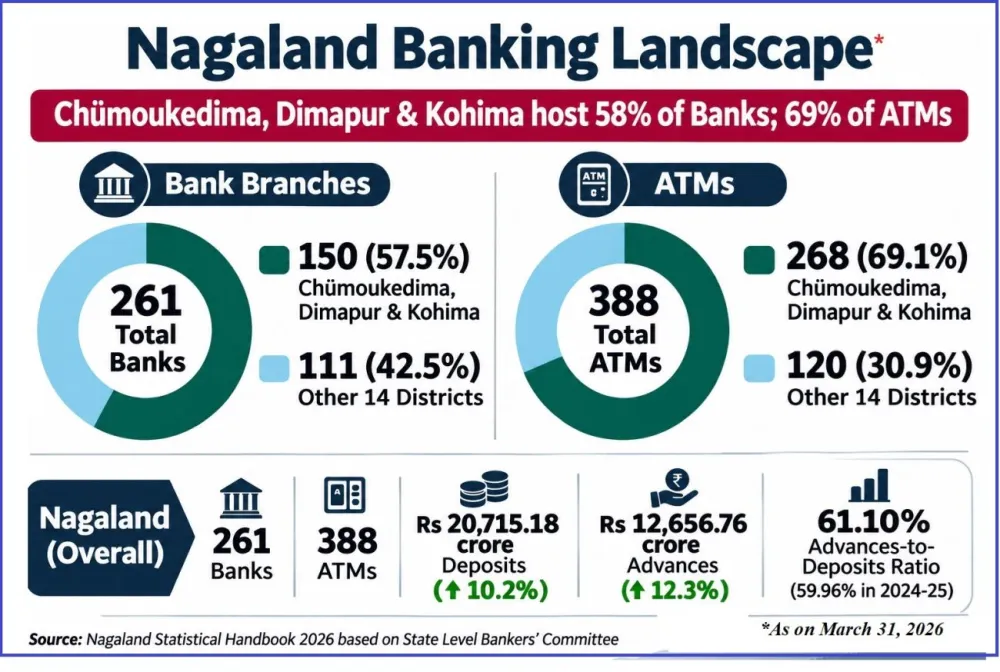
Banking infrastructure in Nagaland remains heavily concentrated in three districts, with Kohima, Dimapur and Chümoukedima accounting for nearly 58% of the State's bank branches and more than 69% of its automated teller machines (ATMs), highlighting an uneven geographical distribution of formal banking facilities.
According to the Nagaland Statistical Handbook 2026, published recently by the State Directorate of Economics and Statistics (DES), the three districts together accounted for 150 of Nagaland's 261 bank branches (57.5%), while the remaining 14 districts shared 111 branches.
As of March 31, 2026, Dimapur had the highest number of bank branches at 67, followed by Kohima with 58 and Chümoukedima with 25.
Beyond these three centres, Mokokchung had 27 banks, Mon 16, Wokha 15 and Zunheboto 13. Phek had nine, Tuensang seven, Peren six, while Kiphire and Longleng had four each. Tseminyu had three, Niuland, Noklak and Shamator two each, while Meluri had the lowest number, with just one bank.
ATM network even more concentrated
The concentration was more pronounced in ATM infrastructure. Dimapur had the highest number at 149, followed by Kohima with 97 and Chümoukedima with 22.
Together, the three districts accounted for 268 of Nagaland's 388 ATMs (69.1%), leaving the remaining 14 districts to share 120 ATMs.
Mokokchung, despite having 27 bank branches, had 36 ATMs, while Mon had 16 banks and 15 ATMs. In comparison, Meluri had just one bank and one ATM. Noklak and Shamator had two banks each but only one ATM apiece, while Niuland had two banks and two ATMs.
Longleng had four banks and five ATMs, Kiphire four banks and six ATMs, while Peren, with six banks, had seven ATMs.
All 17 districts had at least one bank and one ATM in 2025-26, according to the report, which cites data from the State Level Bankers' Committee.
Deposits concentrated in the same three districts
The geographical concentration of banking infrastructure was also reflected in the distribution of deposits.
As of March 31, 2026, Kohima, Dimapur and Chümoukedima together accounted for Rs 17,000.91 crore, or approximately 82.1% of Nagaland's total bank deposits of Rs 20,715.18 crore.
Kohima recorded the highest deposits at Rs 8,539.73 crore, followed by Dimapur at Rs 7,218.96 crore and Chümoukedima at Rs 1,242.22 crore.
The remaining 14 districts collectively accounted for approximately Rs 3,714.27 crore (17.9%). Among them, Mokokchung recorded Rs 1,082.30 crore, followed by Wokha at Rs 472 crore and Mon at Rs 462.66 crore. At the lower end, Niuland had deposits of Rs 21.69 crore, Shamator Rs 22.55 crore, Noklak Rs 61.94 crore and Meluri Rs 74.67 crore.
Nagaland's total bank deposits increased from Rs 18,792.80 crore as of March 31, 2025 to Rs 20,715.18 crore a year later, registering a growth of approximately 10.2%.
Deposits and advances variations
Bank advances increased from Rs 11,269.09 crore in March 2025 to Rs 12,656.76 crore in March 2026, a rise of approximately 12.3%, higher than the 10.2% growth in deposits. Kohima, Dimapur and Chümoukedima together accounted for Rs 8,478.45 crore, or approximately 67% of total advances.
The district-wise figures show considerable variation in the relationship between deposits and advances. The State-level ratio increased from 59.96% to 61.10% during the year. Among the three major banking centres, Kohima recorded 29.47%, compared with 64.59% in Dimapur and 104.59% in Chümoukedima.
Niuland recorded the highest ratio at 206.34%, followed by Longleng (168.45%), Tuensang (166.68%) and Shamator (150.08%). Phek (130.15%), Peren (128.51%), Zunheboto (137.27%), Tseminyu (115.69%), Mon (110.26%) and Kiphire (107.89%) also recorded ratios exceeding 100%. At the other end, Meluri stood at 69.37%, Noklak at 67.57%, Mokokchung at 89.16% and Wokha at 97.29%.
Although the Department's table identifies the indicator as 'Cash Deposit Ratio', the reported percentages correspond to the calculation of advances against deposits and therefore appear to represent the Credit-Deposit (CD) Ratio. On this basis, a ratio exceeding 100% indicates that advances in a district are higher than its recorded deposits.
Notably, Niuland, despite having just two banks and two ATMs, recorded the State's highest ratio at 206.34%, while Kohima, which has the largest banking network and deposit base, recorded the lowest at 29.47%.