

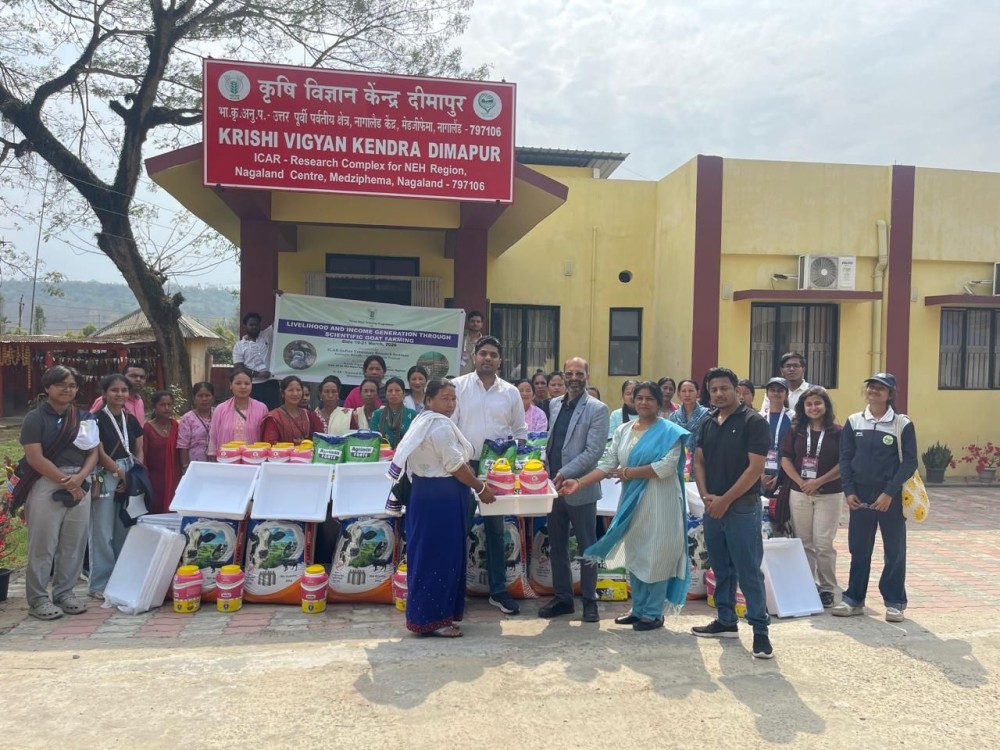
Officials along with the participants during the three-day training programme held on March 21 in Chümoukedima.
Chümoukedima, March 22 (MExN): A three-day training programme on “Livelihood and Income Generation through Scientific Goat Farming” was conducted from March 19 to 21 under the NEH Programme in Chümoukedima.
The programme was jointly organised by ICAR–Indian Veterinary Research Institute (IVRI), Izatnagar, Bareilly, in collaboration with Krishi Vigyan Kendra (KVK) Dimapur, ICAR Research Complex for NEH Region, Nagaland, and ICAR–National Research Centre on Mithun, Nagaland.
A total of 25 women farmers from Dhansiripar and Hazadisa villages under Chümoukedima district actively participated in the programme. The initiative aimed to strengthen scientific knowledge and practical skills in goat farming to enhance livelihood opportunities and income generation among rural women farmers.
The training covered various aspects of scientific goat farming, including its importance and entrepreneurial potential, goat breeds and genetic improvement, scientific housing and management practices, year-round fodder production, routine farm management, record keeping, value addition of goat products, disease prevention and biosecurity, and feeding and nutritional management.
On the final day, participants received practical training on vermicompost production from goat farm waste, methods to improve reproductive efficiency in goats, and integrated farming systems for sustainable livelihoods.
The training sessions were conducted by Course Director Dr Hari Om Pandey of ICAR-IVRI, Izatnagar, along with Course Coordinators Dr Sapunii S Hanah, Scientist at ICAR–National Research Centre on Mithun, and Dr Phool Kumari, Senior Scientist and Head, KVK Dimapur.
To promote the adoption of scientific practices, essential inputs such as goat feed, mineral mixture, feeding trays, and related materials were distributed to all participants to support improved productivity and farm management.
The programme concluded with a feedback session, followed by the distribution of certificates and inputs, including feed, mineral mixture, and vitamin supplements.
Participants appreciated the hands-on training and expressed confidence that the knowledge and skills gained would help improve their goat farming practices, productivity, and household income.

