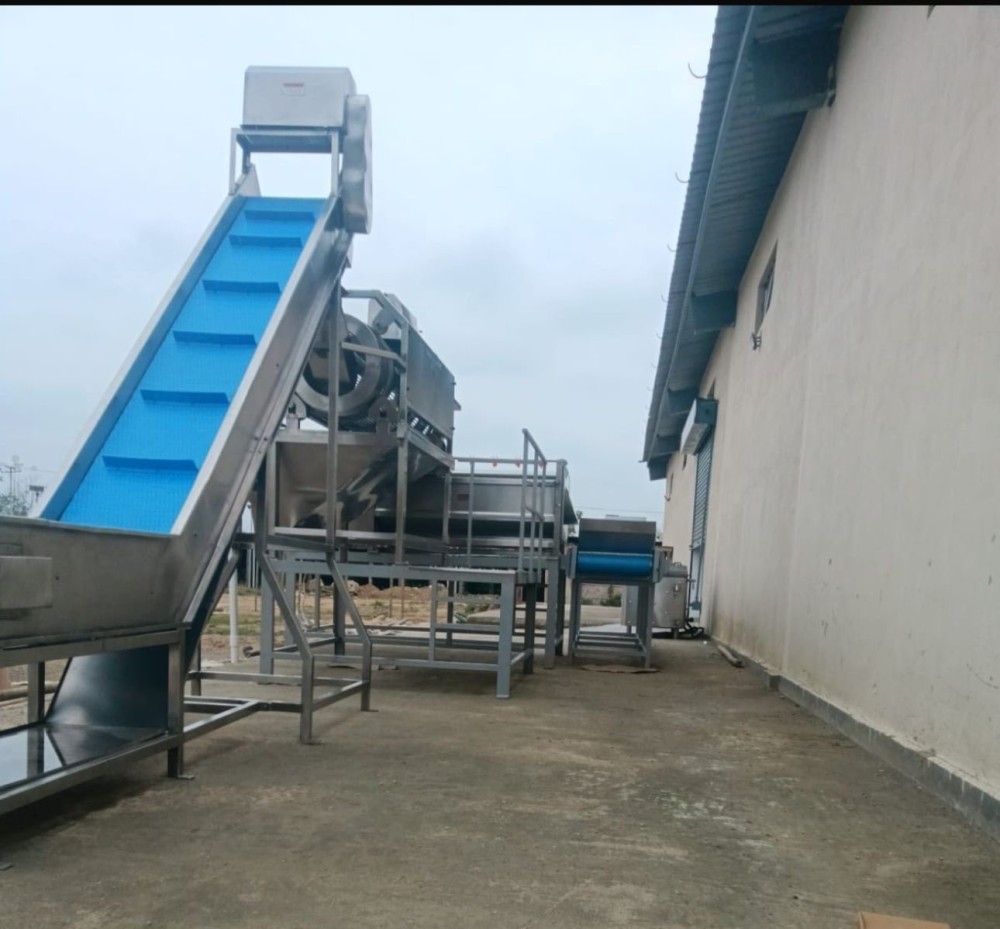
Food processing equipment at the state industrial area in Toluvi , which is one of the projects inaugurated by the Nagaland CM on June 8.
Nagaland gets 4 incubation facilities for entrepreneurs and food processing
Morung Express News
Dimapur | June 8
Chief Minister Neiphiu Rio inaugurated four incubation facilities for entrepreneurs and food processing across Nagaland on June 8. The creation of the facilities is aimed at building a self-sustaining economy and transitioning the state from a consumer to a producer.
Funded under New Delhi's Special Assistance to States for Capital Investment (SASCI) scheme, the projects included the Incubation Centre for Food Processing located within the State Industrial Area, in Toluvi, Dimapur; Incubation Centre for Entrepreneurs and Infrastructure Development at the Industrial Growth Centre, Ganesh Nagar, Chumoukedima; Incubation Centre for Food Processing, Tuensang; and Modern Aggregation Centre, in Longnak, Mokokchung.
The inauguration event was held at the Toluvi State Industrial Area from where the CM remotely inaugurated the other three newly established centres.
Present at the event were Hekani Jakhalu, MLA and Advisor for Industries and Commerce, the nodal department for the projects; MLA and Advisor for SCERT & Food Processing Achumbemo Kikon; other legislators; and Secretary, Industries & Commerce, Kumar Ramnikant.
MLA and Advisor Jakhalu described the establishment of the pilot centres as the beginning of a new, sustainable livelihood and a sustainable economy. She said that the food processing plants were designed to operate on a ‘Farm-Factory-Market’ model to minimise crop wastage. The Ganeshnagar plant was said to have a capacity to acquire and process 300 metric tons of raw mustard worth Rs 2.1 crore procured from local farmers, annually. It is estimated to yield 1 lakh litres of mustard oil annually, generating a net profit of Rs 75 lakh per annum.
The dehydration unit at the Toluvi facility has a projected capacity to process 750 metric tons of raw ginger worth Rs 2.2 crore, annually. The estimated output of 100 metric tons of dry ginger can generate an annual net profit of Rs 75 lakh. Jakhalu said that the facilities can work year round processing seasonal crops, including but not limited to turmeric and king chilly.

Economy & Naga pride
However, setting up facilities is one thing, operating and sustaining them is another. According to Chief Minister Rio, physical infrastructure alone would not guarantee success. While stating the processing units will require consistent agricultural inputs to function, he said, “Without farmers, these units are nothing— it is useless,” he said.
Rio urged the Nagas in general to join the mainstream economy, stating that “Naga pride” and identity cannot be sustained without economic independence. He insisted on moving away from the “subsidy culture” of the past, noting that government schemes are now managed transparently through bank accounts rather than cash hand-outs. The Chief Minister said that through the pilot units, the state government seeks to disrupt the state’s consumerist economy heavily dependent on the salary disbursed to its employees.
Rio also raised concern over the state’s unemployment dynamics, noting that there are over 72,000 individuals on the state’s employment exchange register. He said that degrees alone are insufficient and urged the youth to acquire practical skills, and avoid being overly selective about employment.
The Chief Minister cited a recent job fair conducted through the collaboration of the Nagaland Skill and Entrepreneurship Development Mission and the National Institute of Electronics & Information Technology (NIELIT). Despite the 72,000 registered unemployed youth in the state, only 1,918 registered online for the fair, which featured 33 multinational employers. Only 954 candidates attended the interviews, and ultimately, only 89 received offer letters. Per the CM’s observation, while outside workers find employment within Nagaland, Naga youths remain unemployed because of a perceived choosiness when it comes to jobs.
The department's broader vision is to replicate this pilot model in every district before 2028. The newly appointed Advisor for Food Processing, Achumbemo Kikon, who outlined a "Six Ps" strategy—Production, Processing, Preservation, Packaging, Pricing, and Patenting—will oversee the expansion of the initiative.
Dept of Food Processing
MLA and Advisor Achumbemo Kikon revealed the formation of a new Food Processing Department bifurcated from the Department of Industries and Commerce. As stated by Kikon, the new department’s broader vision is to replicate this pilot model. He outlined a “Six Ps” strategy— Production, Processing, Preservation, Packaging, Pricing, and Patenting to guide the new department forward.