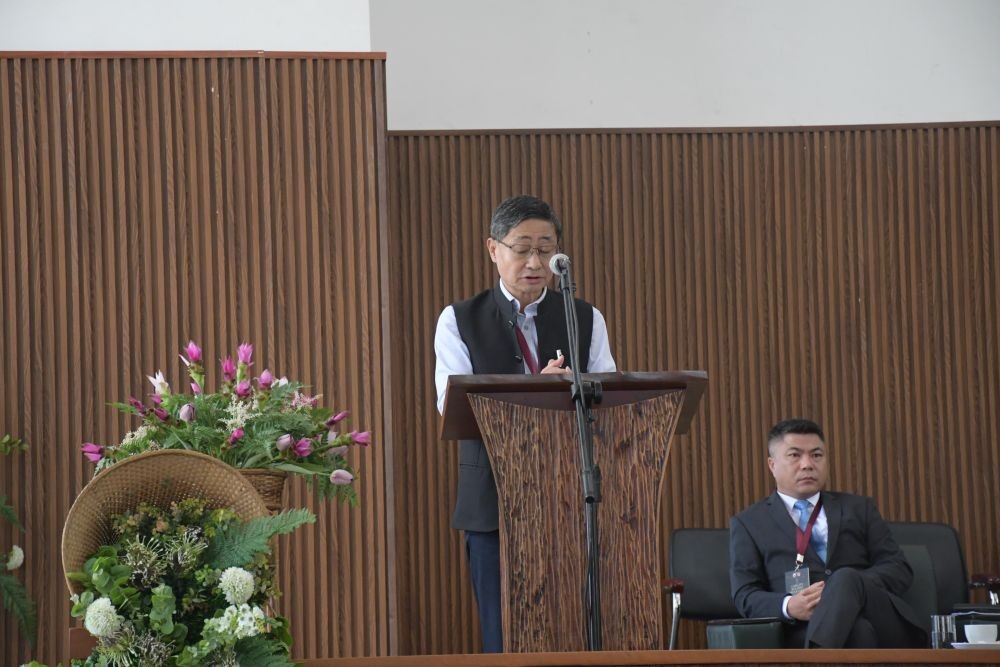
Chief Secretary Sentiyanger Imchen addressing Capacity Building programme for Village Level Functionaries at Kohima Village Multi Purpose Building on September 29. (Morung Photo)
Our Correspondent
Kohima | September 29
Nagaland Chief Secretary Sentiyanger Imchen today said the Naga tradition of community-based decision-making and customary institutions continue to provide a strong foundation for social cohesion and local governance.
“In Nagaland, since the time of our forefathers, we have a tradition of self governance based on community-based decision-making and customary institutions,” he said while addressing Capacity Building programme for Village Level Functionaries at Kohima Village Multi Purpose Building.
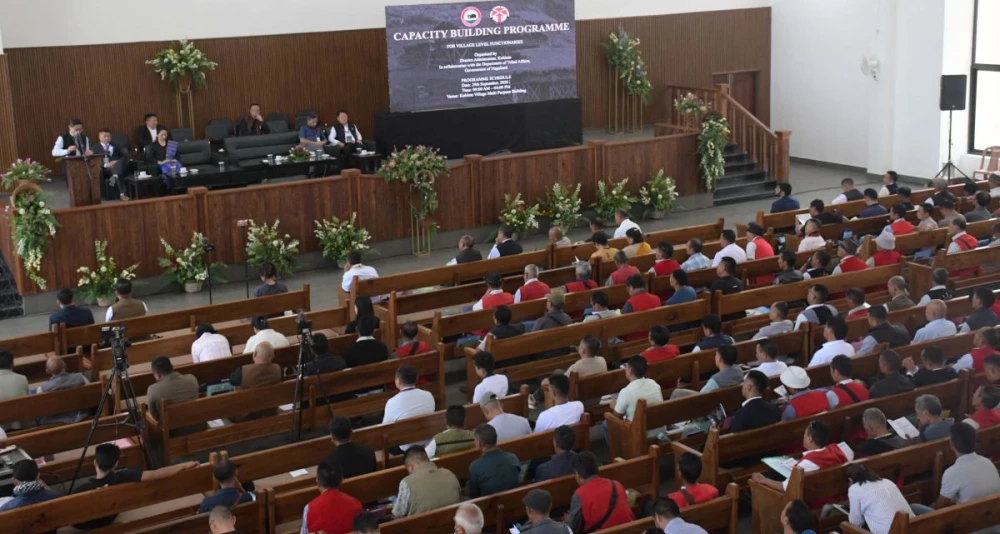
The progamme was organised by District Administration Kohima in collaboration with Department of Tribal Affairs, Government of Nagaland.
Stating that the governance landscape is evolving rapidly in today`s world, he said, “The responsibilities of village institutions are also becoming more complex.”
He said that Government programmes are expanding, financial systems are becoming more structured, service delivery is increasingly going digital while issues relating to the environment, natural resources and development are taking center stage.
In this, he stressed on the need to blend traditional and modern governance to provide progressive and effective governance.
Imchen said that the powers entrusted to village institutions must always be exercised with fairness, transparency, wisdom and in the larger public interest.
“Village authorities are also public servants and their primary focus has to be on public service. Development reaching the village must be just and equitable,” he said adding that the development plan should be decided by all the adults in the village as envisaged in the VDB rules.
Imchen said that the village plan should reflect what people in the village actually need and whether they benefit from the programmes and schemes implemented in the villages.
Describing Nagaland’s VDB model an important example of community participation in development, he said that the model is meaningful only when communities are able to participate responsibly in planning, implementation and monitoring.
‘Every rupee entrusted to village institution is public money’
Touching on financial management, he said “Every rupee entrusted to a village institution is public money. Proper records, transparency, documentation and timely accounting are therefore not merely procedural requirements but the basis of financial propriety are.”
Under the award of the finance commission, the absence of audited accounts of our rural local bodies made us forfeit large amounts earmarked for about 3 years. The same condition has been made mandatory under the award of the 16th Finance Commission covering the years 2026-31, he said.
The CS said the village councils and GBs must also act as the bridge between the government and the common man.
Stating that the government has a wide range of programmes intended to support entrepreneurship, farmers, self-help groups, health care and vulnerable households, Imchen said “The village authorities should disseminate information about the schemes and also actively facilitate them in availing these benefits.
He also told the village authorities to reach out schemes like Chief Minister’s Micro Finance Initiative, CMHIS, Ayushman Bharat-PMJAY and CMLIS, among others, to the eligible households.
He said that they should not take responsibilities lightly especially in Verification and certification of documents such as Scheduled Tribe Certificates, Indigenous Inhabitant Certificates and Permanent Residential Certificates.
“Every certificate and every recommendation must be based on facts, proper verification and due procedure, not on personal relationships, pressure or influence, he said.
Nagaland is fortunate to have article 371(A)
The CS said that Nagaland is fortunate to have article 371(A) of the constitution, providing special protection for customary laws, cultural practices, and ownership and transfer of land and its resources.
He said that land and its resources is not merely an economic asset in Nagaland but has deep social and cultural significance.
“Therefore, land-related matters must be handled with care, transparency, proper documentation and sensitivity to the applicable legal and customary framework,” he said.
Stating that the needs of development and progress cannot be ignored, he said “How can the state have good infrastructure and amenities if land is not made available or the demands to provide land is unreasonable. We have to balance between our traditional rights and practices with the need for development and progress. Village councils must play a pro-active role in land related matters.”
‘Village authority should not summon official or department’
Stating that villages must become cleaner and more environmentally responsible, the Chief Secretary said that the challenges of waste, plastic pollution, open dumping, open burning and degradation of water sources are increasingly visible even in rural areas.
It impacts on the health and quality of life every citizen and village councils will have to come forward to enforce such rules, he said.
He said that the village authority cannot and should not summon a district official or a department and issue ultimatums. Some such instances have come to our notice.
On the matter of Gaon burah openly gone against government decisions, he said “How can Gaon Burahs who are government appointees and representatives of the government in local bodies go against the government. The State Cabinet has taken serious note of this.”
“To exercise the powers and responsibilities effectively, village authorities need to be aware of relevant government rules and regulations, different schemes and the powers you are vested with so that your decisions are procedurally correct, legally sound and ultimately beneficial to the village as a whole,” he said.