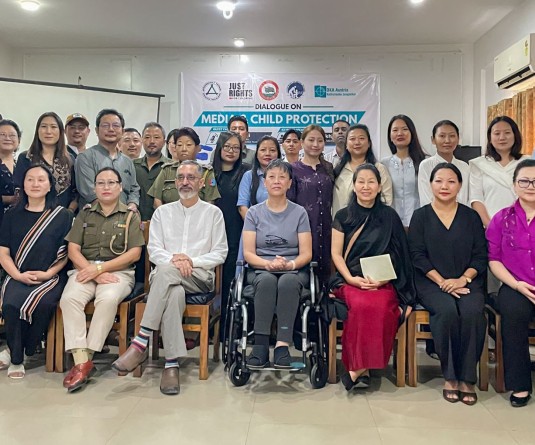
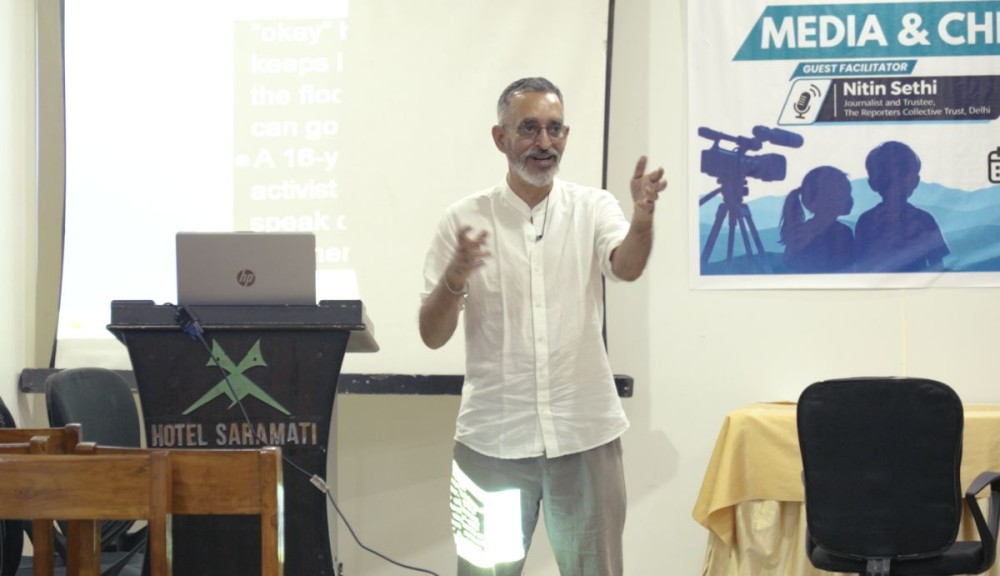
Nitin Sethi, journalist and trustee of The Reporter's Collective Trust at the State level dialogue on media and child protection in Dimapur on November 14. (Morung Photo)
Media weighs child protection vs. public interest
Morung Express News
Dimapur | November 14
Journalist Nitin Sethi told reporters at a state level dialogue on media and child protection in Dimapur on November 14 that the “pretension of journalism being different from society” does not hold up, since “we still live in the same reality” as the people whose stories are written.
The remark came at the end of a run of exercises in which he had asked participants to test their own newsroom habits against cases involving children.
The dialogue at Hotel Saramati was organised by Prodigals’ Home and Just Rights for Children in collaboration with Mission Vatsalya, Department of Social Welfare, Nagaland, with The Morung Express as media partner and Tushimenla Imlong of The Morung Foundation in the chair.
Sethi, a journalist and trustee of The Reporter's Collective Trust, took the media engagement session and the session on responsible reporting, and he organised both around anecdotes and exercises on the ethics of reporting.
Some of the exercise asked whether a media house should publish the photograph of a missing child because the police have handed it out, and whether it should print a child's name because a court document carries it. Sethi asked what the nature of policing and the urgency of a case allow, and put the matter to the room as a question: “Can't this allow for all ethics to be followed and for secondary levels of protection to be followed?” He also drew attention to “the permanence of the information put out there,” and asked participants to weigh it alongside that urgency.
Disclosure, he said, “can be pretty crazy and is a grey zone, though these stories are very powerful.” Consent and agreement, and how far it is acceptable to record children at all, were among the difficulties he listed, along with “the grey zone of young people in activism” and “the agency of young kids to understand the consequences of virality.”
The discussion also brought out an inconsistency in the press itself, and it came up while participants were considering how far a child can be expected to understand the consequences of virality. “We name them when they do good but conceal them when it's something bad,” was how the habit was described, a pattern in which a child who has done something admirable is identified, photographed and quoted, while a child who has done something wrong is shielded. The comparison showed that the decision to name a child often follows the tone of the story, whatever the child's own interests might be, and it sat uneasily beside the question of consent that Sethi had raised earlier.
The same difficulty arises when reporters interview child workers with the aim of taking them out of their conditions, a purpose few in the room would dispute. Sethi spoke of “the burden of evidence and proof for journalists” in such cases, since a story meant to lead to a child's removal from work has to rest on material a reporter can actually establish and defend. That burden, he said, “shows the limits of our profession.”
A part of journalism, he said, relies on “the art of separation,” the habit of setting the profession apart from an ordinary life with all its troubles, and the consequences of a story, “what will happen after our stories come out,” are among the things that get set aside in the process. Since reporters “still live in the same reality” as the people they write about, a more accurate description of the work, he suggested, is “just being decent human beings who occasionally do decent stories.”
The difficulty he returned to at the end was “the structural weakness of journalism,” which “limits us to only writing about the less powerful.” He called this “the truth of this profession,” and the people it leaves reporters writing about are “people who don't have agency over themselves,” among them the young, who were the subject of the day's dialogue.