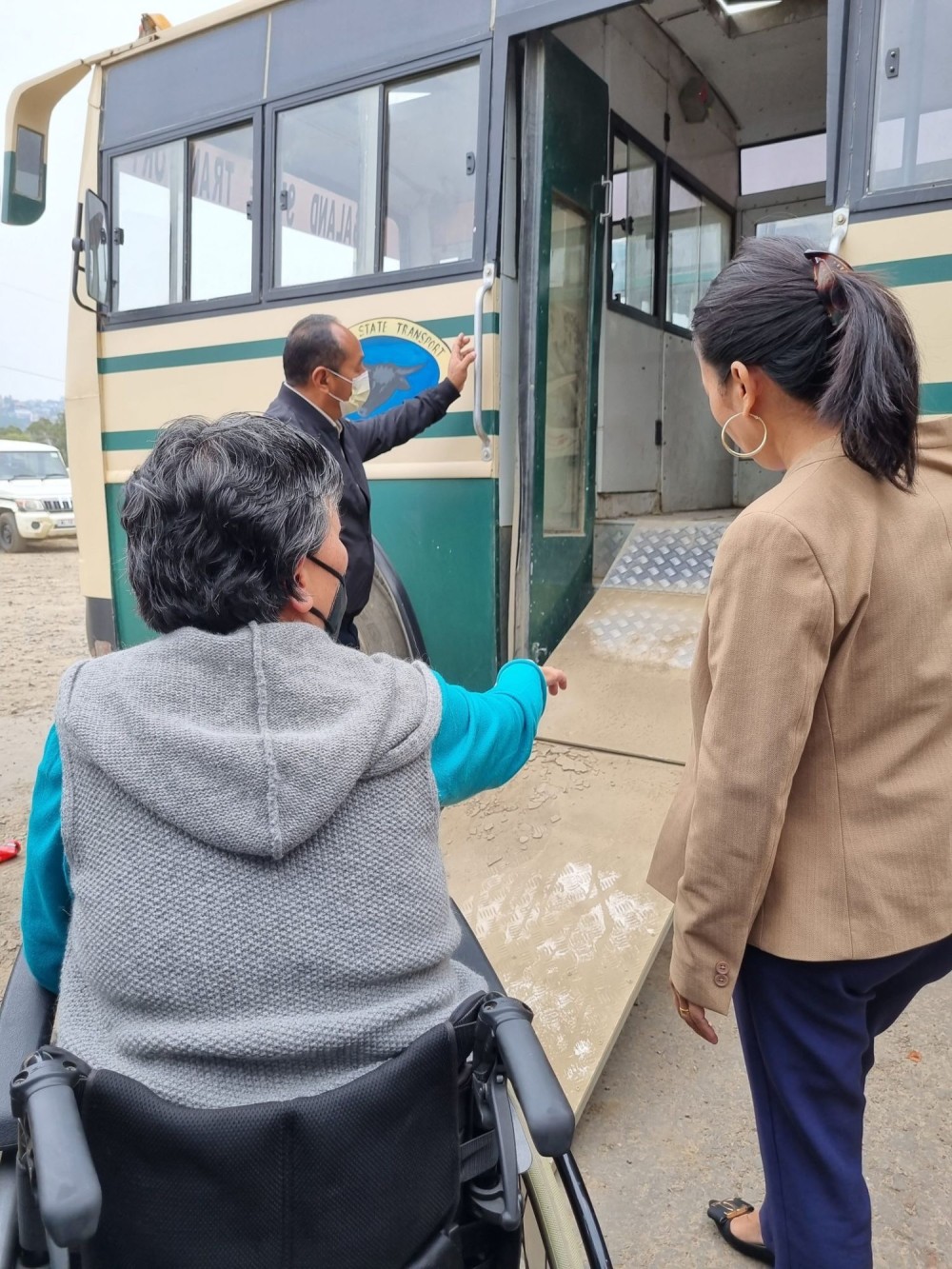
The State Commissioner for Persons with Disabilities office carried out an inspection of the NST station/ISBT in Kohima, together with officials of the Transport Department on April 21, 2023. (scpd.nagaland.gov.in/File Photo)
Former Disability Commissioner writes to CM over accessible transport
Dimapur, May 20 (MExN): Days after the Nagaland government signed an agreement with Tata Motors to procure 43 new buses for the state transport fleet, disability rights activist and former State Commissioner for Persons with Disabilities, Diethono Nakhro, has written to Chief Minister Neiphiu Rio urging him to ensure that all 43 buses are fully accessible to persons with disabilities.
In her letter, Nakhro stressed that the procurement must comply with the Rights of Persons with Disabilities (RPwD) Act, 2016, and the Harmonised Guidelines and Standards for Universal Accessibility in India, 2021.
Legal obligations cited
In her letter, Nakhro invoked the Supreme Court’s landmark December 2017 ruling in Rajive Raturi vs Union of India, in which the Court held that “Section 41 of the Disabilities Act, 2016 provides for comprehensive accessibility in all modes of transport including but not limited to the bus transport. Therefore, it becomes the duty of the Union, States as well as Union Territories to ensure that all Government buses are disabled friendly in accordance with the Harmonised Guidelines.”
The Court had directed that all government and privately owned public transport carriers be made fully accessible by March 2018.
She also cited a notification dated February 5, 2019, issued by the Transport Department, Government of Nagaland, itself under Section 41 of the RPwD Act, which directed that all public transport vehicles must conform to accessibility standards. Further, it stated, “No new vehicle meant for public transport must be registered if such vehicle does not conform to the minimum standards to enable persons with disabilities to access and travel comfortably.”
Additionally, Nakhro noted that in Suo Motu proceedings before the State Commissioner for Persons with Disabilities (SCPD) Court in 2024, the Nagaland State Transport Department had been directed to implement the Harmonised Guidelines 2021 and ensure strict compliance with accessibility standards in all newly procured buses.
Specific standards prescribed
The Harmonised Guidelines and Standards for Universal Accessibility in India 2021, mandated under the RPwD Act 2016 read with RPwD Rules 2017, prescribe the following mandatory requirements for buses: Low-floor buses with maximum ground floor height of 400 mm; Minimum door width of 1200 mm; Installation of handrails and footlights; Hydraulic lifts or pull-out/foldable ramps for wheelchair users and persons with mobility impairments; Designated wheelchair spaces with safety belts and wheel stoppers; Accessible alighting buzzers with Braille/raised markings; and Clearly visible visual route and destination information displays inside and outside the buses.
Terrain argument rejected
Anticipating the state’s common response on geographical constraints, Nakhro directly addressed the argument that low-floor accessible buses are not feasible in Nagaland due to its hilly and rugged terrain.
“While these geographical challenges are indeed real, compounded by frequent landslides and difficult road conditions in many areas, the burden of finding solutions cannot be placed upon persons with disabilities,” she wrote.
“It is the responsibility of the Government to ensure that infrastructure development, including road connectivity, is progressively improved and that alternative accessibility solutions are explored and implemented wherever standard low-floor models may not be fully feasible,” she asserted. “Difficult terrain cannot become a justification for exclusion or denial of the right to accessible public transport.”
Six-point demand
Nakhro has made six demands of the state government to ensure that all 43 buses being procured are fully accessible and compliant with the RPwD Act 2016 and the Harmonised Guidelines 2021; the buses are low-floor and equipped with ramps/lifts and wheelchair spaces; Where standard low-floor buses are not feasible due to terrain or road conditions, ensure that safe and effective alternative accessibility solutions are incorporated so that persons with disabilities are not excluded from public transport services; Incorporate accessible information systems, including visual and tactile signage; Consult with persons with disabilities and accessibility experts prior to finalisation and delivery of the buses; and establish a mechanism for inspection and certification of accessibility compliance before induction into service.
“This fleet expansion presents a historic opportunity for Nagaland to move towards an inclusive and accessible public transport system that upholds the dignity and rights of all citizens,” she stated in the letter.