92% of births registered more than a year late
Moa Jamir
Dimapur | November 26
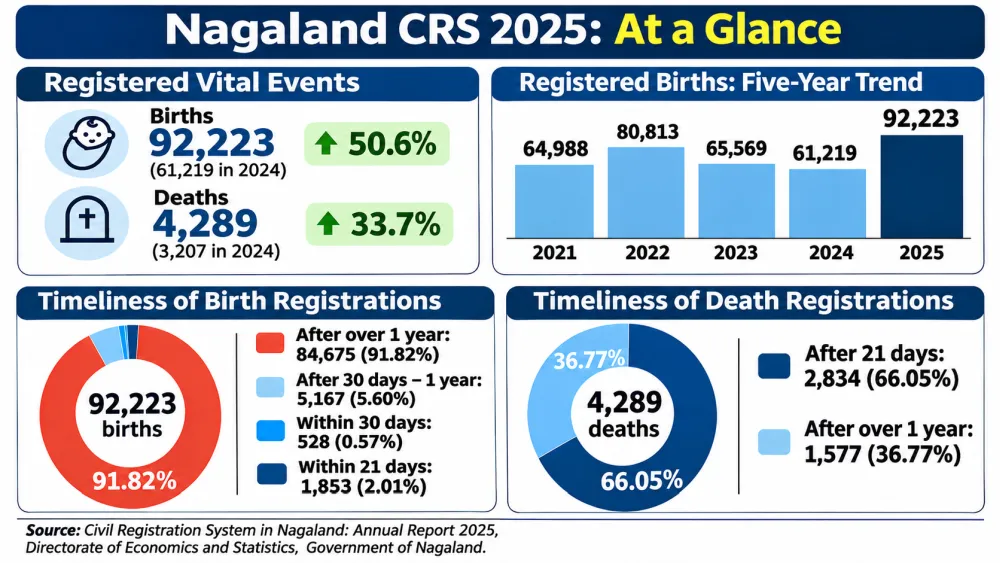
Nagaland recorded a sharp increase in the number of registered births and deaths in 2025, with birth registrations rising by 50.6% over the previous year. However, despite the increase, the State’s civil registration system (CRS) continued to face significant delays, with more than nine out of every 10 births registered only after a year of occurrence.
The figures are from the Civil Registration System in Nagaland: Annual Report 2025, published and released online by the Directorate of Economics and Statistics, on November 25.
It recorded 92,223 births in 2025, up from 61,219 in 2024. Registered deaths also increased by 33.7%, from 3,207 to 4,289 during the same period.
The increase in birth registrations was particularly pronounced in urban areas, where the number rose from 27,349 in 2024 to 55,948 in 2025, more than doubling, accounting for 60.67% of all registered births in 2025, compared with 44.67% a year earlier.
Rural registrations increased more modestly, from 33,870 to 36,275.
In terms of religious composition, Christians accounted for the largest share of registered live births at 76.91%, followed by Hindus at 11.74%, Muslims at 10.73% and other religions at 0.61%.
The five-year figures show that registered births had declined for two consecutive years, from 80,813 in 2022 to 65,569 in 2023 and 61,219 in 2024, before rising sharply in 2025.
Registered deaths, meanwhile, had declined from 3,934 in 2023 to 3,207 in 2024 before increasing to 4,289 in 2025.
Time lags persists
Despite the rise in registrations, timely recording of births remained a major challenge. Of the 92,223 live births registered in 2025, only 1,853, or 2.01%, were recorded within the prescribed 21-day period under the Registration of Births and Deaths Act, 1969.
As many as 84,675 births, accounting for 91.82% of the total, were registered more than a year after occurrence. Another 5,167 were registered after 30 days but within a year, while 528 were recorded within 30 days.
The delay was more pronounced in rural areas, where 95.72% of births were registered after a year, compared with 89.28% in urban areas. Overall, 98.96% of rural births and 97.36% of urban births were registered beyond the prescribed 21-day period.
As per previous CRS records, the proportion of births registered more than a year after occurrence stood at 91.92% in 2022, which declined to 90.49% in 2023, but rose to 94.24% in 2024.
The 2025 figure, though suggest a decline, of 91.82% is still significant.
Death registrations also showed delays, although to a lesser extent. Around 66.05% of deaths registered in 2025 were recorded beyond the 21-day period, while 36.77% were registered after more than a year. Rural areas reported a higher proportion of delayed death registrations at 72%, compared with 64.66% in urban areas.
The report recorded the issuance of 92,223 birth certificates and 4,289 death certificates under Section 12 of the Act in 2025.
Challenges
The report identified inadequate IT infrastructure, poor transport and communication facilities, limited public awareness, delayed reporting by registrars and inadequate funding as key challenges to civil registration.
The CRS-ORGI online registration portal was launched in Nagaland in April 2022, followed by training programmes for registrars across districts in February and March 2025. While data are digitally compiled at district headquarters, village- and block-level units continue to use both manual and digital processes.
In response to queries from The Morung Express in July 2025, the Directorate had identified the public’s failure to report vital events on time as the primary reason for delays. Despite awareness campaigns, posters and collaborations with local bodies and media outlets, many events continued to be reported well beyond the prescribed period.
Registration within 21 days is free, while cases delayed beyond one year require a Magistrate’s approval.
In March, 2026 , the State Government also reconstituted the Inter Departmental Coordination Committee (IDCC) on the Registration of Births and Deaths with the objective of achieving 100% registration.
From June 1, 2026, the State shifted to an online-only system for registration. The Directorate stated that digitisation of previously issued manual certificates would also continue.
Whether the online-only system will produce a different outcome in the 2026 CRS remains to be seen; the 2025 figures, however, underline the persistent challenge of ensuring timely registration of vital events.