Union Home Minister Amit Shah, Nagaland Chief Minister Dr Neiphiu Rio, Deouty CM Y Patton, ENPO leaders and others during the signing of Tripartite agreement for Frontier Nagaland Territorial Authority in New Delhi on February 5. (Photo Courtesy: @Neiphiu_Rio)
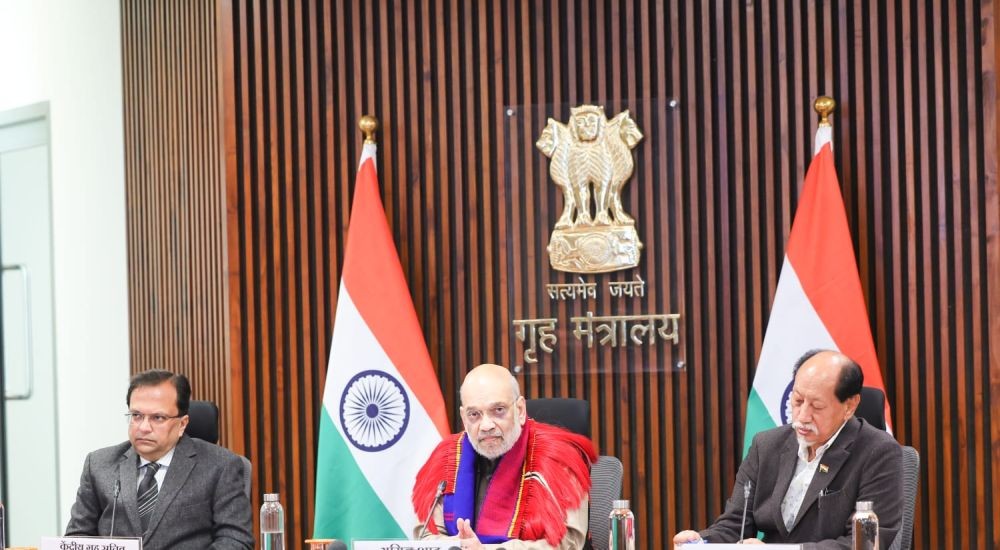
Kohima, February 5 (MExN): Nagaland Chief Minister Dr Neiphiu Rio led an official high-level delegation to New Delhi, raising “important and pertinent issues” concerning Nagaland with the Government of India (GoI).
The delegation, comprising Deputy Chief Minister Y Patton, members of the State Cabinet and members of the Sub-Committee of the Political Affairs Committee (PAC), met senior Central leaders, including Union Home Minister Amit Shah, Union Finance Minister Nirmala Sitharaman and Union Defence Minister Rajnath Singh, among others.
During the meeting with the Union Home Minister, Members of Parliament Supongmeren Jamir (Lok Sabha) and Phangnon Konyak (Rajya Sabha) also participated as members of the PAC Sub-Committee.
As per the State DIPR, during the meeting, the delegation raised several pertinent issues, including the Indo-Naga peace process, State finances, the Protected Area Permit and the Free Movement Regime, among others.
Indo-Naga peace process
In line with the four-point resolutions adopted at the Consultative Meeting on the Naga Political Issue held on September 12, 2024, the Chief Minister reiterated that the Indo-Naga peace talks were declared as talks at the highest level.
He noted that it was necessary to restore the talks at the highest political level through the appointment of an interlocutor of political or ministerial rank to expedite discussions and work towards the realisation of an early and honourable solution to the Indo-Naga political issue.
The Union Home Minister responded positively to the suggestion and indicated that a Minister of State for Home Affairs and officers from the Home Ministry would be appointed for the Naga talks, the DIPR informed.
Financial pattern for Nagaland
The Chief Minister highlighted the financial situation of the State and stated that Nagaland is a special political State formed out of a political agreement, and that it was assured under the 16-Point Agreement that the funds required for the administration and development of Nagaland would be paid from the Consolidated Fund of India.
In his official representation, the Chief Minister stated: “When Nagaland became a State in 1963, it was recognised as a special case because of its history, political context and limited economic base at the time. In fact, Nagaland’s creation as the 16th State of the Indian Union was the outcome of a political settlement.”
“The 16-Point Agreement acknowledged that the new State would begin its journey under exceptional circumstances—political, geographic, security-related and economic. Recognising these realities, as per Point No. 11 of the Agreement, the Government of India undertook to bear the expenditure of the State from the Consolidated Fund of India, allowing Nagaland the fiscal space to stabilise governance, institutions and public administration,” he said.
This, he asserted, was a nation-building commitment, not a concession. However, the withdrawal of this arrangement in 1989, without dialogue or concurrence of the State, disrupted the foundational understanding. Over time, this placed Nagaland in a structurally vulnerable fiscal position, requiring resource gap funding in the form of Revenue Deficit Grants, among others, he added.
Accordingly, CM Rio appealed for restoration of the original financial pattern, considering the financial position and political nature of Nagaland.
On this issue, Home Minister Amit Shah responded positively and assured that the request of the Nagaland Government for funding from the Consolidated Fund of India would be examined. Similarly, the same issues were flagged to the Union Finance Minister for urgent consideration, to which she assured support from the Government of India, the DIPR noted.
Protected Area Permit regime
The issue of lifting the Protected Area Permit (PAP) regime in Nagaland and relaxation of the Free Movement Regime was once again raised during the meeting.
In this regard, the Chief Minister highlighted that the State Government had written to the Ministry of Home Affairs on January 22, 2025, seeking a review of the re-imposition of the PAP regime in Nagaland and restoration of the earlier relaxation.
The State Cabinet further deliberated on the matter on December 16, 2025, and February 3, 2026, and decided to pursue with the MHA, GoI, the complete relaxation of the PAP regime in Nagaland.
The Chief Minister had also written to the Government of India on July 18, 2025; September 10, 2025; November 17, 2025; and November 28, 2025, seeking a review of the re-imposition of PAP in the State.
As per the State DIPR, the Union Home Minister assured that the matter would be positively examined by the Ministry.
Free Movement Regime
In his representation, the Chief Minister also highlighted that Nagaland shares a 215-kilometre international boundary with Myanmar across Naga communities residing on both sides of the border.
He stated that these communities have, for generations, maintained deep-rooted social, cultural and economic ties, with regular cross-border movement for agriculture, traditional practices and familial responsibilities.
The State Cabinet deliberated on the issue on January 6, 2025, following which the State Government wrote to the MHA requesting restoration of the earlier Free Movement Regime.
In a letter dated July 18, 2025, CM Rio again drew the Centre’s attention to changes made to the FMR, stating that they were causing hardship and distress to border communities. He requested a re-examination of the revised guidelines and consideration of a more flexible and context-sensitive approach that safeguards national security while respecting traditional rights and ways of life.
The State Cabinet again deliberated on the Free Movement Regime at its meeting on February 3, 2026 and, taking into account public concerns and the region’s unique demographic and cultural realities, decided to once again approach the Ministry of Home Affairs to seek a re-examination of the revised FMR guidelines.
The Union Home Minister gave a patient hearing and assured a positive approach and examination of the matter, the State DIPR added.