‘When the government is busy creating districts on the basis of tribe how is it possible to overcome tribalism?’
Morung Express News
Dimapur | April 11
A public poll on the question of overcoming tribalism in Nagaland has drawn an open portrait of a society aware of its own fractures and impatient for solutions that go beyond symbolism. A commanding 80% pointed to ‘Education and Inter-Tribe Exchange’ as the most effective tools, while only 06% named ‘Healing and Reconciliation Through Forgiveness’ as the path forward and 14% respondents offered alternative perspectives.
The Morung Express poll, which invited opinions alongside categorical responses, reflects a growing disillusionment with what some respondents called performative Christianity, where faith is professed publicly but tribal loyalty governs actual behaviour. “We say Nagaland is the land of Christ… we see big churches,” wrote one respondent, “but the bitter truth is we Nagas do this just for namesake.” The statement summed up a frustration expressed across multiple responses that the moral architecture of Naga civil society, rooted in the Church, has failed to translate into inter-community solidarity.
Central to the education argument was not merely formal schooling, but a deeper unlearning. A respondent stressed the need to shed stereotypes “ingrained in our mindset” and cultivate genuine broad-mindedness. “We need to get rid of the stereotypes that we have of other tribes. That will come only when people are truly educated to be broad minded, and letting go of ‘isms’ ingrained in our mindset.”
One respondent framed the issue in humanistic terms, arguing that people seen “only through word of mouth, paper or through electronic screens.” The person wrote, “If we want to overcome tribalism, we have to humanise the other person. We have to learn to see the world through their lenses as well and when we are able to do that, we will break down barriers of structural biases that keep us from seeing our shared humanity.”
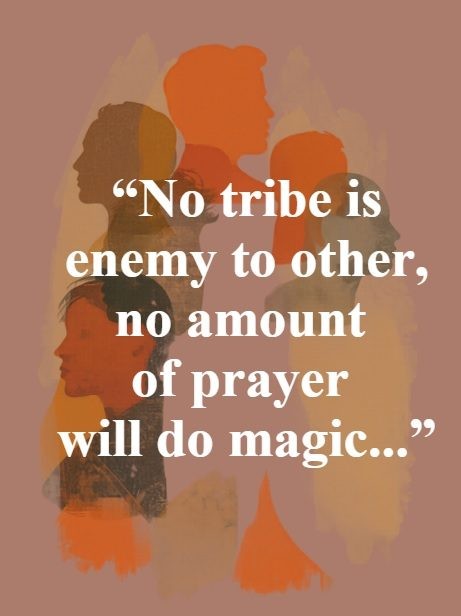
Inter-tribal marriages were cited as a social bridge, with one respondent noting that Naga, society is based on the “close family bond, inter-tribe marriage will brings us closer.” Others called for formal facilitation of cross-community encounters as a policy priority, arguing that proximity dismantles prejudice more reliably than any institutional decree. “No tribe is enemy to other, no amount of prayer will do magic - inter-tribe exchange, and facilitating people to meet each other, is the best idea,” one cited.
The respondents who offered alternative views stressed two specific institutions: the Church and the Government. On the question of religion, multiple voices called on tribal churches, which function as linguistically and ethnically segregated congregations in Nagaland’s towns and cities, to open their doors to inter-denominational and inter-tribal worship. “Can the tribal churches give way to the Naga church?” asked one respondent pointedly. “Why should Christians be separated by tribes?”
The media was also put in the dock. One respondent called on Nagaland’s press to eliminate felicitation sections that routinely identify individuals by their tribe and village, arguing that such seemingly harmless practices reinforce subconscious tribal biases, particularly among the youth. “Why not just mention his or her name and the district?” the respondent asked. “Isn't that more than enough?”
Perhaps the most politically charged observation came in the form of a critique of the state government itself. A respondent pointed out, “When the government is busy creating districts on the basis of tribe how is it possible to overcome tribalism. The creation of tribe-based districts is going to create a lot of isms and will only lead to more divisions and fragmentation among Nagas.”
One respondent offered a keen observation, distinguishing tribalism from its irrational form: “Tribalism is not a disease — it's natural anywhere in the world. The disease is when one becomes blinded by it. Justifying the wrong deeds of tribesmen and supporting them even when they are wrong.” The respondent underscored, “The issue is purely ethical and being morally correct, and Nagas are a pitiful lot in this regard.”