Moa Jamir
Dimapur | May 29
India’s Constitution provides broad guarantees of equality, dignity, and protection to all citizens. However, a landmark legislation establishing a specialised child-centric framework of protection was the Protection of Children from Sexual Offences (POCSO) Act, 2012, dealing exclusively with sexual offences against minors.
Enacted in alignment with India’s ratification of the UN Convention on the Rights of the Child in 1992, the Act was passed by the Indian Parliament on May 22, 2012 and came into force on November 14, 2012, coinciding with Children's Day in India. Subsequent amendments introduced stricter punishments for aggravated offences to enhance deterrence.
Today, the POCSO Act functions as one of India’s frontline legal safeguards for children, not only in physical spaces, but in digital environments as well.
Crucially, the law makes child protection a collective obligation, binding all citizens through legal and ethical responsibilities.
In Nagaland, where community institutions play an influential role in public life, understanding the basic framework of the POCSO Act and its legal obligations is imperative.
This second report in the series seeks to explain the basic framework and functioning of the POCSO Act, while contextualising its relevance within Nagaland’s social, institutional, and community realities.
What is POCSO?
The purpose of the POCSO Act is clearly laid out in its preamble:
“An Act to protect children from offences of sexual assault, sexual harassment and pornography and provide for establishment of Special Courts for trial of such offences and for matters connected there with or incidental thereto.”
The Supreme Court has also underlined this in a 2017 judgment observing that the POCSO Act “treat the minors as a class by itself and treat them separately” and the “sanguine purpose is to safeguard the interest and well-being of the children at every stage of judicial proceedings...”
This naturally raises a basic legal question: Who is considered a child under the Act?
Under Section 2(d) of the POCSO Act, a child is defined as “any person below eighteen years of age.” Expressly gender-neutral, its protections apply equally to all children without any distinction.
I. Types of Offences
The POCSO Act covers a wide range of conduct and is not limited to only the most extreme forms of sexual abuse.
Under Sections 3 & 4, penetrative sexual assault includes any form of penetration involving body parts or objects.
Sections 5 & 6 deal with aggravated penetrative sexual assault, where the offender is a person in a position of trust or authority, such as a teacher, police personnel, relative, or institutional caregiver, or involves particularly grave circumstances, including communal violence, serious injury, or resulting pregnancy.
Sections 7 & 8 criminalise sexual assault involving physical contact with sexual intent without penetration while Sections 11 & 12 address non-contact sexual harassment, including stalking, making sexually coloured remarks, or online abuse.
Sections 13 to 15 further prohibit the use of children for pornographic purposes, including the creation, possession, storage, circulation, or transmission of exploitative material, now widely referred as Child Sexual Exploitative and Abuse Material (CSEAM) and intersect with provisions of the Information Technology Act. The Supreme Court has clarified that knowingly accessing, downloading, storing, or circulating such material without lawful reporting may itself attract criminal liability.
Section 16 and 17 penalise ‘abetment of offences’ by instigating, conspiring or assisting in commission of offences against a child, including trafficking.
II. Mandatory Reporting: A Legal Obligation for Every Citizen
One of the most significant features of the POCSO Act is the mandatory reporting mandate.
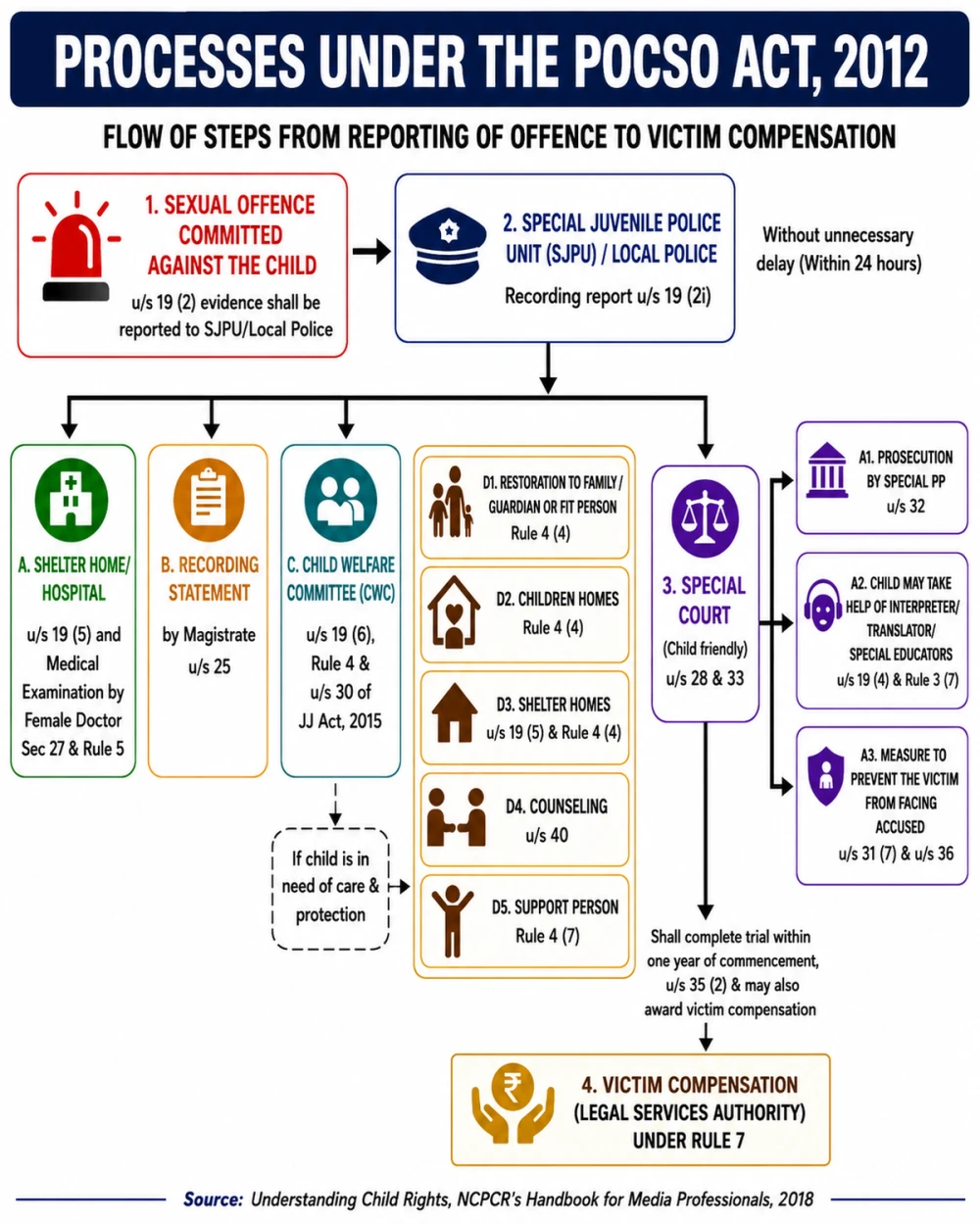
Under Section 19, any person who has knowledge of, or even a reasonable apprehension that an offence under the Act has been committed, is legally bound to report it to the Special Juvenile Police Unit (SJPU) or the local police.
Intentionally broad, “any person” may include parents, guardians, teachers, hostel wardens, doctors, neighbours, community leaders, church workers, institutional caregivers, or any member of the public aware of such information.
These provisions ensure that abuse does not remain hidden due to fear, stigma, social pressure, or concerns over family or community reputation.
This has particular relevance in Nagaland, where customary mediation and informal settlements often resolve social disputes, even in serious allegations.
The POCSO framework strictly rules out such informal ‘compromises.’ Section 21 prescribes penalties, including imprisonment and fines, for individuals or institutions (schools, hostels, hospitals) that fail to report an offence.
Conversely, genuine reporting in “good faith” is protected from legal repercussions under Section 19(7).
To prevent misuse, Section 22 mandates penalties for knowingly making false complaints, though children themselves are exempted from this punishment.
Section 20 extends this reporting obligation to media personnel and commercial establishments (hotels, studios, lodges) encountering CSEAM.
III. Identity Shield: Nagaland’s Compliance Challenge
Perhaps the most frequent legal violation, often inadvertent, in Nagaland involves the disclosure of a child’s identity, which is not limited to name only.
Section 23 of POCSO establishes a near-total ban on identifiers including “name, address, photograph, family details, school, neighbourhood or any other particulars which may lead to disclosure of identity of the child.”
The media itself is prohibited from making “any report or present comments on any child from any form of media or studio or photographic facilities without having complete and authentic information… (Section 23/1). The publisher or owner of such entities is jointly liable for non-compliance.
Violation of these provisions can lead to imprisonment from six months to one year, a fine, or both.
Under the Act, only a Special Court may permit disclosure only if it is satisfied that such disclosure is in the “best interest of the child.” However, the reasons have to be recorded in writing.
This has particular relevance in a close-knit society like Nagaland where even references to a school, village, family background, or incident-specific details may be enough to reveal identity within a small community.
Even well-intentioned public statements due to public outrage, community solidarity, or demands for justice can breach these statutory boundaries.
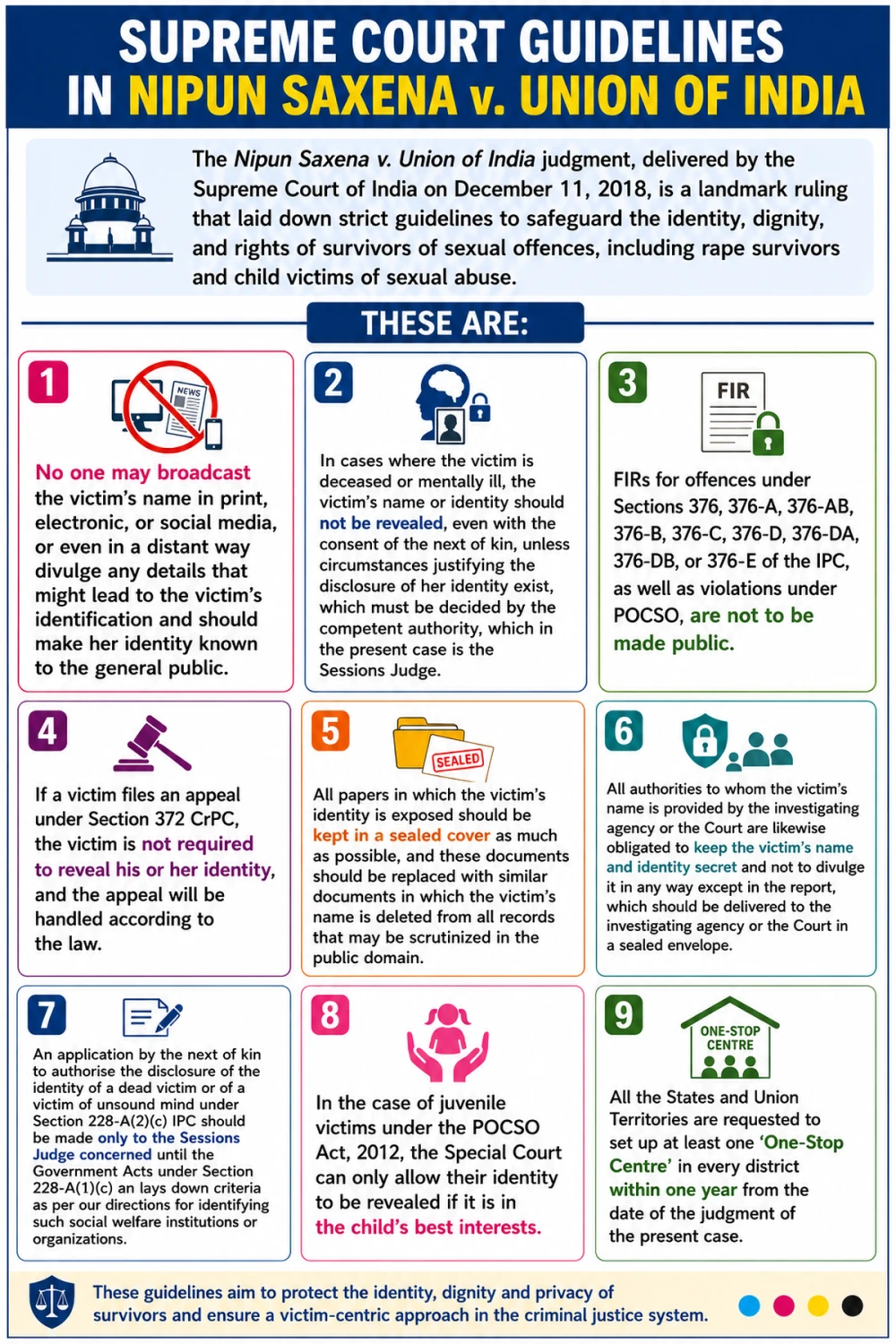
The Supreme Court, in Nipun Saxena v. Union of India (2018), further laid down stringent guidelines to safeguard the identity, dignity, and rights of survivors of sexual offences.
IV. Child-Friendly Judicial Procedures
Another defining feature of the POCSO Act is its recognition that the legal process itself can sometimes become a source of secondary victimisation through insensitive investigations or intimidating court procedures, among others.
To address this, Sections 24 to 27 of the Act lay down a series of child-friendly safeguards intended to make the justice process more responsive to the needs of the child.
Recording Statements (Sections 24 & 25): Statements should be recorded where children feel safe, preferably at their place of stay, by a female police officer not below the rank of Sub-Inspector, who must be in plain clothes.
A child cannot be detained in a police station overnight, must never come into contact with the accused, and statements before a Magistrate must be recorded exactly as spoken without intimidation.
The law also ensures that the lawyer of the accused cannot be present in a manner that may intimidate the child during this stage.
Support Structures (Sections 26): Statements must be taken in the presence of parents, guardians, or any trusted adult chosen by the child. Authorities are required to use translators, interpreters, or special educators where language or developmental disabilities present barriers. Audio-video recordings should be utilised to minimise repeated questioning and preserve evidence accurately
Medical Examination (Section 27): A child survivor is entitled to a medical examination even if an FIR has not yet been formally registered to ensure that procedural formalities do not delay the process. Girl survivors must be examined by a woman doctor in the presence of a parent or a trusted female nomineeby the medical institution.
IV. Special Courts
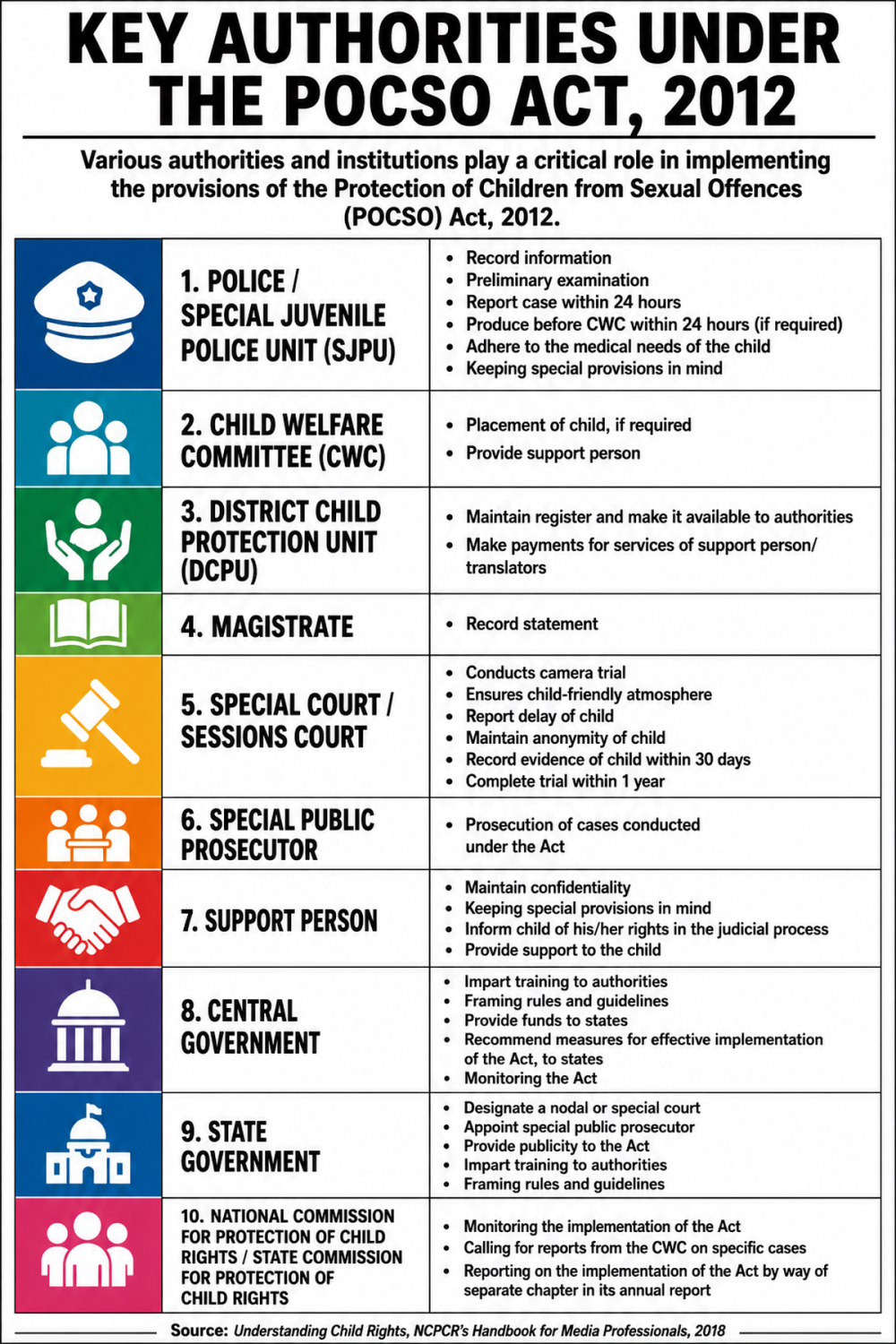
For speedy trial, the Section 28 mandates that state governments, in consultation with the High Court Chief Justice, establish Special Courts in each district for speedy trials, alongside appointing Special Public Prosecutors.
Trials are to be conducted in-camera (privately).
Under Section 33(8), these courts can direct immediate interim compensation for medical or relocation needs, as well as final compensation for physical and mental trauma.
The child’s family or guardian is also entitled to legal assistance from a counsel of their choice for offences under the Act.
In Nagaland, apart from the Fast Track Special Court (FTSC) in Dimapur that handles sexual offences and POCSO cases, Special Court has been designated in every district of offences under the Act.
V. Conclusion
Protecting children in Nagaland requires aligning customary values with statutory reality. The law is unequivocally clear that silence, delay, or informal compromise carry severe legal consequences while the identity of a child is protected as a statutory mandate.
The anonymity mandate and the duty to report must be complied with to ensure that the “shield” of POCSO remains strong enough to protect the dignity and future of every child.
Thus, every stakeholder must ensure that in the pursuit of justice, a child’s dignity, privacy, and long-term well-being must take absolute precedence over any other concern.
Media Mandates Under POCSO: Procedure for Media (Section 23)
.webp)
1) No person shall make any report or present comments on any child from any form of media or studio or photographic facilities without having complete and authentic information, which may have the effect of lowering his reputation or infringing upon his privacy.
2) No reports in any media shall disclose, the identity of a child including his name, address, photograph, family details, school, neighbourhood or any other particulars which may lead to disclosure of identity of the child: Provided that for reasons to be recorded in writing, the Special Court, competent to try the case under the Act, may permit such disclosure, if in its opinion such disclosure is in the interest of the child.
3) The publisher or owner of the media or studio or photographic facilities shall be jointly and severally liable for the acts and omissions of his employee.
4) Any person who contravenes the provisions of sub-section (1) or sub-section (2) shall be liable to be punished with imprisonment of either description for a period which shall not be less than six months but which may extend to one year or with fine or with both.
Supreme Court guidelines in Nipun Saxena v. Union of India
The Nipun Saxena v. Union of India judgment, delivered by the Supreme Court of India on December 11, 2018, is a landmark ruling that laid down strict guidelines to safeguard the identity, dignity, and rights of survivors of sexual offences, including rape survivors and child victims of sexual abuse.
These are:
1) No one may broadcast the victim’s name in print, electronic, or social media, or even in a distant way divulge any details that might lead to the victim’s identification and should make her identity known to the general public.
2) In cases where the victim is deceased or mentally ill, the victim’s name or identity should not be revealed, even with the consent of the next of kin, unless circumstances justifying the disclosure of her identity exist, which must be decided by the competent authority, which in the present case is the Sessions Judge.
3) FIRs for offences under Sections 376, 376-A, 376-AB, 376-B, 376-C, 376-D, 376- DA, 376-DB, or 376-E of the IPC, as well as violations under POCSO, are not to be made public.”
4) If a victim files an appeal under Section 372 CrPC, the victim is not required to reveal his or her identity, and the appeal will be handled according to the law.
5) All papers in which the victim’s identity is exposed should be kept in a sealed cover as much as possible, and these documents should be replaced with similar documents in which the victim’s name is deleted from all records that may be scrutinized in the public domain.
6) All authorities to whom the victim’s name is provided by the investigating agency or the Court are likewise obligated to keep the victim’s name and identity secret and not to divulge it in any way except in the report, which should be delivered to the investigating agency or the Court in a sealed envelope.
7) An application by the next of kin to authorise the disclosure of the identity of a dead victim or of a victim of unsound mind under Section 228-A(2)(c) IPC should be made only to the Sessions Judge concerned until the Government Acts under Section 228- A(1)(c) an lays down criteria as per our directions for identifying such social welfare institutions or organizations.
8) In the case of juvenile victims under the POCSO Act, 2012, the Special Court can only allow their identity to be revealed if it is in the child’s best interests.
9) All the States and Union Territories are requested to set up at least one ‘One-Stop Centre’ in every district within one year from the date of the judgment of the present case.
Key POCSO terms
1. Child Section 2(1) (d): Any person below the age of 18 years.
2. Special Juvenile Police Unit (SJPU) Section 2(1)(q): A specialised police unit designated to handle offences involving children and to ensure child-sensitive procedures during reporting and investigation.
3. Local Police Section 2(1)(l)): The police station or police officer having jurisdiction over the area where the offence is reported or detected.
4. Special Court (Section 28): A designated court established for the speedy trial of offences under the POCSO Act and to ensure child-friendly judicial proceedings.
5. Special Public Prosecutor (Section 32): A prosecutor appointed to conduct cases under POCSO before the Special Court, preferably with experience in child rights or criminal prosecution.
6. Child-Friendly Procedure (Sections 24, 26, 33 & 36): Procedures under the Act designed to ensure that reporting, evidence recording, investigation, and trial are conducted in a manner that minimises trauma to the child.
7. Statement of the Child (Section 24): The child’s statement recorded by police, preferably at the child’s residence or a place of the child’s choice, in a non-threatening environment.
8. Support Person (Section 19(6) read with POCSO Rules, 2020): A person assigned to assist the child and family throughout the investigation, trial, counselling, rehabilitation, and access to services.
9. Person in Trust or Authority (Referenced in Sections 5 & 9): Any person who, by virtue of profession, relationship, or responsibility, exercises care, supervision, control, or influence over a child—such as teachers, guardians, institutional staff, or caregivers.
10. Child Welfare Committee (CWC) (Section 19(6), read with JJ Act): A statutory body that may be informed in POCSO cases to ensure the child’s care, protection, counselling, shelter, or rehabilitation.
11. In Camera Trial (Section 37): A court proceeding conducted privately, excluding the general public, to protect the child’s dignity, privacy, and identity.
12. Interpreter / Translator / Special Educator (Section 38): Professional assistance provided where the child has language barriers, disability, or communication difficulties.
13. Medical Examination (Section 27): A child-sensitive medical examination conducted in the presence of a trusted person nominated by the child or guardian, wherever possible.
14. Mandatory Reporting (Section 19): A legal obligation requiring any person with knowledge or reasonable apprehension of an offence under the Act to report it to the SJPU or local police.
15. Punishment for Failure to Report (Section 21): Prescribes penalties for individuals or institutions that fail to report or record offences under the Act.
16. Confidentiality of Identity (Section 23): Prohibits disclosure of a child’s name, address, photograph, school, family details, or any information that may reveal the child’s identity.
17. Compensation Section 33(8): Financial compensation that may be directed by the Special Court for the child’s rehabilitation, treatment, education, or recovery.
Disclaimer: This report is Part II of the ‘Media Fellowship Initiative on Child Protection Awareness and Ethical Public Discourse’ series, supported by DKA Austria and implemented by Prodigals’ Home. The content is intended for public legal literacy and preventive awareness and does not constitute legal advice.