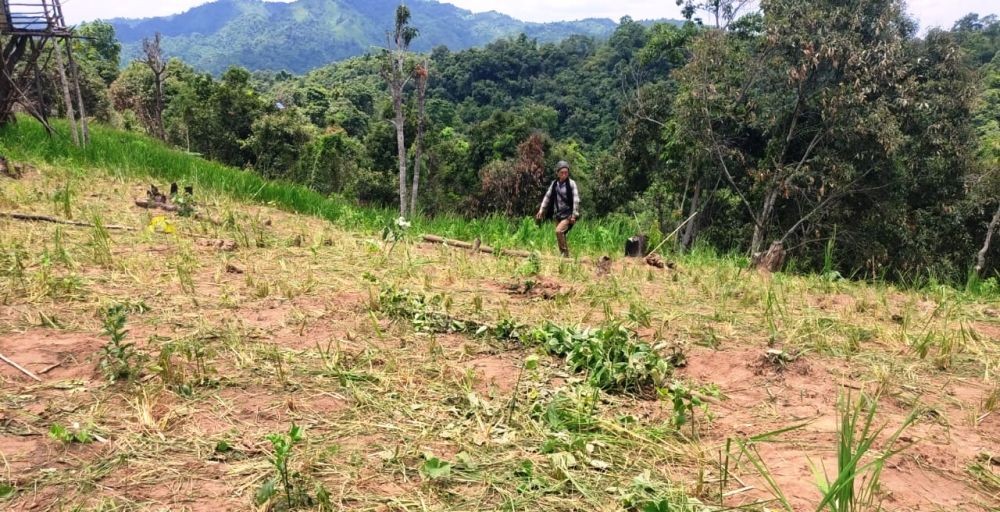
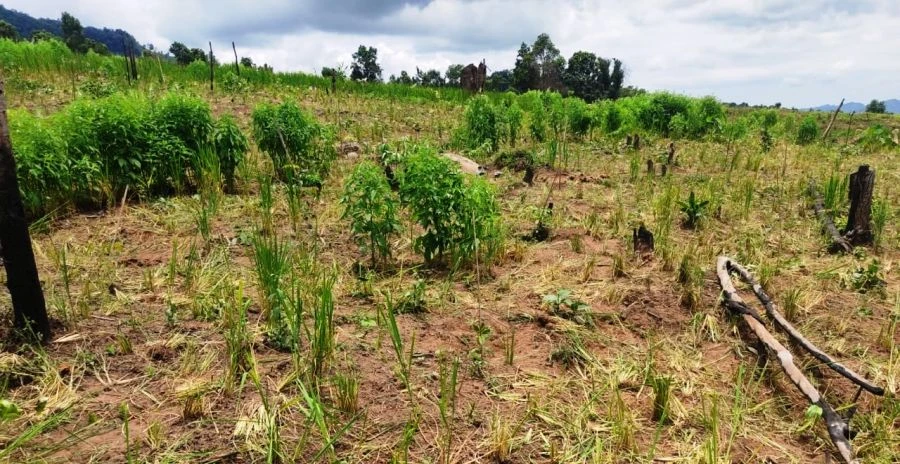
A field in Lakhuti which was damaged by a herd of wild elephants on July 11.
Around 60 Human-Elephant Conflict cases reported in recent months
Morung Express News
Dimapur | July 13
A herd of around four to five wild elephants, including a calf, damaged a newly established rubber plantation and adjoining agricultural fields at Azumra Hayi under Lakhuti village in Wokha district on July 11 morning, affecting the livelihoods of farming families dependent on the site.
According to affected farmer Nongothung Ngullie, a farm hut was destroyed, while rubber saplings and adjoining fields belonging to Chenithung Ngullie and Nongothung Ngullie were damaged. Around 13 households are engaged in rubber farming at the site. No injuries were reported in the incident.
Nongothung said this was not the first incident of elephant intrusion in the area. In May this year, another herd of around eight to nine elephants reportedly entered the area and damaged six to seven agricultural fields.
Former chairman of Lakhuti village, Mhonthung Yanthan, said incidents of Human-Elephant Conflict (HEC) have occurred in the area on several occasions in previous years, including earlier this year. He said such incidents had been regularly reported to the concerned department and officials had also visited the area for inspections.
However, Yanthan said some villagers have become hesitant to immediately report the latest incident due to their past experiences and expectations regarding follow-up support and guidance. While acknowledging the challenges involved in accessing the affected sites, he stressed that farming remains the primary source of income for many families and communities rely on institutional support whenever such incidents occur.
Responding to the concerns, Jongponglemba, Wildlife Warden, Doyang Wildlife Division, confirmed that the department had received information regarding the July 11 incident through the Human-Elephant Conflict (HEC) Control Room in Wokha district and had initiated steps to assess the damage.
“Our staff have already updated us about the incident. I have directed my range officer to contact the affected farmers and collect all necessary information and details. We have constituted teams and instructed our staff to carry out an assessment survey of the damage,” he said.
The Wildlife Warden acknowledged operational challenges faced by the division, stating that many affected farms and fields are located in remote and interior areas with poor road connectivity.
“Most of these farms and fields are situated in far-flung and interior areas where there are no proper roads for access. The Doyang Wildlife Division is also a relatively new division and we lack several resources, including vehicles. We have already submitted vehicle requisitions to the directorate and I have personally highlighted these issues to the head of the department, as we are receiving elephant-related reports almost on a daily basis,” he said.
Regarding the villagers’ concerns on the previous interactions with the department, Jongponglemba expressed regret if any community members had felt dissatisfied with previous interactions and acknowledged that human-elephant conflict remains a sensitive and serious issue. He encouraged affected communities to continue reporting incidents of elephant intrusion and informed that a Human-Elephant Conflict (HEC) Control Room has been operational since April this year, with range officers and field staff available to respond to reports and conduct inspections.
On compensation, he clarified that the financial assistance provided by the department is not intended to fully compensate for losses incurred by farmers but serves as relief support. According to him, compensation is processed based on available funds received under relevant schemes and is directly transferred to beneficiaries’ bank accounts after verification and authentication of claims by village authorities.
The Wildlife Warden further observed that incidents of human-elephant conflict in Wokha district appear to be increasing. According to him, around 60 cases have been reported in recent months, indicating a growing trend of elephant intrusions and crop damage incidents, although some cases may have gone unreported.