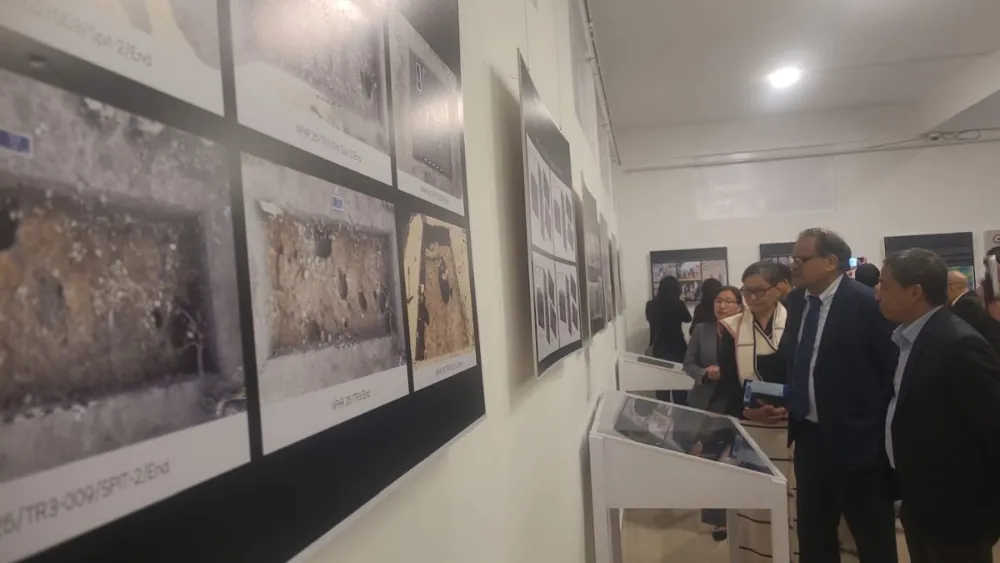
Nagaland University Vice Chancellor Prof Jagadish K Patnaik and others during the launch of the special exhibition “Rediscovering Naga History: The Deep Roots” in Kohima on November 20. (Morung Photo)
Our Correspondent
Kohima | November 20
A special exhibition titled “Rediscovering Naga History: The Deep Roots” was launched at the State Museum, Directorate of Art & Culture, Kohima, on Friday, bringing together archaeology, indigenous knowledge systems and interdisciplinary scholarship to explore the antiquity and historical foundations of Naga society and culture.
According to the Department of Art & Culture, the exhibition highlights the importance of archaeological research in Nagaland in uncovering and interpreting material evidence of the distant past, contributing to a deeper understanding of the region's historical landscape.
The department acknowledged Dr Vikousa Nienu of the University of California, Los Angeles (UCLA), USA, for contributing artefacts from Burakha, which he had excavated in 1980. It also thanked the communities of New Phor and Chipur for their cooperation, hospitality and assistance during the archaeological expedition.
The Pochury Hoho, Phor Social Action Committee, New Phor Village Council in Meluri district and Chipur Village Council in Noklak district were also acknowledged for their institutional support.
It also recognised the research and scientific assistance provided by the Birbal Sahni Institute of Palaeosciences, Lucknow; University of Sydney; La Trobe University, Melbourne; University of York, UK; University of New South Wales Chronos Radiocarbon Laboratory; and Beta Analytic, Miami. The Australian Research Council was also acknowledged for its support through the Discovery Project (DP250I00522).
Patnaik calls for digitisation of oral traditions
Gracing the occasion as the special guest, Nagaland University Vice Chancellor Prof Jagadish K Patnaik said the present time was crucial for reassessing and establishing Naga identity.
He said the Department of History & Archaeology, Nagaland University, had been making efforts to uncover history and called for public support. He emphasised that lost history needed to be discovered and rediscovered through new initiatives and greater efforts.
Patnaik later released a documentary film titled “Burakha: Reading the Land”, based on the excavation at New Phor, Burakha.
An overview of the excavations at New Phor and Chipur villages was presented by Prof Tiatoshi Jamir of the Department of History & Archaeology, Nagaland University, Kohima Campus, Meriema.
New Phor seeks museum to preserve archaeological findings
Speaking at the programme, Chuthitu Thurr, former chairman of New Phor village, recalled that Dr Vikousa Nienu had undertaken the first archaeological excavation at Burakha in the early 1980s, before New Phor village was established.
He said the villagers migrated from Phor to Burakha in 1986 and named the settlement New Phor. The excavation findings reportedly dated human settlement in the area to 50 BC.
Another excavation was conducted in 2008 by the Department of History & Archaeology, Nagaland University, led by Dr Tiatoshi Jamir. Its findings, published in a local newspaper, indicated human settlement dating from 50 BC to 90 AD, he said.
The latest excavations were conducted in two seasons during 2025 and 2026. Thurr said the findings of the first season indicated human settlement dating to the third and second centuries BC, while the results of the second season were awaited.
He said archaeological materials recovered from the sites had been taken to Nagaland University for research and display with the permission of the New Phor Village Council and would be returned after completion of the research and display.
Appealing for the construction of a museum at New Phor, Thurr said a dedicated facility was necessary to preserve the archaeological materials for future generations, research and public display.