SDO (Civil), Chümoukedima, Chumbenthung Murry along with other officials during a District Level Convergence Consultation held at the Deputy Commissioner's Conference Hall, Chümoukedima, on November 20. (DIPR Photo)
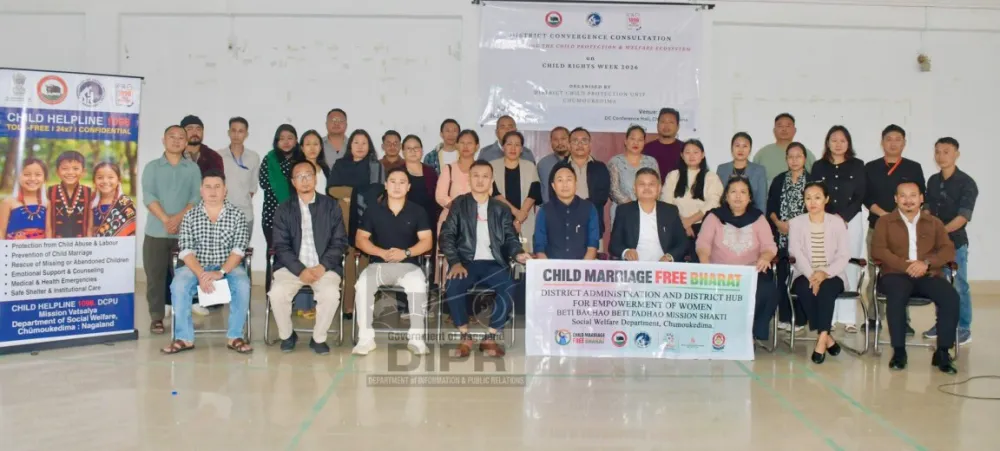
Chümoukedima, November 20 (MExN): More than 200 cases have been registered through the Child Helpline in Chümoukedima since 2024, Project Coordinator, Child Helpline (CHL), Mhaseto Rhakho, informed during a District Level Convergence Consultation on “Strengthening the Child Protection and Welfare Ecosystem” held at the Deputy Commissioner's Conference Hall, Chümoukedima, on November 20.
Organised by the District Child Protection Unit (DCPU), Department of Social Welfare, Chümoukedima, as part of Child Rights Week, the consultation brought together various stakeholders to deliberate on strengthening coordination and improving services for children in need of care and protection.
In his presentation, Rhakho highlighted Child Helpline 1098, a toll-free number through which children in need of care and protection can seek assistance. He outlined the functions of the DCPU and the services, schemes and programmes implemented by the unit, including financial assistance, foster care, legal adoption, children's homes and reintegration services.
He said the DCPU also coordinated with the police through the TrackChild and Khoya-Paya portals to trace missing children and worked with village councils to conduct awareness programmes and child protection surveys.
Delivering the keynote address, SDO (Civil), Chümoukedima, Chumbenthung Murry, said child protection was a collective responsibility and not that of any single department.
Calling for a strong child protection ecosystem, Murry said communities, institutions and departments must work together to ensure that every child in distress received proper care and support.
He urged teachers to remain proactive and ensure timely intervention whenever a child faced difficulties. He also encouraged officials and stakeholders to continue their work with commitment and provide a healthy and supportive environment for children to grow up in.
Murry said child protection should not begin only after a child had suffered harm, adding that vulnerable families must be supported before they reached a crisis through financial assistance, access to education and healthcare, and efforts to prevent child marriage and child labour.
He said the responsibility of stakeholders did not end with rescuing a child or placing them under care. Children must also receive counselling, education, support and a caring environment to help them rebuild their lives.
Observing that the effectiveness of child protection efforts should not be measured by the number of meetings, orders or awareness programmes conducted, he said the real measure was whether vulnerable children felt safe seeking help and whether children at risk received timely protection and support.
He called upon participants to use the consultation to strengthen coordination and build a more humane and compassionate system of care, where every child was supported to grow into a responsible and contributing member of society.
Brief presentations on departmental service delivery were also made by various stakeholders. These included the Special Juvenile Police Unit by T. Wopen Jami, UBSI, CWPO, DPS; Child Welfare Committee by Longme, Member, CWC; Juvenile Justice Board by Athunglo Humtsoe, Member, JJB; and Health and Support Services by Senti Jamir, Block Programme Manager, NHM, Chümoukedima.