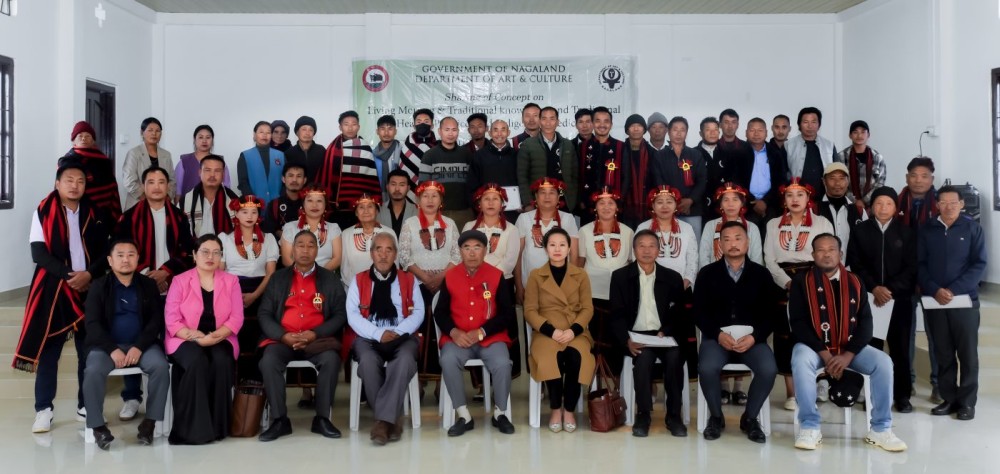
Officials and participants during the programme on ‘Living Morung, Traditional Knowledge, Traditional Healing Practices and Indigenous Medicine’ held at the Cultural Hall, Satoi Town on April 20. (Morung Photo)
Living Morung event at Satoi underscores revival of indigenous knowledge, healing and wisdom
Morung Express News
Zunheboto | April 21
Emphasising the centrality of language in preserving identity, Hokato Zhimo, GB of Ghokhuvi, asserted that “the foundation of culture lies in the mother tongue (Izatsa)” at a one-day programme on ‘Living Morung, Traditional Knowledge, Traditional Healing Practices and Indigenous Medicine’ held at Satoi Town on April 20.
The programme was organised by the Department of Art & Culture, Government of Nagaland as part of the 1st Satoi Connect Fest, with the objective of preserving, documenting, and promoting indigenous knowledge systems and traditional healing practices.
Addressing the gathering as special guest, Zhimo underscored the importance of preserving the wisdom and practices of forefathers, noting that these were once upheld with diligence and responsibility. He expressed concern that the present generation has gradually distanced itself from this heritage and lauded the department for organising the programme.
He urged the younger generation to speak their mother tongue fluently and with pride, and highlighted the role of folk songs in transmitting history, values, and ancestral narratives. Referring to traditional forms such as Lejole, Thighale, Lusale, and Ghushole, he encouraged elders to actively guide and impart this knowledge to the youth.
Zhimo also encouraged young people to learn traditional handicrafts, not only to preserve cultural identity but also as a pathway to self-reliance. Emphasising entrepreneurship, he urged youth to move beyond dependence on government employment and instead build sustainable livelihoods through skill and creativity.
Morung’s significance
In her welcome address, Kuvili Zhimo, ARO, noted that education in earlier times was imparted through oral traditions within the Morung, known among the Sumi community as Apuki for young men and Iliki for young women.
She observed that with the advent of Christianity and modern development, the Morung system has gradually declined, but stressed that progress should not come at the cost of cultural identity and ancestral heritage.
She added that the Morung historically shaped discipline, character, moral values, and social responsibility among the youth, while also serving as a centre for practical learning, including craftsmanship, community defence, and survival skills. While society may not return to earlier times, she emphasised that the values and knowledge of the Morung remain relevant today.
Kuvili further highlighted the need to document and preserve traditional healing practices, noting that earlier generations sustained themselves without modern healthcare systems. She called for such knowledge to be archived for research and encouraged practitioners to share their expertise to ensure continuity.
The programme also featured a folk tale narration by Romeo Aye, who highlighted the significance of Apuki and Iliki, drawing from personal experiences. He explained that children were traditionally initiated into these institutions at a young age, where learning began through storytelling and progressed to physical training and social discipline.
He also described the traditional understanding of time and seasons, noting that the year was divided into four seasons, each comprising three months, while the week was observed from Monday to Sunday (Tughakhani), symbolising a day of rest. He further spoke on the significance of festivals and folk traditions.
The programme began with an invocation by Daniel Pastor of Satoi Town and included traditional folk song presentations and a cultural dance led by Tozheli K Aye.
A technical session on traditional healing practices and indigenous medicine was conducted by resource persons Inahoto V Awomi and Yekato Achumi. Around 20 medicinal plants were showcased, along with demonstrations of their preparation and use. The resource persons noted that over 30 additional medicinal plants exist in the region but could not be presented due to time constraints. An interactive session followed.
The programme concluded with the distribution of certificates and a vote of thanks by Tito (UDA)