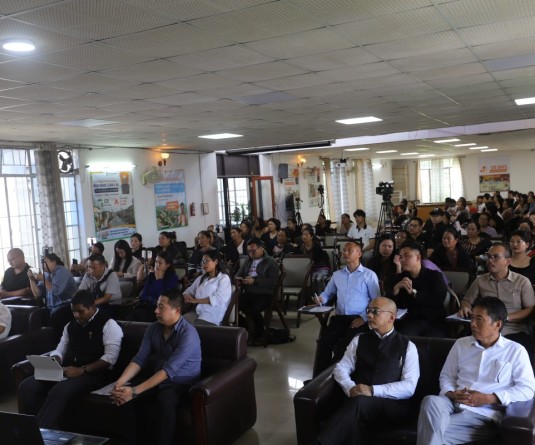
Participants at the International Human Rights Day 2025 organized by the Nagaland State Human Rights Commission at St Joseph University, Chümoukedima on December 10.
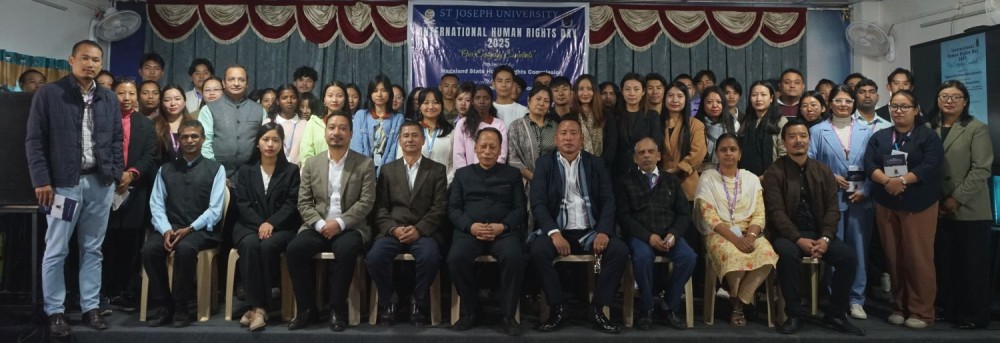
International Human Rights Day observed at SJU
CHÜMOUKEDIMA, DECEMBER 10 (MExN): The Nagaland State Human Rights Commission (NSHRC) on Wednesday observed International Human Rights Day 2025 by organising an awareness programme at St Joseph University (SJU), Chümoukedima, under the theme “Our Everyday Essentials.” The event sought to familiarise students with the fundamental principles and legal framework underpinning human rights protections.
The programme opened with a welcome address by Pemei Konyak, Junior Secretariat Officer, NSHRC.
In the first address, NSHRC Member R. Nazanbemo Lotha spoke on the “Protection of Human Rights Act,” noting that the NSHRC is the youngest such commission in the country, having been constituted two years ago. He urged students to deepen their understanding of the aims and objectives of the Protection of Human Rights Act, 1993.
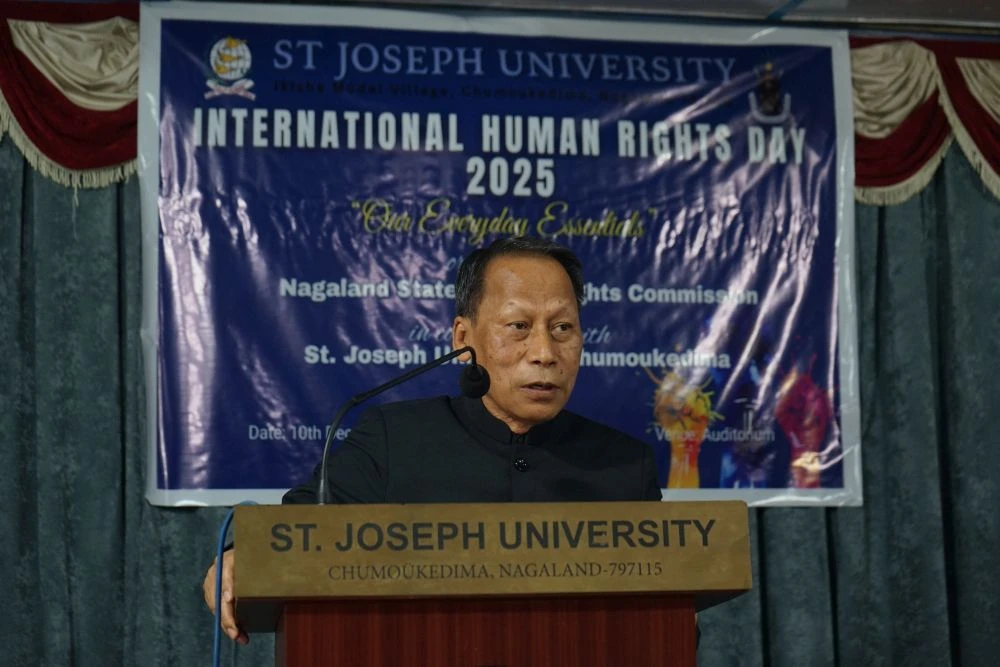
Emphasising that the Act seeks to safeguard the life and dignity of every individual, he highlighted the importance of human rights awareness initiatives. Lotha also clarified that the Act empowers state commissions to take suo motu cognisance of human rights violations, a power not extended to the armed forces or private individuals.
Delivering the second address on “The Importance of Protecting and Promoting Human Rights in Today’s Context,” NSHRC Chairman Justice Songkhupchung Serto traced the emergence of human rights as a global concern to the aftermath of the Second World War, which led to the adoption of the Universal Declaration of Human Rights (UDHR) in 1948. He said the UDHR’s 30 articles, centred on dignity, equality, justice and peace, were framed to prevent war and uphold freedom for all.
Stressing the contemporary relevance of human rights protections, he noted that conflicts often arise from greed and discrimination. Justice Serto underlined that human rights ensure inherent dignity, equality and the prevention of abuse of power, forming the basis for peace and development. “There is no peace if there is no development, and without peace, development cannot exist,” he said. Citing Matthew 7:12, he added that the principle of doing unto others as one would have them do unto oneself reflects the essence of human rights.
The proceedings were anchored by Dr Limongi, Assistant Professor, Department of Political Science, SJU, and concluded with a vote of thanks by Prof Charles Mhonthung Ezung, Dean of Student Affairs, SJU.