

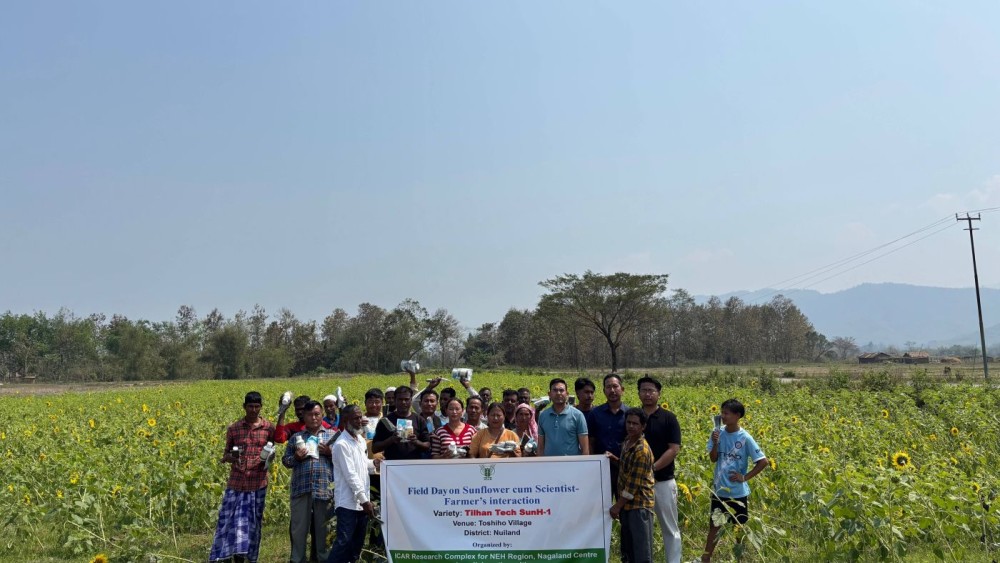
Dimapur, March 27 (MExN): The ICAR Research Complex for NEH Region, Nagaland Centre, Medziphema, organised a Farmer Field Day on sunflower along with a scientist–farmer interaction programme on March 25 under the aegis of the ICAR-Indian Institute of Oilseeds Research.
The programme began with remarks from the Head of Research Centre, who spoke on the current scenario and potential of oilseed cultivation in Nagaland. He noted that despite favourable agro-climatic conditions, oilseed production in the state remains limited, leading to dependence on external sources. Stressing the need for self-sufficiency, he encouraged farmers to adopt improved oilseed varieties and make effective use of rice fallow lands to improve productivity, nutritional security and income.
The field day was held at Toshiho Village under Nuiland district, where farmers observed improved oilseed cultivation practices in the field. The initiative aimed to promote oilseed cultivation and motivate farmers to utilise rice fallow lands to enhance cropping intensity and strengthen livelihoods.
During the technical session, Dr Harendra Verma, Scientist at ICAR Nagaland Centre, highlighted the importance of the sunflower variety “Tilhan Tec SunH-1” as a high-value oilseed crop with strong market demand and adaptability to post-rice cultivation systems. He stated, “Tilhan Tec SunH-1 is a high-value oilseed crop with strong market demand and excellent adaptability to post-rice cultivation systems,” and urged farmers to adopt sunflower cultivation immediately after rice harvest instead of leaving fields fallow. He added that such practices can “significantly enhance land use efficiency and farm income.”
He also explained key aspects of sunflower seed production technology, including optimal sowing time, scientific crop management practices, and the economic advantages of integrating sunflower into rice-based cropping systems.
Dr Moatoshi Jamir from the Plant Breeding and Genetics division encouraged farmers to expand oilseed cultivation in rice fallows. He said improved varieties like “Tilhan Tec SunH-1” have strong productivity potential and also highlighted linseed as an additional income-generating crop. He further discussed nutrient management strategies and improved cultivation practices to promote diversified and sustainable oilseed farming in the region.
Altogether, 20 farmers participated in the programme, interacting with scientists and expressing interest in adopting sunflower and linseed cultivation. Agricultural inputs, including biofertilisers, bio-insecticides and fungicides, were distributed to support sustainable crop production practices.
