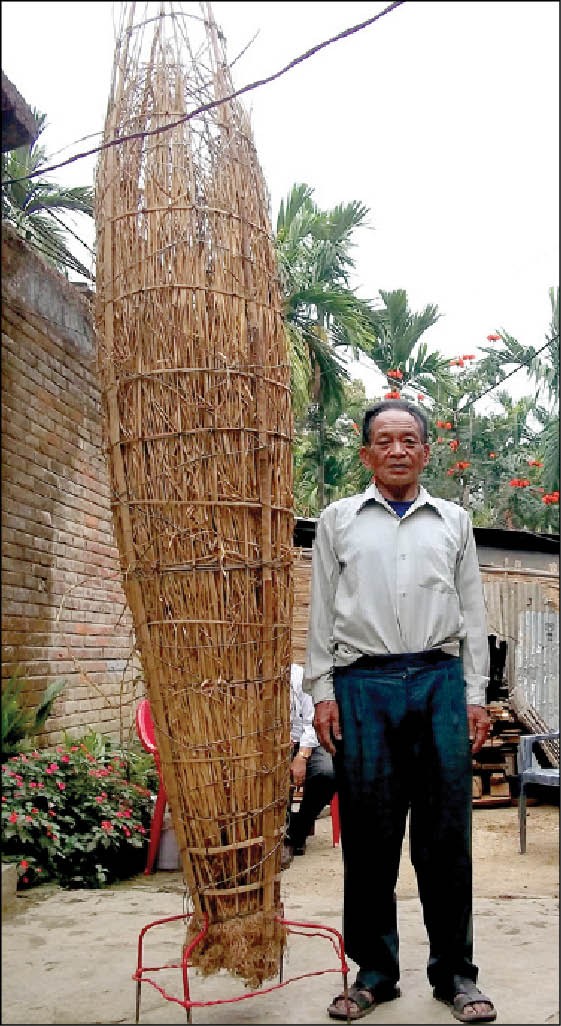
Melhite Kenye standing alongside a preserved and dried giant rice plant, an offspring of the “tallest paddy plant in the world” he discovered in 1998. The rice plant measures 9 feet.
Ashikho Pfuzhe
Dimapur | March 25
In the sunset of his years, 90-year-old Melhite Kenye’s eyes still light up when he recalls the events leading to the discovery of the tallest paddy plant in the world 14 years ago.
“At first I was confused, then I realized that this was the ‘manna’ I dreamt of,” said Melhite, a preacher who retired this year after serving as pastor in local churches for 40 years.
On October 1, 1998, while roaming the jungles of the foothill town of Chumukedima, Melhite (then serving as pastor of Chumukedima Town Baptist Church) saw a rice plant roughly 3 feet tall swaying in the autumn breeze. Struck by the singularity of the plant, he took his wife and some friends to show them the plant.
“But when I took them to the spot and pointed out the plant, they were confused as they could not see any rice plant and we went home. After two months, I again took them to the site and pointed to the rice plant which had grown into a giant plant by then, towering over us by at least 3 feet and weighed down with grains. Still, they were not able to see,” he said.
It was only in the first week of December when Melhite went alone and uprooted the giant plant intact with the ripe grains and brought it home that his wife and relatives were able to see the miracle rice plant, which he refer to as ‘manna.’
On plausible explanation why his wife and others could not see the paddy plant in the jungle, the preacher said, “God works in strange ways. Maybe He closed the vision of the rice plant to others. Whatever, I know that He is the true living God as He has fulfilled a vision I had many, many years ago.”
Melhite’s tryst with his ‘manna’ plant began long before he migrated to Dimapur when he was still in his native Chizama in Phek district. “Just before I migrated to Dimapur in 1968, I use to get a recurring vision wherein a voice said that when I move down to Dimapur I would ‘get riches’ and that the ‘world’s big bird’ awaits me. I didn’t know what it was then. It was after a long wait of 30 years when I discovered the giant rice plant that I came to realize the meaning of my vision,” he said.
News of the giant rice plant spread and soon Melhite’s house became a pilgrimage site for agriculturists, and curious visitors eager to see the wonder plant, which he had preserved.
On December 12, 2001, Guinness World Records certified “The tallest paddy plant (Oryzopsis) was discovered by pastor Melhite Kenye (India) on 1 October 1998 in Chumukedima town, Nagaland State, India. It measured 2.6 m (8 ½ feet), had 175 stalks and 510 grains in each ear.”
Among other awards, Melhite also received the Governor’s Gold Medal 2002 and the paddy he discovered is now called “Melhite paddy.”
In 2003, to make sure that the giant rice plant was not a freak of nature, Melhite sowed the grains taken from the original plant and planted them in his compound. The experiment produced similar results with the new paddy plants measuring 9 feet, having 240 stalks and 460 grains in each ear with each plant yielding 1.18 kg grains average.
Melhite said the special paddy can be sown in two seasons: the grains sown in March will produce giant rice plants like the one he discovered while the grains sown in June will a little taller than rice plants of other varieties. Both are harvested in November. He also said the rice tastes “good” with no aroma like basmati rice.
After being relieved of pastoral duties, Melhite and his wife Kwewetsou Kenye who have just shifted to their new house plan to take up cultivation of the special rice on a larger scale. “This year, we could not cultivate the giant paddy because of shifting of our home, but I will never cease to cultivate this special gift of God as long as I am alive,” said Melhite whose tryst with the miracle rice plant is detailed in a book titled “Naga paddy man to the world” authored by Oken Jeet Sandham.
Fame has not changed the lives of this ordinary God-fearing couple and they still struggle to eke an honest living. They also had their fair share of detractors belittling the “discovery.” One man the nonagenarian always keeps referring to is Dr. Shurhozelie Liezietsu, Nagaland minister for Urban Development and veteran regionalist. “He has helped us in many ways including publication of my book. He is a straight man and he knows an honest working man,” the retired pastor said.