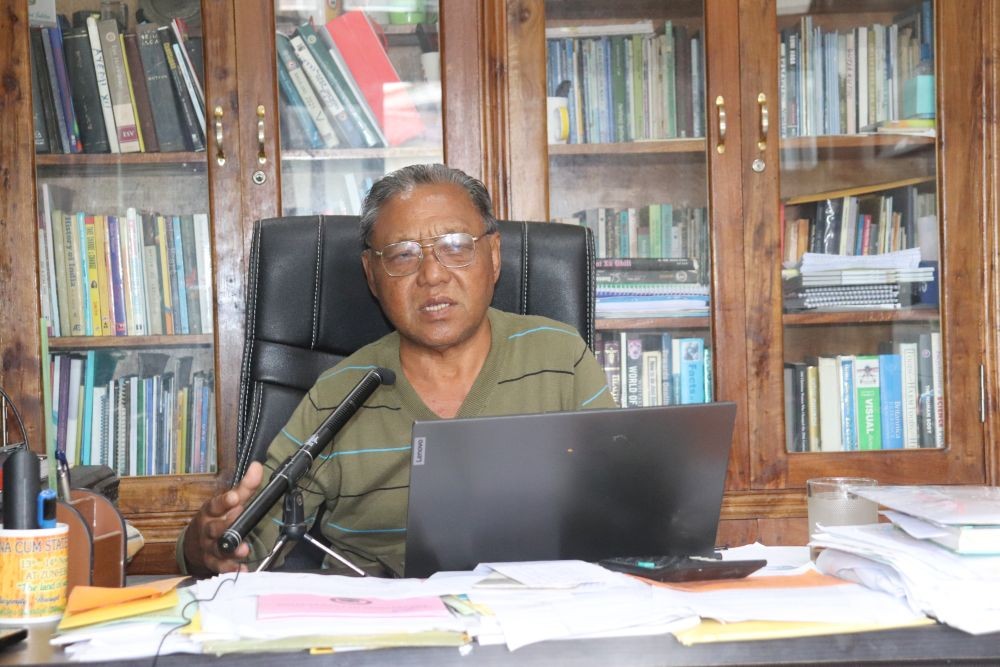
Sumi Literature Board Chairman Y Vihoshe Muru explains the cultural significance and enduring traditions of Tuluni during an interview with The Morung Express in Zunheboto on July 7. (Morung Photo)
Morung Express News
Zunheboto | July 7
Beyond the feasts and festivities for which Tuluni is best known lies a deeper cultural significance rooted in the Sumi way of life.
The festival reflects the Sumi people's history, agrarian heritage, customary practices and enduring community values passed down through generations, Sumi Literature Board (SLB) Chairman Y Vihoshe Muru said in an exclusive interview with The Morung Express.
According to him, Tuluni and Ahuna are the Sumi community's two principal festivals, with Tuluni traditionally regarded as the more significant, although Ahuna has gained wider prominence in recent decades.
"Tuluni is supposed to be more important than Ahuna. However, because it falls during the midsummer season when rainfall is frequent, outdoor celebrations are often affected. Gradually, many people began paying more attention to Ahuna, which is celebrated during better weather," he said.
Muru said Tuluni is rooted in the Sumi community's agrarian heritage, when agriculture formed the foundation of traditional society. It is observed after paddy transplantation, as crops in both wet paddy fields and jhum cultivation begin to yield their first produce.
"The main purpose of celebrating Tuluni is to seek God's blessings for a good crop and a bountiful harvest. It is essentially a thanksgiving festival connected with our agricultural life," he said.
The festival also marks a pause in agricultural work, allowing families and villages to gather for communal feasts and traditional activities. It serves as an important occasion for preserving Sumi customs, language and oral traditions.
"It is during Tuluni that our folk songs are sung, our traditional dances are performed and stories passed down by our forefathers are shared. These traditions continue to remind us of who we are as a people."
Historical legacy
Tracing the festival's history, Muru said every Sumi village was once autonomous, governed by its own customary laws, resulting in Tuluni being celebrated on different dates.
"Every Sumi village was autonomous," he said, noting that neighbouring Natha New and Natha Old villages continue to follow different customary rules.
This changed in the 1960s when the Sema Tribal Council (STC) resolved that all Sumi villages would celebrate Tuluni on July 7 and 8.
"The Sema Tribal Council decided that all Sumis should celebrate Tuluni on July 7 and 8 every year. The Government of Nagaland later recognised these dates by declaring restricted holidays, and the first common celebration began in 1972," Muru said.
He added that although some villages traditionally called the festival "Ani", the STC officially adopted the name Tuluni.
Customary rituals
Muru said Tuluni is traditionally observed over seven days, with each day marked by distinct rituals and customary practices.
The first day, Monday (Asu Zani), begins with the preparation of millet for brewing traditional beverages. Since millet is among the earliest crops to be harvested, it signifies the start of the festival preparations.
The second day, Tuesday (Aghi Zani), is dedicated to preparing rice for brewing traditional rice beer. On the third day, Wednesday (Ashi Gheni), families slaughter livestock such as pigs or cattle according to their means. The meat is shared equally among members of agricultural working groups known as Aloji, while the animal's head is presented to the Alojitou, the leader of the group.
Muru explained that the Aloji system was central to traditional Sumi agriculture, with members working collectively to cultivate one another's fields throughout the farming season.
The fourth day, Thursday (Ani Gheni), is regarded as the principal day of Tuluni. "This is the day when people gather for feasting, traditional games, folk songs and dances. The entire village comes together in celebration," Muru said. Indigenous games and competitions are organised among different groups, while food and locally brewed rice and millet beverages are shared throughout the day.
The fifth day, Friday (Mucholani), is observed by married villagers, who clean the pathways leading to their fields before sharing a communal meal. According to tradition, any leftover food is left behind rather than taken home.
The sixth day, Saturday (Tupu Lani), is reserved mainly for the youth, who spend the day visiting different parts of the village and celebrating together.
The seventh and final day, Sunday (Tughakani), is observed in complete silence.
"There should be no pounding of rice, no splitting of firewood and even unnecessary noise is avoided. Our forefathers believed that remaining quiet on the final day would keep away evil spirits," Muru explained.
According to Muru, Tuluni has long strengthened family and social ties. Traditionally, engagements were formalised during the festival through exchanges of meat, rice and traditional brews between families.
"Once the engagement ceremony was completed during Tuluni, both families recognised the relationship and marriage was expected to follow," he said.
Sharing uncooked meat with relatives, neighbours and friends remains another enduring custom.
"Even if it is only a small portion, meat should be shared. It is a way of maintaining family ties and friendship within the community," Muru said.
Newly married couples also visit their parents and parents-in-law with cooked food and traditional brews, receiving blessings and gifts in return. Muru also highlighted the custom of honouring Angakupmi babysitters, who were once presented with gifts such as chickens and specially prepared portions of meat for caring for children while parents worked in the fields.
"This custom reflects how every contribution to community life was valued in our traditional society," he said.
While some practices have evolved over time, Muru said Tuluni continues to preserve Sumi identity and urged younger generations to understand the meaning behind its customs.
"Tuluni is part of our history and our identity. Every custom has a purpose, and by understanding these traditions we continue to preserve the values and heritage of the Sumi people," he said.