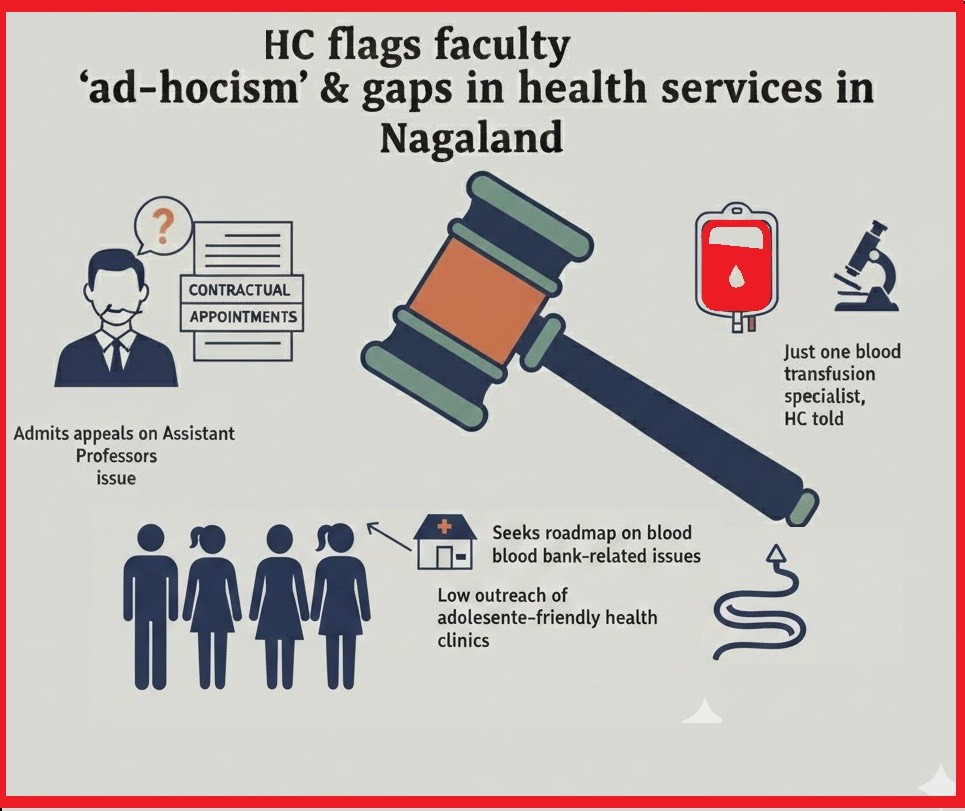
• Admits appeals on Assistant Professors issue
• Just one blood transfusion specialist, HC told
Morung Express News
Kohima | December 7
The Gauhati High Court, Kohima Bench, has flagged the State’s decade-long practice of faculty ‘ad-hocism’ and the acute shortage of blood transfusion specialists in Nagaland, raising concerns over higher education recruitment practices as well as gaps in critical health services.
On December 5, a Division Bench of Chief Justice Ashutosh Kumar and Justice Arun Dev Choudhury took up two appeals filed by NET-qualified aspirants challenging the Single Judge’s November 12 dismissal of petitions related to the engagement of contractual Assistant Professors.
The Bench observed that the prolonged “ad-hocism” in faculty appointments indicated a persistent need for sanctioned posts that should have been opened to the public through due process.
During the proceedings, it expressed concern over the State Government’s explanation that the private respondents (contractual Assistant Professors) had been serving for several years against non-sanctioned posts.
Such a justification, it held, “does not augur well for the sound administration of a State.”
If the Government had continuously relied on contractual teachers for nearly a decade, the Bench noted, it presupposes that there is a need for such posts, which ought to be created, sanctioned, and thereafter opened for appointment to eligible persons at large.
“Not doing so displays an apathetic attitude of the State Government,” it stated.
The appeals arise from a batch of writ petitions in which NET-qualified aspirants challenged the appointments of contractual Assistant Professors, alleging “backdoor entry” without public advertisement.
The Single Judge had dismissed the petitions on grounds of maintainability and lack of locus standi, holding that several petitioners were not qualified when the contested appointments were made.
Meanwhile, on December 5, the Bench also noted the Single Judge’s advisory to the State Government to discontinue its persistent reliance on ad hoc and fixed-pay faculty appointments, create sanctioned teaching posts, and fill them through a transparent recruitment process.
Recording that such ad-hocism has continued for a decade, the Bench held that “the issue requires determination” and accordingly issued notices.
The Government Advocate, who accepted notice on behalf of the State respondents, was directed to respond to the Memo of Appeal by the next date of hearing on December 10. Notices to private respondents will also be addressed on the next date.
Seeks roadmap on blood bank–related issues
Separately, on December 4, the Bench was informed that Nagaland currently has only one blood transfusion specialist and accordingly it directed the Health Department to file a detailed roadmap for strengthening blood storage and transfusion services across the State.
Hearing a Public Interest Litigation (PIL) concerning blood storage infrastructure, the Bench was informed that seven Blood Storage Centres have been established across seven of Nagaland’s 17 districts.
The Health Department’s counsel further submitted orally that the “total blood supply requirement in the State of Nagaland matches the requirement of 20,000 units per annum” and efforts are on to establish of at least one Blood Storage Centre in one hospital in each district.
The Bench observed, however, that expanding Blood Storage Centres alone would not improve healthcare delivery unless the State addresses the severe shortage of qualified specialists.
With only one blood transfusion specialist currently available, the Court sought clarity on how emergency situations requiring transfusion services are being managed.
The Court further stated that no permission would be granted for opening additional Blood Storage Centres unless the State provides reliable data on annual blood consumption and ensures adequate specialist support.
Accordingly, the Health Department was directed to file a comprehensive affidavit.
Low outreach of adolescent-friendly health clinics
In another PIL concerning the implementation of Adolescent-Friendly Health Clinics under the RKSK scheme, the Bench noted significant gaps in coverage and outreach.
According to an affidavit filed by the State, such clinics have been established in only 12 of Nagaland’s 17 districts, with no information available for the five newly created districts.
The Bench also expressed concern over the low number of adolescents registered under the clinics, noting that across 12 districts with 37 clinics, only about 14,000 adolescents have enrolled, of whom around 12,000 have received counselling.
The figures are disproportionately low compared to Nagaland’s adolescent population of approximately five lakh, it held.
The modest enrolment could suggest that public outreach and awareness regarding the scheme may be inadequate, the Bench observed, seeking clarity on whether outreach activities include schools, whether girl students are involved, and whether sanitary napkin dispensers have been installed in schools as part of menstrual hygiene initiatives.
The State’s counsel submitted that efforts are underway to improve information dissemination while clinics have recently been set up in some of the new districts.
The Bench directed the Health Department to file a composite affidavit addressing all issues. Both PILs have been listed for further hearing on January 28, 2026.