Our Correspondent
Kohima | December 13
Nagaland Power and Parliamentary Affairs Minister, KG Kenye on Saturday assured the Gorkha community that the state government is committed to finding a “permanent and just policy framework” to address their long-standing concerns, including the question of status and opportunities, while maintaining the rights of indigenous Nagas.
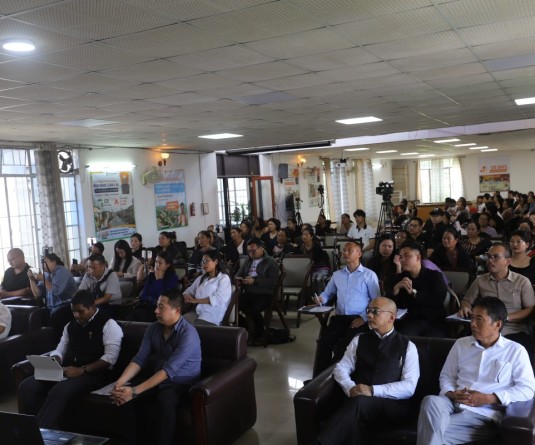
Addressing the Gorkha Students’ Union Kohima (GSUK) Platinum Jubilee celebration at the GPPK Multi Utility Hall in Chandmari, Kohima as the special guest, Kenye acknowledged the deep historical association of the Gorkha community with Kohima and Nagaland. He said recent debates on indigeneity had created anxiety but would be addressed in a “mature and balanced manner.”
The Minister stated that indigeneity, as understood globally, is linked to ancestral roots in a particular territory and cannot be altered by policy alone. However, he stressed that communities like the Gorkhas, who have lived alongside Nagas for generations and contributed significantly to the state, deserve institutional safeguards and recognition.
He indicated that placing such communities under appropriate categories, including Other Backward Classes (OBC), had already been explored by the government, though the process was temporarily slowed due to broader policy reviews. He expressed confidence that these issues would be resolved in a permanent and structured manner.
Kenye also spoke at length on the shared values between Nagas and Gorkhas, highlighting qualities such as honesty, discipline, loyalty and courage, which he said were increasingly rare in modern society. He urged students to uphold these virtues, focus on education, live simply and prepare themselves to become responsible leaders.
MLA of Kohima Town, Dr Tseilhoutuo Rhutso, the guest of honour, strongly pitched for national-level recognition of Gorkhas as OBCs to ensure access to central opportunities without disturbing Nagaland’s reservation framework.
He said that while the state’s reservation system protects Scheduled Tribes, recognition under OBC at the national level would enable Gorkha youths to compete in central services and examinations.
Rhutso noted that he had raised Gorkha-related issues in the Nagaland Legislative Assembly during the recent session, underlining his role as a representative of all communities in his constituency.
He explained that while the term “indigenous” may be restricted to Nagas by blood, the government could still recognize Gorkhas as permanent residents, a status that should come with concrete support mechanisms.
He appealed to the cabinet to recommend the inclusion of the Gorkha community under the OBC category at the All India level, stating that this would not affect tribal reservations in Nagaland.
On the same issue, Nagaland Gorkha Association President, Nobin Pradhan said the Gorkha community accepted the government’s decision to reserve the term exclusively for Nagas, but expressed hope that justice would be ensured for Gorkhas who had settled in Nagaland prior to statehood.
He also informed that recent interactions with the Naga Students’ Federation and the Inner Line Permit regulation authorities had been positive and reassuring.
Emphasising that Kohima is home for the Gorkhas, Pradhan said the community was not seeking special privileges but only continued love, acceptance and fair treatment.