Officials and participants during the national seminar on “Integrating Indian Knowledge Systems (IKS) in Teacher Education: Opportunities and Challenges in North East India” held at NU on March 18
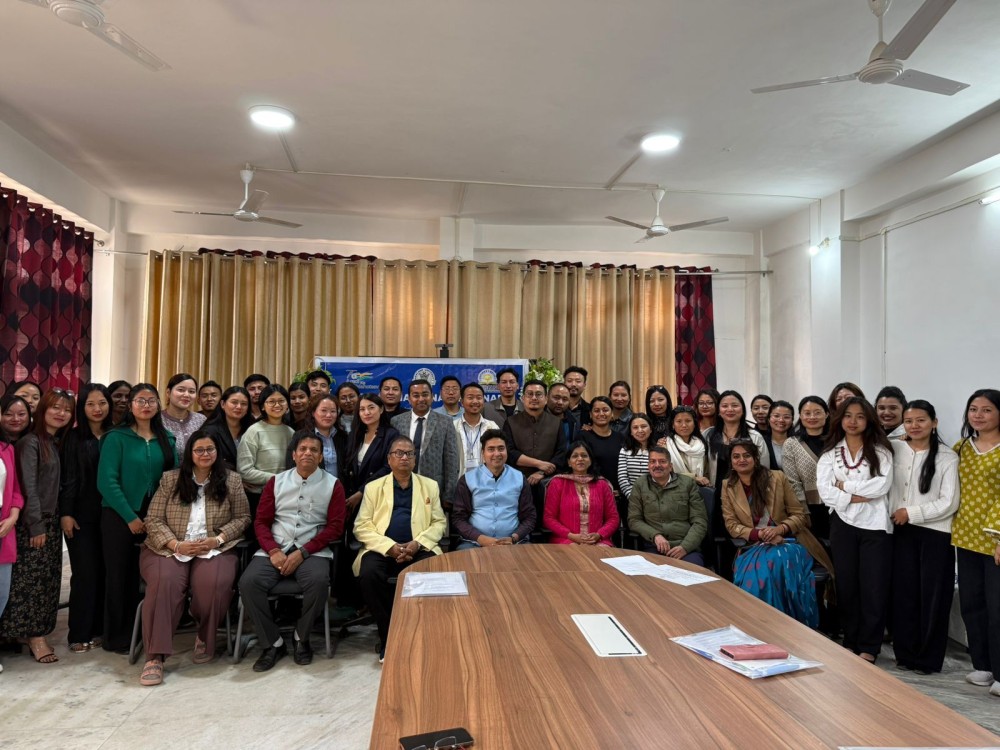
Lumami, March 23 (MExN): A two-day national seminar on “Integrating Indian Knowledge Systems (IKS) in Teacher Education: Opportunities and Challenges in North East India” concluded at Nagaland University (NU) on March 18, with deliberations focusing on blending indigenous knowledge with modern pedagogy.
The seminar, held from March 17–18, began with an inaugural session chaired by Dr Neha Rawat, Co-Convener. Prof Jano S Liegise delivered the welcome address, highlighting the role of IKS in contextual and inclusive teacher education. Prof P K Pattnaik presented the background note, stating that 80 papers (60 offline, 20 online) were submitted.
Keynote speaker Prof Prasanta Kumar Acharya spoke on IKS in the National Education Policy 2020, advocating documentation, contextual pedagogy and curricular reforms. Pro Vice-Chancellor Prof N Venuh addressed regional challenges and preservation of traditions, while Vice-Chancellor Prof Jagadish K Patnaik emphasised civilisational values and integration of IKS with technology. Prof Gyanendra Nath Tiwari delivered the vote of thanks.
In a lecture session, Prof Lungsang Zeliang highlighted stakeholder roles in IKS integration under NEP 2020, citing initiatives like NEIKS and calling for collaboration among policymakers, educators and institutions such as UGC, NCERT and NAAC.
Parallel technical sessions covered themes including institutional partnerships, digital pedagogy, culturally responsive teaching, indigenous language preservation, cultural identity, traditional crafts, Pancha Kosha, AI integration and interdisciplinary approaches.
On Day Two, sessions chaired by Dr Neha Rawat featured lectures by Prof Gyanendra Nath Tiwari on tribal knowledge documentation and ecological wisdom, and by Dr Sushil Kumar Singh on challenges of marginalisation and the role of teacher education in bridging traditional and modern knowledge systems.
Subsequent technical sessions addressed ethnomathematics, sustainability, digital competency, traditional medicine, community-based learning, digital storytelling, linguistic diversity and alignment with NCF-2023.
The valedictory session included remarks by Dr Sushil Kumar Singh, a welcome by Prof Gyanendra Nath Tiwari, and an address by Chief Guest Prof Nigamananda Das on cultural revival. Dr Neha Rawat presented the seminar report, followed by certificate distribution and a vote of thanks by Prof P K Pattnaik.
A total of 53 out of 55 papers were presented by participants from across the country, including UG, PG and PhD scholars. The research, largely focused on the Northeast region, particularly Nagaland, marked the seminar as a significant step in advancing Indian Knowledge Systems in education.