A visual summary of workforce activity and the social security coverage gap in Nagaland based on ‘Survey Report on Employment, Unemployment, Skill and Migration in Nagaland 2025,’ Directorate of Economics & Statistics, Nagaland. (Visualisations with input from Google Gemini)
.jpg)
• Most workers lack pensions, healthcare and gratuity
• Roughly two in three workers lack job contracts
Moa Jamir
Dimapur | January 4
Alongside high unemployment, employment in Nagaland remains deeply insecure, with nearly half of those employed ineligible for social security benefits, an official survey report has revealed.
Further, roughly two in three workers lack written job contracts, pointing to the largely informal nature of employment in the state.
These are among the many facets of workers’ conditions reflected in the 'Survey Report on Employment, Unemployment, Skill and Migration in Nagaland 2025,' conducted by the Directorate of Economics and Statistics (DES), Government of Nagaland. The report was officially released in September 2025 and was made widely available in the public domain recently through the department’s website.
Employment picture
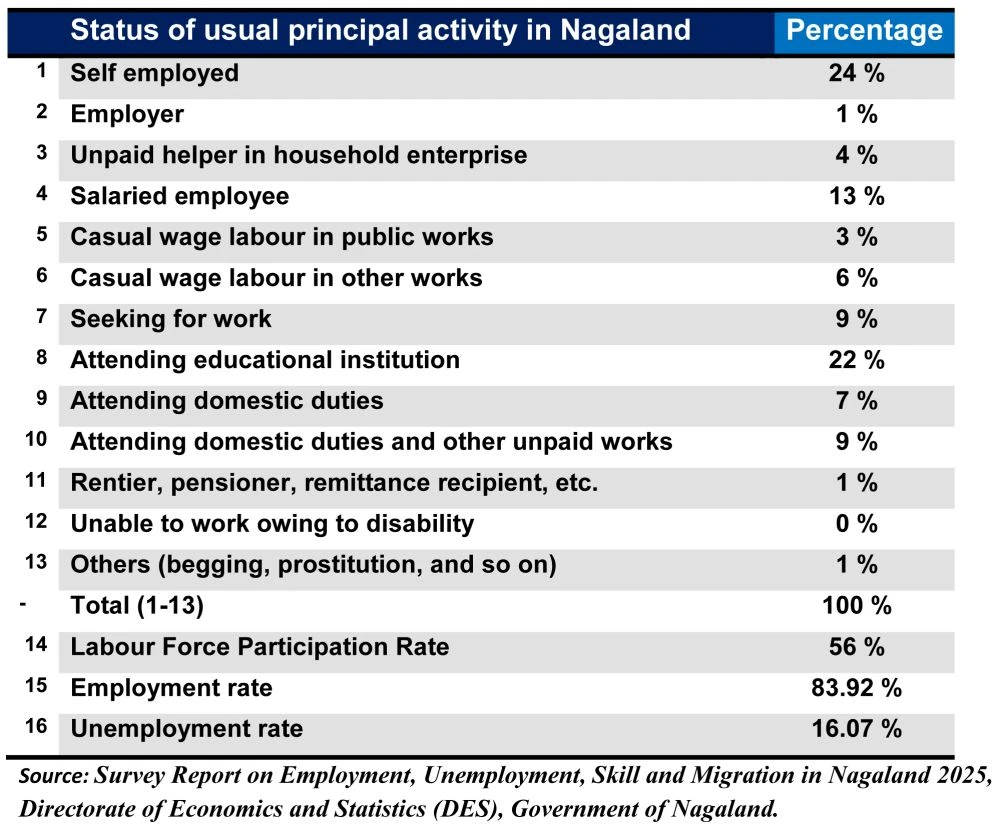
The survey estimated Nagaland’s employment rate at 83.92 per cent, while the unemployment rate stood at 16.07 per cent, reflecting the high unemployment levels reported in national surveys such as the Periodic Labour Force Survey (PLFS).
The Labour Force Participation Rate (LFPR) stood at 56 per cent.
Based on usual principal activity—defined as the activity on which a respondent spent a relatively long time during the 365 days preceding the survey—only 13 per cent of those surveyed were found to be salaried employees in the public and private sectors.
A total of 24 per cent were self-employed, while casual wage labour in public works and other works stood at 3 per cent and 6 per cent, respectively.
Other forms of activity included unpaid helpers in household enterprises (4 per cent) and those attending domestic duties and other unpaid work (9 per cent).
At the other end of the spectrum, just 1 per cent of respondents were employers, while rentiers, pensioners and remittance recipients also accounted for 1 per cent.
Further, 22 per cent were attending educational institutions and 9 per cent were seeking work.
Meanwhile, 35 per cent of respondents in Nagaland without jobs have been unemployed for more than three years, an issue that will be examined in a subsequent report.
Workers without protection
However, the DES survey indicated that even among those who are employed, a significant section remains highly exposed due to limited access to social security benefits.
The survey defines social security benefits to include access to pensions and provident funds, gratuity, healthcare benefits, or combinations of these. While the report does not explicitly distinguish between coverage for workers and their dependants, the benefits are assessed in relation to employed persons and are generally understood to apply to workers.
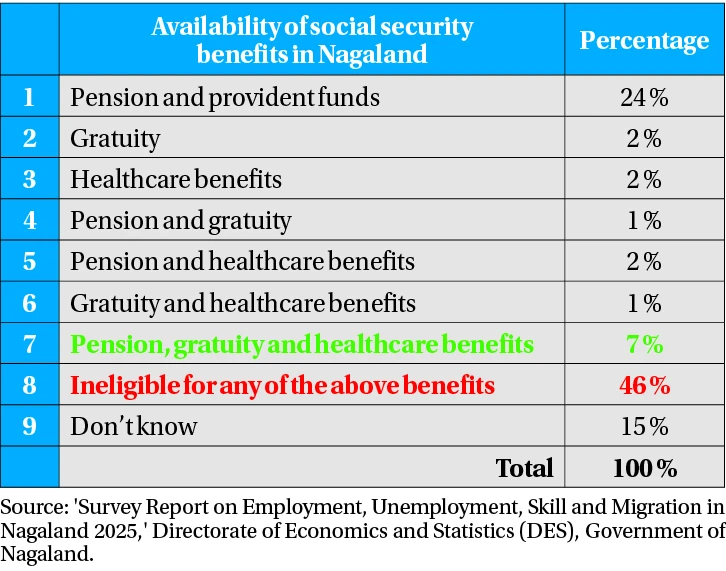
As per the survey, only 7 per cent of workers had access to a full combination of pension, gratuity and healthcare benefits.
A total of 24 per cent were covered by pension and provident funds, while access to gratuity alone and healthcare benefits alone stood at 2 per cent each. Those with a combination of gratuity and healthcare benefits accounted for just 1 per cent.
Most concerningly, 46 per cent of respondents were designated as ineligible for any of the social security benefits listed in the report.
The responses may also reflect gaps in awareness or enrolment, particularly in the context of flagship schemes such as the Chief Minister Health Insurance Scheme (CMHIS), which are available to indigenous residents.
Notably, 15 per cent of respondents said they did not know whether they were covered by any social security scheme, further reinforcing such conclusion.
Overall, the figures suggest that most workers in Nagaland remain exposed to financial risk in the event of illness, injury, job loss or old age.
Insecure terms of employment
The precariousness of employment in Nagaland becomes more evident when job contract arrangements and eligibility for paid leave are examined.
As per the report, 55 per cent of employed respondents stated that they are not entitled to paid leave, while only 45 per cent reported being eligible. This reflects limited workplace protections even among those who are employed.
Patterns in job contracts further reinforce this precariousness. Nearly two-thirds of workers (65 per cent) reported having no written job contract, underscoring the dominance of informal employment arrangements.
Only 32 per cent had written contracts extending beyond three years, while short-term contractual security remained rare, with 2 per cent reporting contracts of less than one year and 1 per cent contracts lasting between one and three years.
Taken together, the lack of written contracts and limited access to paid leave point to widespread employment precariousness, raising concerns about income stability, worker protection and long-term security in Nagaland’s labour market.
About the survey
As per the DES, the field survey for ‘Survey Report on Employment, Unemployment, Skill and Migration in Nagaland 2025’ was carried out between February and March 2025 across 11 districts, using a multi-stage stratified rural–urban sampling design.
A total of 1,315 households were surveyed from 60 urban wards, while 3,080 households were surveyed from 140 rural villages. Altogether, the statewide sample comprised 4,395 households.
Accordingly, the reported data pertains to 2025. Employment status was assessed using the usual principal activity approach, based on the activity on which a person spent a relatively longer duration during the 365 days preceding the date of the survey.
This is Part I of a series on the findings of the 'Survey Report on Employment, Unemployment, Skill and Migration in Nagaland 2025.'
Read Part II & III here:
- 98% literate, 92% lack technical skills: Nagaland’s education paradox
- Districts diverge on employment, but insecurity cuts across Nagaland