Moa Jamir
Dimapur | January 6
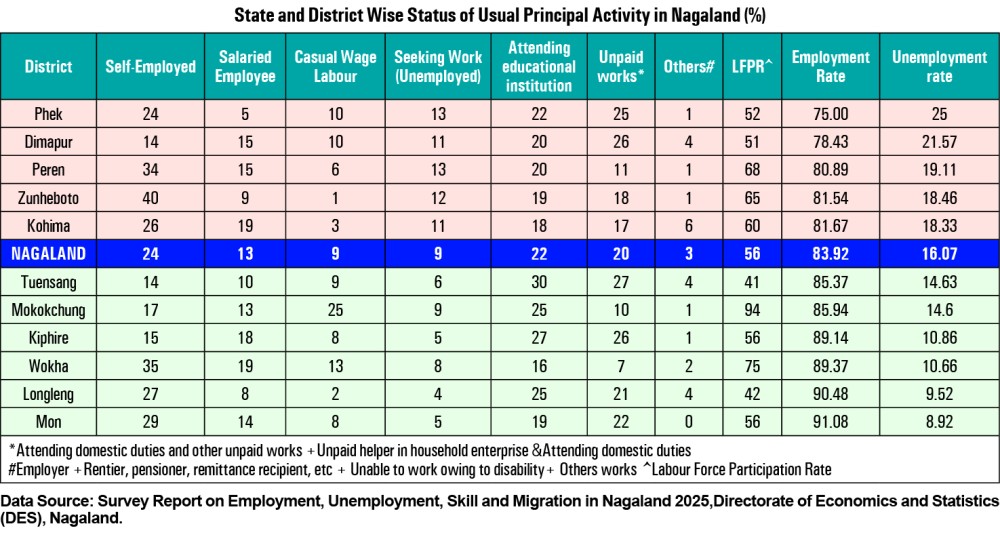
District-wise data from the Survey Report on Employment, Unemployment, Skill and Migration in Nagaland 2025 has highlighted that while labour force participation and employment levels vary widely across Nagaland, employment insecurity remains a common thread across most districts, irrespective of whether participation rates are high or low.
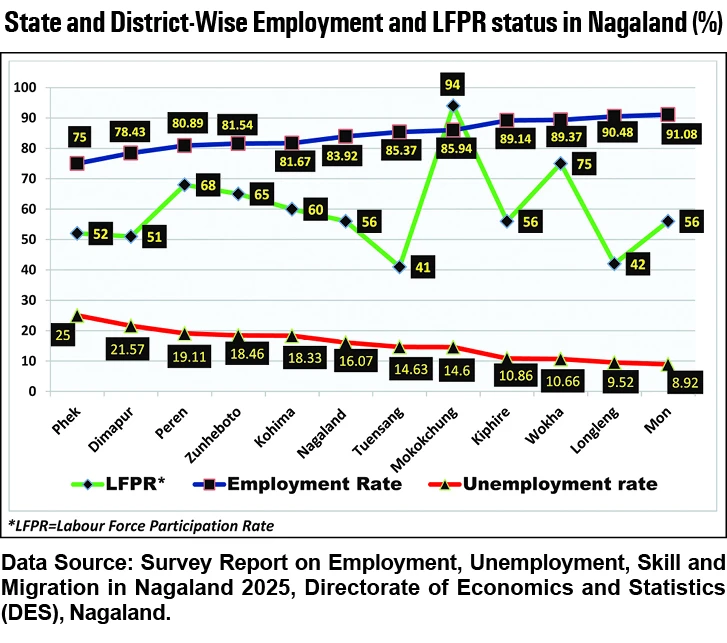
At the State level, Nagaland’s Labour Force Participation Rate (LFPR) stands at 56%, with an employment rate of 83.92% and an unemployment rate of 16.07%.
Participation high, but vulnerability persists
LFPR varies sharply across districts. Mokokchung, with an LFPR of 94%, records the highest labour force participation in the State, followed by Wokha (75%) and Peren (68%), all well above the State average. In contrast, Tuensang (41%) and Longleng (42%) report the lowest participation rates, suggesting limited engagement with the labour market.
However, district-wise figures indicate that high participation in the labour market does not necessarily translate into secure or quality employment.
Mokokchung’s case illustrated why high LFPR does not automatically mean better employment outcomes.
Despite near-universal participation of 94%, nearly one-fourth (25%) of the workers in the Mokokchung were engaged in casual wage labour, almost three times the State average of 9%, indicating that employment is driven largely by economic compulsion rather than stable opportunities.
Employment rates further underline these contrasts. While Mon (91.08%), Longleng (90.48%), Wokha (89.37%), and Kiphire (89.14%) report employment rates higher than the State average,
Phek records the highest unemployment rate at 25%, followed by Dimapur (21.57%) and Zunheboto (18.46%), all exceeding the State unemployment rate.
Nature of work varies
The structure of employment differs significantly across Nagaland.
At the State level, 24% of workers are self-employed and 13% are salaried employees. Self-employment is particularly high in Zunheboto (40%), Wokha (35%), and Peren (34%), pointing to a heavy reliance on own-account and informal economic activity.
Salaried employment is relatively higher in Kohima (19%), Wokha (19%), and Kiphire (18%), while remaining limited in districts such as Phek (5%) and Longleng (8%), highlighting the uneven spatial distribution of formal job opportunities.
Informal contracts dominate most districts
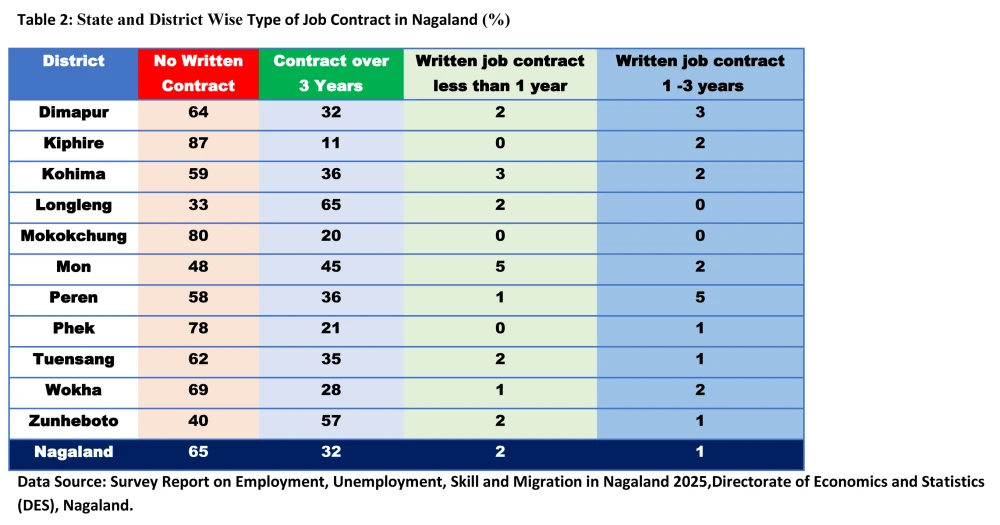
Employment insecurity becomes more apparent when job contracts are examined. Across Nagaland, 65% of workers have no written job contract, indicating that informal employment remains the norm.
This proportion rises sharply in Kiphire (87%), Mokokchung (80%), and Phek (78%), where most workers lack formal contractual protection. In contrast, Longleng (65%) and Zunheboto (57%) record a higher share of workers on contracts exceeding three years, performing better than the State average of 32% for long-term contracts.
Paid leave limited
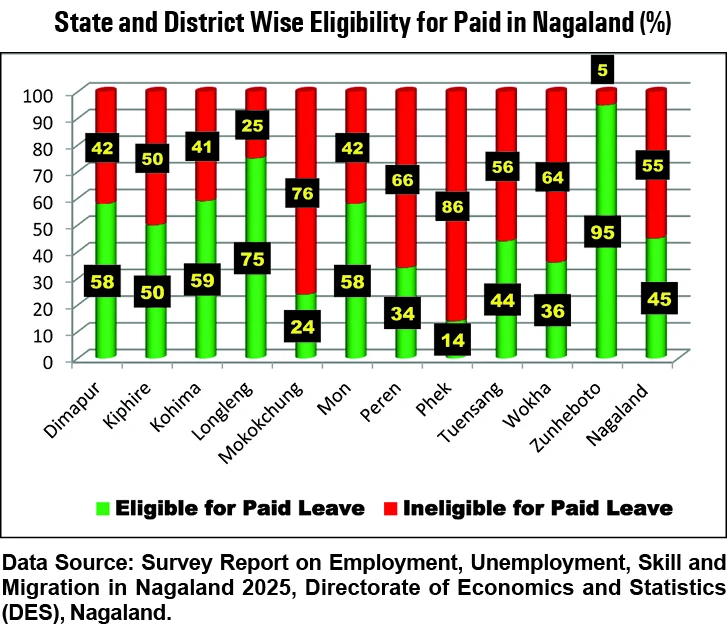
Eligibility for paid leave further reflects disparities in job quality. While 45% of workers at the State level are eligible for paid leave, access remains particularly low in Phek (14%), Mokokchung (24%), and Peren (34%), suggesting weak income security during illness or emergencies.
At the same time, Zunheboto (95%) and Longleng (75%) report unusually high eligibility for paid leave, a contrast that appears striking given the high levels of informality recorded in other indicators.
Curious gaps in social security coverage
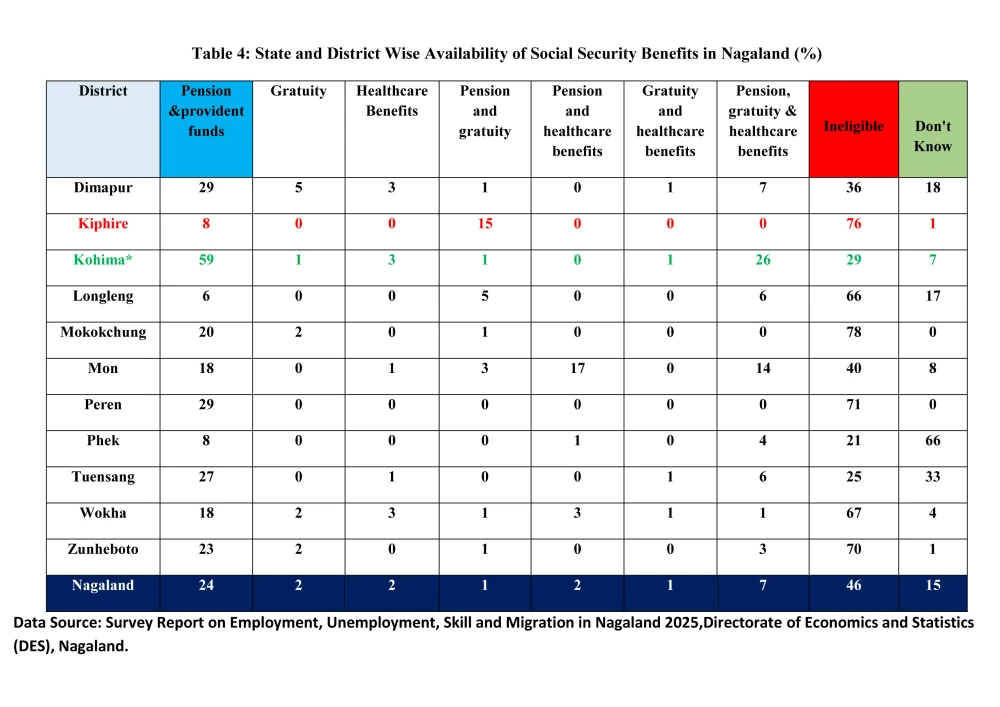
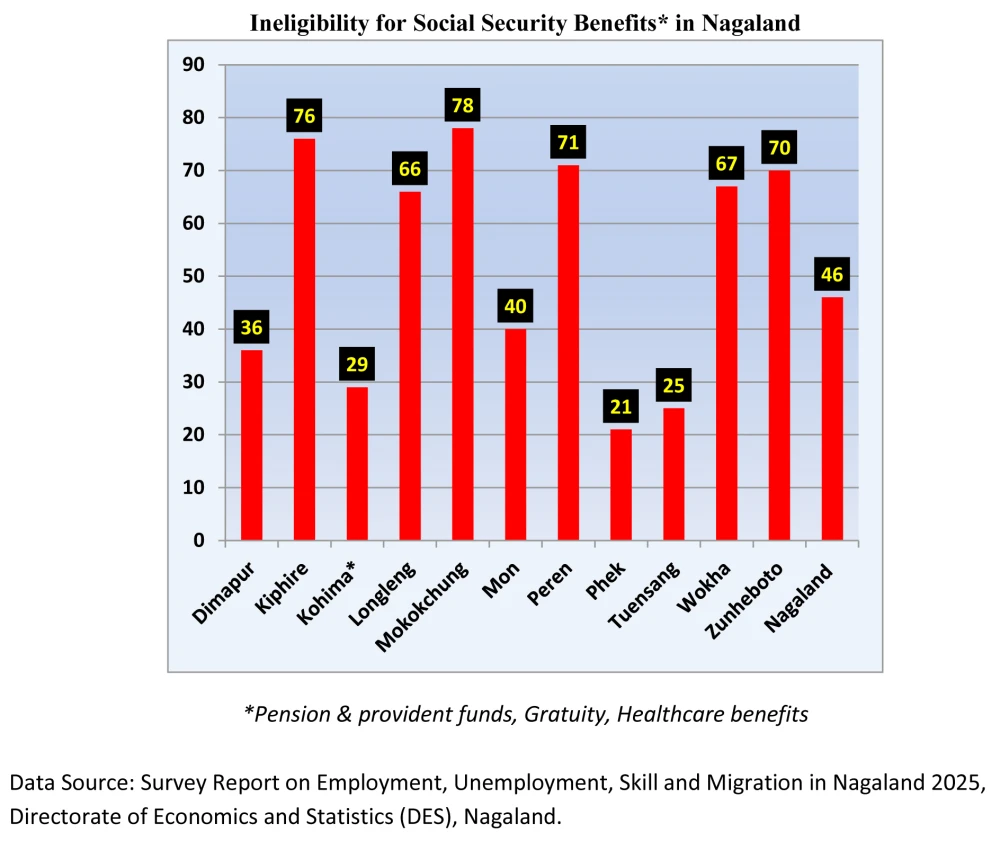
Social security coverage remains limited across Nagaland. 46% of workers are ineligible for any social security benefit, while 15% report that they do not know whether they are covered, pointing to both exclusion and uncertainty.
District-level data shows even higher exclusion in Mokokchung (78%), Kiphire (76%), Peren (71%), and Zunheboto (70%).
Zunheboto presents a notable contrast: despite high self-employment, high paid leave eligibility, and a sizeable share of long-term contracts, most workers still report being ineligible for social security benefits.
Kohima emerged as a relative outlier, with better access to pensions and provident funds, reflecting a higher concentration of salaried and formal employment. Even here, however, nearly one-third of workers remain outside the social security net.
Low reporting of healthcare benefits across districts is also striking, particularly in the context of a universal health insurance scheme such as the Chief Minister’s Health Insurance Scheme (CMHIS).
The data raises questions about enrolment levels, awareness, or whether respondents associate public health insurance with employment-linked social security. The sizeable “don’t know” responses further suggest information gaps.
Debunking conventional narratives?
The survey outcome also seems to challenge the assumption that development necessarily translates into better employment outcomes.
Districts often regarded as relatively ‘underdeveloped’ such as Mon, Tuensang, Longleng and Kiphire record employment indicators that, in several respects, appear stronger than those of more urbanised districts like Dimapur and Mokokchung.
While districts such as Mon and Longleng report higher employment rates, Dimapur and Mokokchung show higher unemployment, greater reliance on casual labour, and wider exclusion from social security.
At the same time, these patterns raise questions about data quality and sampling.
For instance, figures on the availability of social security benefits show inconsistencies, with totals reaching 127 in Kohima but only 93 in Tuensang, despite the conventional aggregate being capped at 100. Two districts also recorded totals of 101, which the report attributes to rounding off.
Overall, the district-wise data underscores that headline employment and participation figures conceal deep vulnerabilities in job quality across Nagaland.
This is Part III of a series on the findings of the ‘Survey Report on Employment, Unemployment, Skill and Migration in Nagaland 2025.’
Read Part I&II here:
- Nearly half of Nagaland’s workforce without social security coverage: Survey
- 98% literate, 92% lack technical skills: Nagaland’s education paradox