Members of the Naga Students' Federation pay tribute to the six Naga civilians killed in Manipur during a candlelight vigil in Kohima on July 9. (Morung Photo)

Kohima, July 9 (MExN): The Naga Students' Federation (NSF) has called for an independent investigation into all incidents of violence documented during the Naga-Kuki conflict in Manipur, including the abduction, torture and killing of six Naga civilians, while urging the Government of India to review or abrogate the Suspension of Operations (SoO) agreement with Kuki militant groups.
The recommendations are contained in the concluding chapter of the Federation's report on the Naga-Kuki Conflict, prepared following its Reconnaissance and Solidarity Mission to Southern Nagalim, Manipur, from June 4 to 6, 2026.
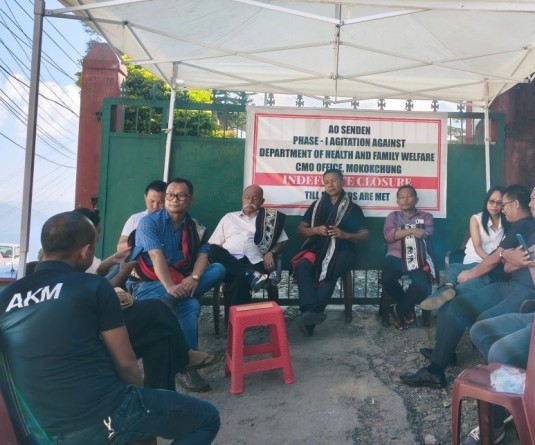
The 27-member delegation comprised senior NSF leaders, officials and presidents of seven federating units—All Sumi Students' Union (SKK), Angami Students' Union (ASU), Ao Students' Conference (AKM), Chakhesang Students' Union (CSU), Pochury Students' Union (PSU), Rengma Students' Union (RSU) and Zeliangrong Students' Union Nagaland (ZSUN).
Drawing on field observations, consultations with affected communities and documentation of incidents spanning March 2023 to June 2026, the report noted that the humanitarian and security situation across Southern Nagalim remains "deeply concerning," with sustained violence, civilian displacement, repeated attacks, hostage-taking, destruction of villages and the killing of six Naga civilians continuing to inflict severe human suffering.
The conflict has disrupted civilian life across several Naga-inhabited areas and that the violence documented during the review period reflects a sustained pattern rather than isolated incidents, it said.
The report further contended that the conflict is rooted not only in armed confrontations but also in deeper structural issues, particularly what it described as demographic changes in Naga ancestral areas arising from alleged encroachment, expansion of settlements, illegal poppy cultivation and cross-border movement of armed groups.
It maintained that these factors have altered ground realities over time and should be addressed as part of any lasting political solution.
Among its principal recommendations, the NSF called for an independent, impartial and time-bound investigation into all incidents of violence documented during the review period, with all perpetrators, facilitators and conspirators identified and prosecuted in accordance with the law. It said the abduction, torture and killing of six Naga civilians represented one of the gravest humanitarian violations documented during the conflict and demanded accountability.
The Federation also urged the Government of India to undertake an immediate review or abrogation of the SoO arrangement with Kuki armed groups, alleging repeated violations of the agreement, continued armed activities and serious human rights abuses during the conflict.
It further recommended the constitution of an independent inquiry into allegations concerning the conduct, neutrality and operational role of security forces in conflict-affected areas, including observations recorded during the NSF delegation's field visit.
The report also called for coordinated measures to curb illegal poppy cultivation, narcotics trafficking and the cross-border movement of SoO Kuki militant groups, maintaining that the narcotics economy and proliferation of sophisticated weapons have aggravated the conflict and require comprehensive investigation and enforcement.
To safeguard civilians, the Federation sought effective and impartial security arrangements to ensure safe and unrestricted movement along National Highway-202 and other strategic routes, which it described as vital lifelines repeatedly affected by violence and insecurity.
The NSF further urged the Government of India to initiate sincere political engagement with all stakeholders to address what it termed the underlying causes of the conflict. It maintained that lasting peace cannot be secured through militarisation alone but requires justice, dialogue, accountability and recognition of the ancestral, historical and political realities of the region.
It also appealed to national and international human rights institutions to continue monitoring the conflict-affected areas to ensure protection of civilians and adherence to humanitarian and human rights standards.
In its concluding observations, the Federation asserted that "peace cannot be sustained solely through the deployment of armed forces," and argued that durable peace requires impartial administration of justice, protection of civilian lives, accountability for human rights violations, restoration of public confidence and sincere political engagement with all stakeholders. It said the report has been placed on record to present the findings of its reconnaissance mission and contribute towards a factual understanding of the humanitarian situation prevailing in the conflict zones of Manipur during the period under review.
Meanwhile, following the candlelight vigil in Kohima on July 9, the NSF submitted a memorandum to the President of India through the Governor of Nagaland, seeking urgent intervention to ensure justice, accountability and protection of innocent Naga civilians affected by the ongoing conflict in Manipur, particularly in connection with the abduction, torture and killing of six Naga civilians and other incidents documented during its mission.
The Federation also annexed its 41-page report, "Report on the Naga-Kuki Conflict in Manipur: Findings of the Naga Students' Federation Reconnaissance and Solidarity Mission to Southern Nagalim, Manipur," containing the mission's field observations, community interactions, documentation of incidents and recommendations.