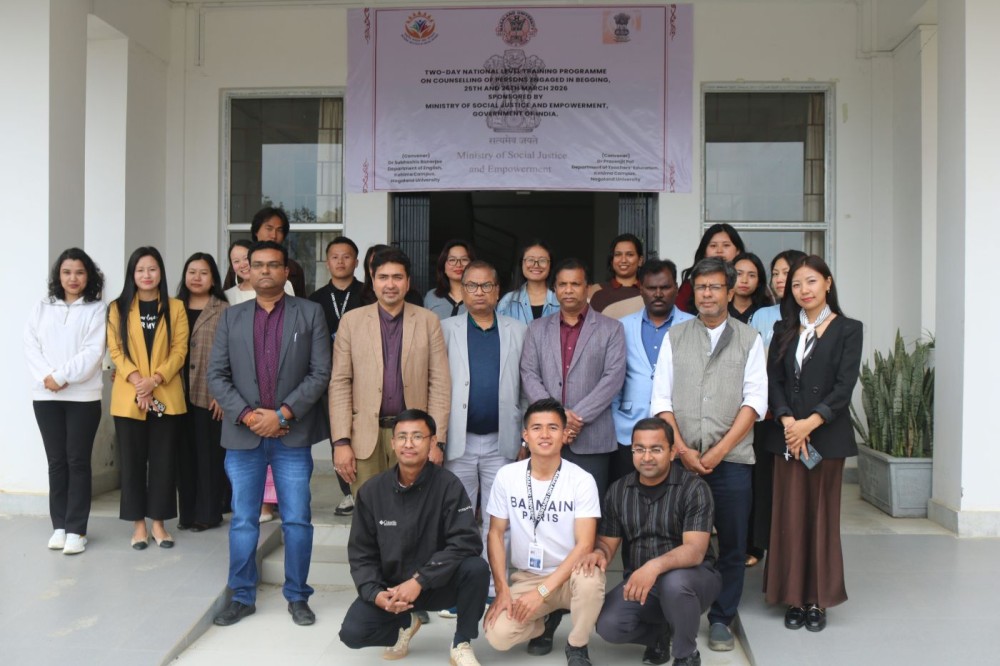
Dimapur, March 27 (MExN): The two-day National Level Training Programme and Workshop on Social Empowerment and Beggary Prevention concluded on March 26 at the Department of English, Nagaland University, Kohima Campus. The programme was conducted in hybrid mode, with the final day anchored by Thejase-e Nahi, Research Scholar, Department of English.
The proceedings began with a session by Dr Imlisongla Longkumer, Associate Professor and HoD, Department of Psychology, who spoke on “Counselling and Beggary.” She described counseling as the practice of “working with individuals” and said that those trapped in beggary often suffer from low self-efficacy and self-esteem, calling for structured rehabilitation and supportive approaches.
Dr Gyanendra Nath Tiwari, Professor and HoD, Department of Teacher Education, spoke on the interlinkages between educational access and beggary prevention. He focused on the need to map a transition from systemic poverty to sustained empowerment.
The mid-day segment included a screening of the documentary Children for Sale: The Fight Against Child Trafficking in India, followed by a discussion led by Dr Prasenjit Pal, who urged the audience to extend a hand of compassion toward vulnerable populations.
Prof Joy Das, Head, Department of Commerce, delivered a lecture on financial inclusion, describing it as a pathway to reduce beggary by empowering marginalized individuals through specific structural measures.
In the afternoon session, Dr Tanmoy Bhattacharjee from Women’s Christian College, Kolkata, joined virtually and spoke on the economic aspects of beggary within the transgender community. He used the artwork of K.G. Subramanyan to highlight lived experiences and societal challenges.
Prof Suresh Kurapati from the Department of English, Nagaland University, discussed whether beggary in India is a societal menace or a structural failure. He referred to the historical contexts of nomadic communities in Telangana and Andhra Pradesh, including the Budubudakkala and Beda Jangam.
The programme concluded with a valedictory session. Dr Prasenjit Pal delivered the vote of thanks, acknowledging the contributions of the resource persons, volunteers, and participants.
Distinguished faculty present included Prof Nigamananda Das, Dr Pradipta Pattnaik, and Dr Subhashis Banerjee.
.jpg)