Morung Express News
Dimapur | May 17
Despite significant progress in sanitation coverage across Nagaland, a recent household survey has found that open defecation persists in pockets of the state, raising questions over the long-term sustainability of its Open Defecation Free (ODF) status.
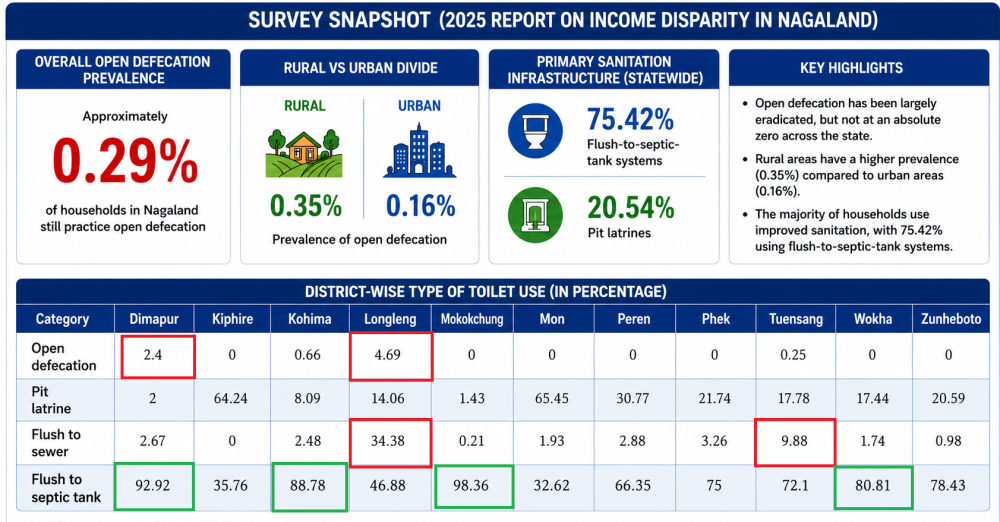
According to the Report on Income Disparity in Nagaland 2025, around 0.29% of households in the state still practice open defecation.
The findings show that approximately 0.29% of households in Nagaland still practice open defecation, pointing to gaps in sustaining universal sanitation coverage.
The prevalence remains higher in rural areas at 0.35%, compared to 0.16% in urban areas.
The survey also found that improved sanitation coverage remains widespread, with 75.42% of households using flush-to-septic-tank systems, while 20.54% rely on pit latrines.
District-wise variations
However, district-wise data reveals notable variations.
Among the districts surveyed, Longleng recorded the highest open defecation rate at 4.69%, significantly above the state average.
This was followed by Dimapur at 2.4%, Kohima at 0.66%, and Tuensang at 0.25%.
In Longleng, despite nearly half of households (46.88%) using flush-to-septic-tank systems, the district emerged as the most prominent outlier in terms of open defecation practices.
Incidentally, 34.38% of respondents in Longleng used a “flush to sewer” system, followed by 9.88% in Tuensang, while all other districts fell below 4%, including Kiphire at 0%, Mokokchung at 0.21%, and Zunheboto at 0.98%.
Dimapur, one of the state’s most urbanised districts, also reported a relatively higher prevalence of 2.4%, even though 92.92% of households use flush-to-septic-tank sanitation systems.
By contrast, seven of the eleven surveyed districts reported zero open defecation.
The data also points to variations in the type of sanitation infrastructure across districts. While districts such as Mokokchung reported 0% open defecation alongside 98.36% usage of flush-to-septic-tank systems, districts such as Kiphire and Mon, despite recording 0% open defecation, showed heavy dependence on pit latrines, accounting for 64.24% and 65.45% of households respectively.
The findings come despite Nagaland’s reported progress under the Swachh Bharat Mission (Grameen) ODF Plus phase. As of August 2025, official data showed that 1,134 of the State’s 1,425 villages had achieved ODF Plus status, including 553 classified as “Model” villages, reflecting progress in sanitation sustainability and waste management.
Nagaland had declared all 1,122 rural villages ODF in October 2018, ahead of the national deadline, and extended the status to urban areas in 2019. Since 2020–21, the State has been implementing ODF Plus, shifting focus from toilet construction to sustaining sanitation behaviour and village cleanliness.
Other indices
Other indicators in the DES also highlighted that water access, critical to sustaining ODF gains, remains concerning.
While only 24% of households reported having drinking water within their dwelling, 31.14% across the State, and 34.89% in rural areas, still depend on sources located “elsewhere.”
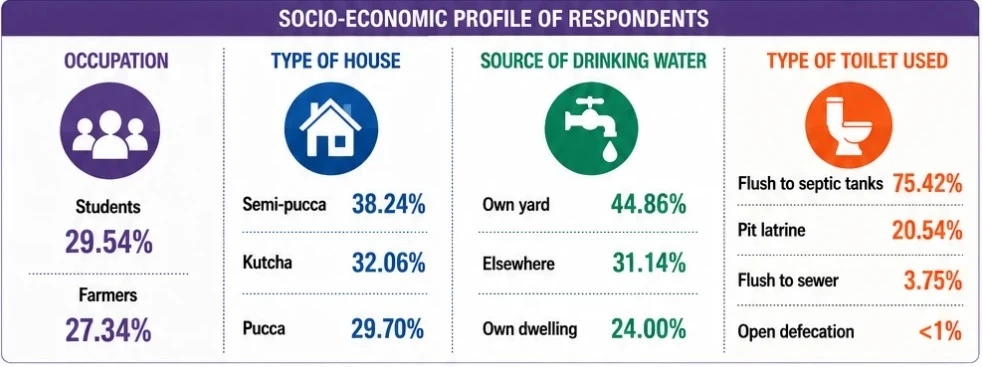
The disparity was as high 95.97% in Kihpire, 57% in Kohima and 53.93% in Mokokchung. All other districts had source of water “elsewhere” above 20% except Dimapur and Wokha reported which had below 10%. (see infographic)
Housing and livelihood indicators paint a similar picture. Only 29.7% of respondents lived in pucca houses, while the majority stayed in kutcha (32.06% ) or semi-pucca structures (38.24%).
Occupationally, out of the 12,222 respondents, the largest groups were students (29.54%) and farmers (27.34%), followed by housewives (13.54%), job seekers (8.19%), Daily wage earners (4.78%) private employment or self-employment (4.44%).
Only 7.35% were Government Employee and 7.7% were pensioners reflecting large segment population dependent on agriculture, informal work, unpaid domestic labour, or is still economically inactive.
About the report
The Report on Income Disparity in Nagaland 2025 was undertaken by Department of Economics and Statistics Nagaland in collaboration with University of Hyderabad and prepared under the Union Ministry of Statistics and Programme Implementation’s (MoSPI) Support for Statistical Strengthening sub-scheme.
The field survey was conducted between October and December 2024, and the findings reflect income data for the 2024 calendar year.
The study covered 4,396 households across the State, including 1,315 households from 60 urban wards and 3,080 households from 140 rural villages.