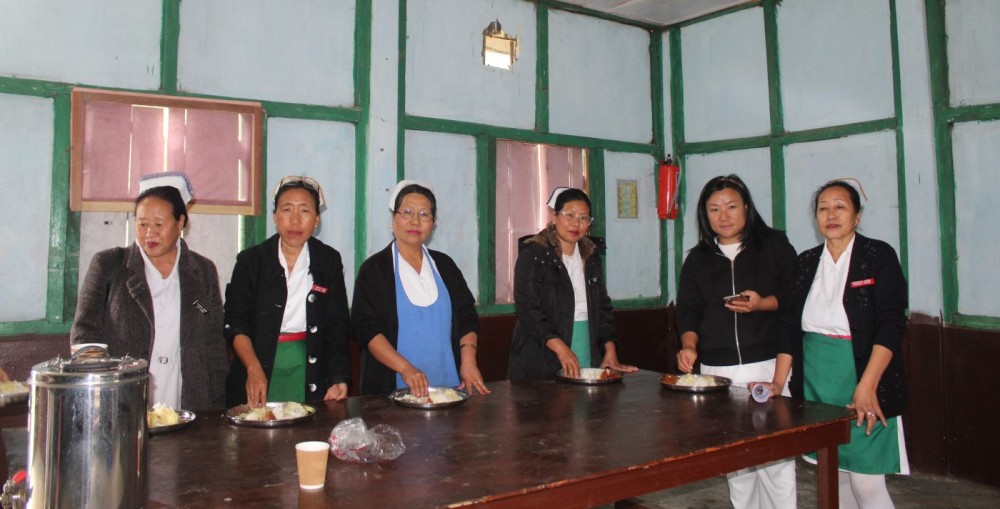
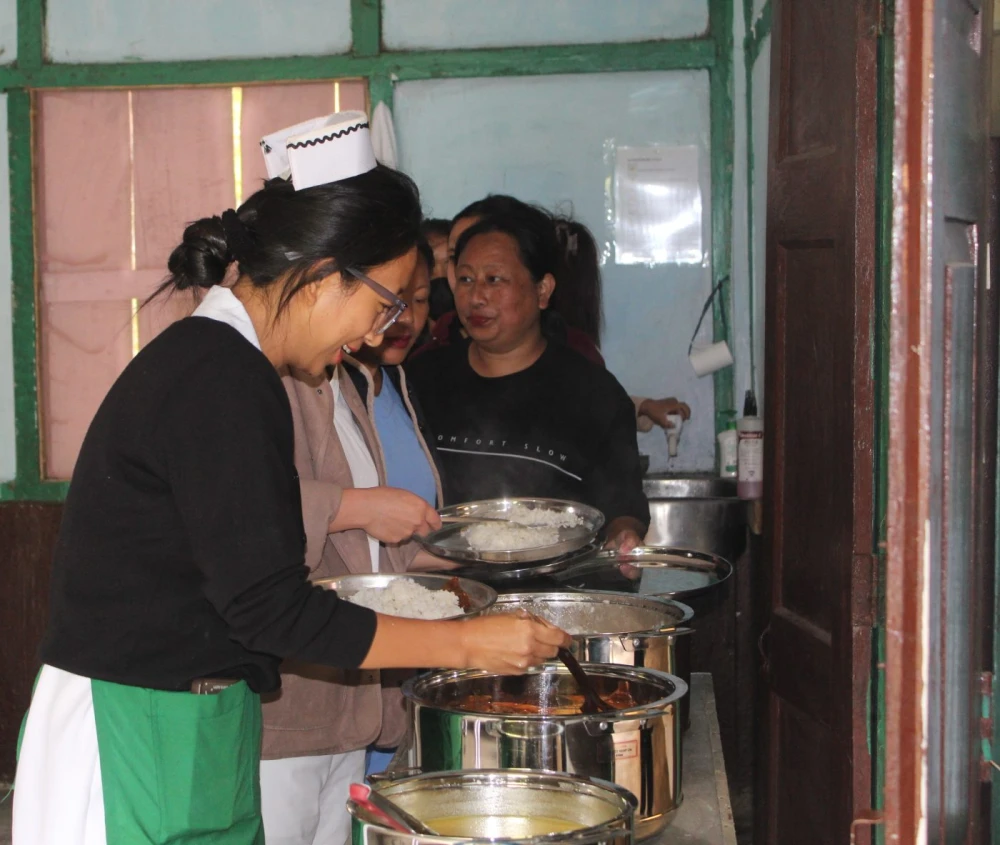
Nursing staff of the Hezukhu Memorial District Hospital, Zunheboto sharing a fellowship lunch in observance of International Nurses Day 2026 on May 12. (Morung Photo)
Veteran nurses in Zunheboto reflect on decades of service
Tokavi K Zhimo
Zunheboto | May 12
In the quiet corridors of Hezukhu Memorial District Hospital (HMDH), Zunheboto, where newborn cries echo alongside with the footsteps of healthcare workers, two veteran nurses remain devoted to a profession they view not as a job, but as a calling. On International Nurses Day 2026, senior nurses Khekhuli Jimo and Ghovili reflected on their decades-long service in Nagaland’s remote, underserved regions, marked by difficult terrain, emergencies, disease outbreaks and countless sleepless nights.
Khekhuli Jimo, Assistant Nursing Superintendent (ANS) Incharge at HMDH, views nursing as a mission of prayer and perseverance. Appointed in 1994, she served at Aghunato PHC, spent most of her career at Satakha, and then transferred to Zunheboto District Hospital in July 2023. Hailing from Xuivi village (Satakha area), she grew up in a “very economically challenged” farming family.
“This is a very noble profession. We carry out our work through faith and prayer,” she said, adding that despite not considering herself “a brilliant student,” hard work and dedication helped shape her career. “I never missed my classes during my training at Naga Hospital Authority Kohima (NHAK). I always tried my level best,” she recalled.
In the era of scarce roads and infrastructure, Khekhuli walked village to village to assist deliveries. “There were no proper roads or vehicles. We had to travel by foot and deliver babies in villages because mothers could not come to the hospital. Sometimes we deliver babies under oil lamp light,” she said. Referrals were rare; nurses handled difficult cases alone.
Over her career, Khekhuli estimates she has helped deliver more than 2,000 babies during her posting in Satakha alone, over 100 in Aghunato, and about 20–30 so far in Zunheboto. “Sometimes we deliver at least four babies in a day here,” she noted. Reflecting on nursing, she emphasized compassion, equality, and patience, “In this profession, we have to love even our enemies and give equal care and support to everyone without discrimination.”
She stressed that nurses should never hurt patients with harsh words but instead respond with kindness. “Patients are already suffering. Speak softly to them. Discipline, patience, and smiling care are what matter,” she said.
One unforgettable memory from her training at NHAK involved two alleged militants brought to the hospital under tight security. Many were afraid to treat them. “I was on night duty. The doctors and nurses were scared, but I gathered courage and took care of them,” she said. The two patients were on hunger strike and in an unconscious condition. Khekhuli convinced them to drink water by telling them it was medicine. “They slowly recovered and later told me, ‘You are a good, smart, and intelligent nurse.’”
During the COVID-19 pandemic, Khekhuli said nurses stood on the frontline, sacrificing personal and family life. “We left everything behind and dedicated our lives to serving patients,” she recalled.
Beyond her hospital duties, as president of the Sumi Totimi Hoho Satakha, she cooked food for quarantined patients and motivated them during isolation.
Highlighting the nursing shortage at the district hospital, she noted, “We have only around 15 active nurses” while many are assigned to ICU, OPD,and other sections. Ideally, every patient should have a designated nurse, but manpower remains a major challenge.
Speaking about the condition of nurses in the district, she lamented the lack of basic facilities. “There is no proper nurses’ duty room, it is in a pathetic condition… No quarters, no proper rooms, kitchen, or washroom. We live in a rented private house without proper security,” she said. Despite the hardships, she called nursing a blessing and lifelong responsibility, “Nurses never retire till death, even at home, we continue taking care of people.”
She encouraged young nurses to wear their uniforms proudly, “The uniform defines you and your profession. Nurses are like angels.” Approaching retirement in March 2027, Khekhuli leaves a legacy of compassion, resilience and dedication.
Another senior nurse Ghovili, Nursing Sister at HMDH, shares a similarly journey. Appointed in 1994, her first posting was at Satoi, where she served for many years before transferring to Zunheboto in 2024. She will retire in 2029. Hailing from Khukiye Lukhai village, Ghovili admitted that nursing was never originally her dream.
“My dream was to study theology, but my father encouraged me to become a nurse because theology was expensive,” Ghovili said. Looking back, she feels grateful. “I never dreamed about this profession, and for that I am thankful to God.”
She recalled the hardships of working in Satoi when there were no roads or proper transport. “We travelled in a Nissan 4W73 (Nissan Gari) carrying firewood. Sometimes we walked to collect medicines and vaccines from the CMO Office in Zunheboto town.” Health awareness campaigns often meant trekking long distances through difficult terrain.
Encouraging younger nurses, she noted they are fortunate to have better facilities. “Today’s generation should remain faithful and dedicated. They have many facilities now compared to our time.
Never forget prayer because it is your foundation.”
Doctors at HMDH also paid tribute to the nursing fraternity. Dr Josia Sema, Medical Officer, called nurses the “backbone” of healthcare delivery. “Without them, the basic care and support doctors need would not be possible. They are the fundamental unit of healthcare in any hospital,” he said.
Acknowledging the challenges nurses face balancing demanding shifts with family and personal responsibilities, he said, “I thank them all for the effort they put into taking care of patients at a personal level.”