Ground data, however, raise underreporting concerns
Moa Jamir
Dimapur | May 17
Nagaland retained the lowest crime rate against women among States and Union Territories in India, reinforcing its position as the “safest” State for women, according to the latest Crime in India 2024 report by the National Crime Records Bureau.
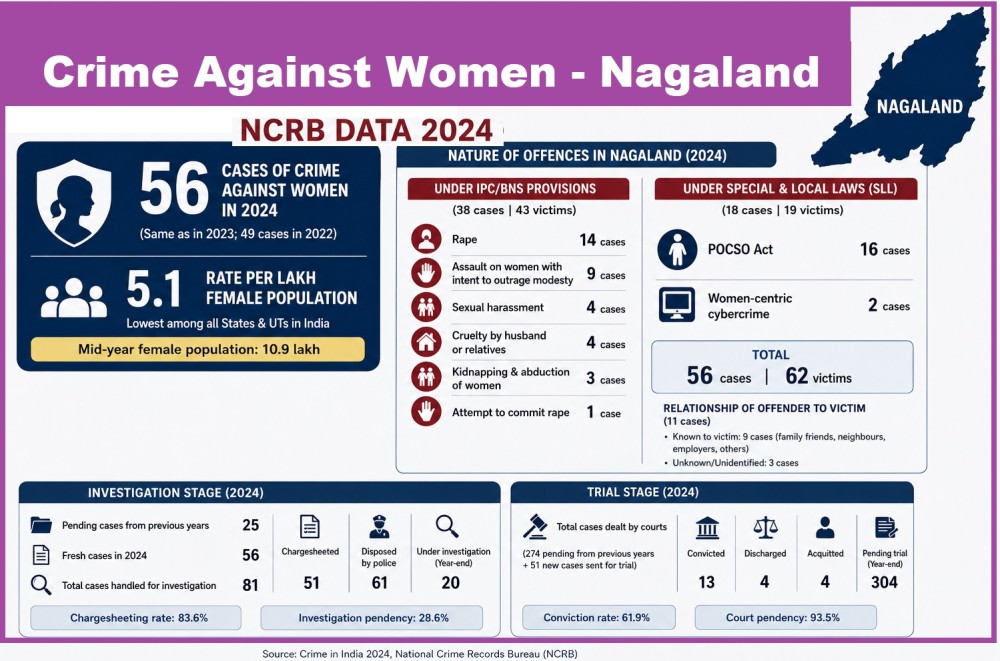
The NCRB data showed that Nagaland registered 56 cases of crime against women in 2024, unchanged from 2023.
With a mid-year female population estimated at 10.9 lakh, the State’s crime rate stood at 5.1 per lakh women population, the lowest among all States and UTs, and far below the national average of 64.6.
In 2023, the State had also recorded the lowest rate at 5.2.
In contrast, some of the highest crime rates in 2024 were reported in Delhi (130.7), Telangana (128.6), and Odisha (118.3). In absolute terms, the lowest number of cases was reported in Lakshadweep (13 cases), followed by Ladakh (34 cases).
Among North-East States, Assam recorded the highest rate of 59.3, while status in others were: Manipur (12); Arunachal Pradesh (41.8), Meghalaya (38.9), Mizoram (41.7), Sikkim (39.7) and Tripura (34.7).
Across India, the NCRB recorded 4,41,534 cases of crime against women in 2024, a 1.5% decline from 4,48,211 cases in 2023.
Sexual offences dominate
While the absolute numbers remain low, the nature of offences continues to raise concern in Nagaland.
Under the Indian Penal Code (IPC)/Bharatiya Nyaya Sanhita (BNS) provisions, Nagaland recorded 38 cases involving 43 victims.
The largest category was rape with 14 cases, followed by assault on women with intent to outrage modesty with 9 cases.
There were four cases each of sexual harassment and cruelty by husband or relatives, three cases of kidnapping and abduction of women, and one case of attempt to commit rape.
Under Special and Local Laws (SLL), the State registered 16 cases under the Protection of Children from Sexual Offences (POCSO) Act and two women-centric cybercrime cases.
Together, these accounted for 18 cases involving 19 victims. Overall, 62 victims were recorded across the 56 cases.
The NCRB data also showed that in 11 cases, offenders were known to victims. Of these, 9 cases involved family friends, neighbours, employers, or other known persons, while 3 cases involved unknown or unidentified offenders.
Meanwhile, a total of 57 persons were arrested in crimes against women cases in Nagaland during 2024, including 56 men and 1 woman.
Nationally, the largest categories were cruelty by husband or relatives (1,20,227 cases; 27.2%), kidnapping and abduction of women (67,829; 15.4%), POCSO cases (67,809; 15.4%), and assault on women with intent to outrage modesty (48,303; 10.9%).
Police investigation and court disposal
At the investigation stage, Nagaland began the year with 25 pending cases from previous years. With 56 fresh cases added in 2024, police handled 81 cases for investigation.
By year-end, 51 cases were chargesheeted, 61 cases were disposed of by police, and 20 cases remained under investigation.
Nagaland recorded a chargesheeting rate of 83.6%, higher than the national average of 77.2%. The State’s investigation pendency stood at 28.6%, marginally lower than India’s 29.8%.
Overall, a total of 61 persons were chargesheeted.
At the trial stage, courts dealt with 325 cases, including 274 pending from previous years and 51 new cases sent for trial.
Of these, 13 cases resulted in conviction, while 4 each ended in discharge or acquittal.
Nagaland’s conviction rate stood at 61.9%, substantially higher than the national average of 25.7%. However, 304 cases remained pending trial, pushing court pendency to 93.5%, slightly above the national average of 92.1%.
Beyond NCRB figures
Analysis of NCRB reports by The Morung Express indicated that crimes against women in Nagaland have largely remained below the 100-case mark annually over the years.
However, recent findings from institutions and frontline agencies suggest official crime statistics may capture only part of the picture.
During the 16 Days of Activism Against Gender-Based Violence events held in Dimapur and Chümoukedima in November 2025, concerns were raised on persistent underreporting and barriers to formal justice.
Data shared in Chümoukedima showed that Women Helpline 181 has received over two lakh calls since 2016, but only around 3,400 complaints were converted into formal cases. It was also disclosed that One Stop Centres in the State had assisted more than 1,700 survivors.
At the law enforcement level, officials stated that the Women Police Station in Dimapur converted only 11% of domestic violence complaints into FIRs in 2025, pointing to continued reliance on mediation and compromise in abuse cases.
Incidentally, there were no cases registered under the Protection of Women from Domestic Violence Act in the State that year though there were four cases of ‘Cruelty by Husband or his relatives.’
Meanwhile, a state-wide survey by the Sisterhood Network, conducted across all ten districts between May and July 2025, collected 742 responses, of which 50.8% reported experiencing gender-based violence.
Among survivors, 59.8% said they experienced violence before the age of 18, while 40.3% reported the abuse occurred at home.
The survey further found that 64% of survivors did not formally report their experiences, citing stigma, fear, distrust in institutions, and uncertainty about available support systems.
The findings add broader context to NCRB’s 2024 figures, suggesting that while Nagaland continues to record the country’s lowest official crime rate against women, social, institutional, and cultural barriers may results in underreporting.