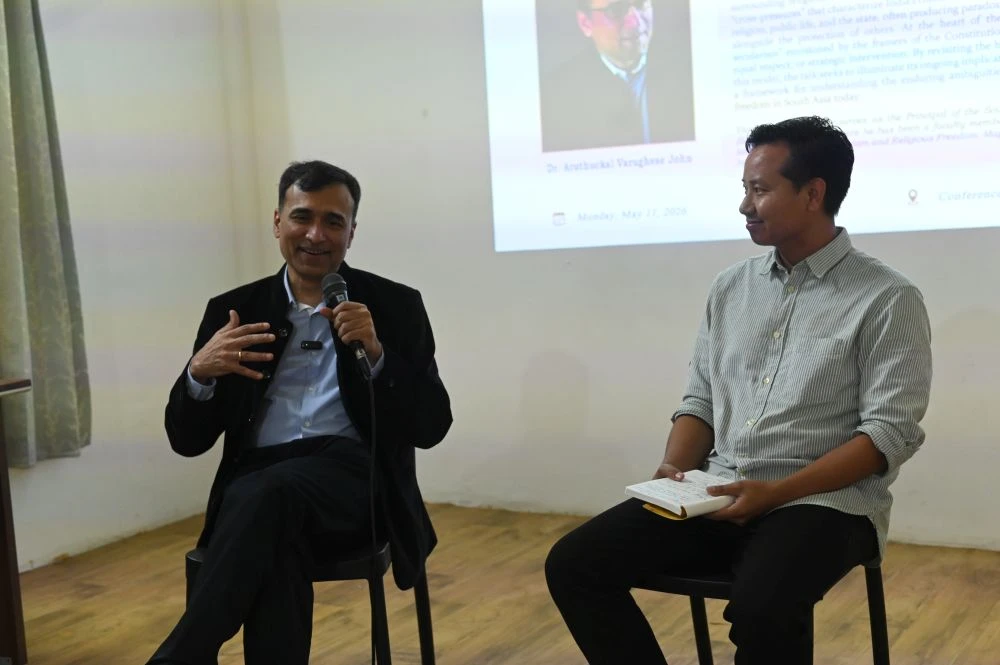
1. SAIACS Bengaluru Principal Dr Aruthuckal Varughese John delivers a lecture on ‘Indian Secularism and Religious Freedom: Mapping the Cross-Pressures,’ at Patkai Christian College (Autonomous) on May 11. (Photo Courtesy: PCC Mass Comm)
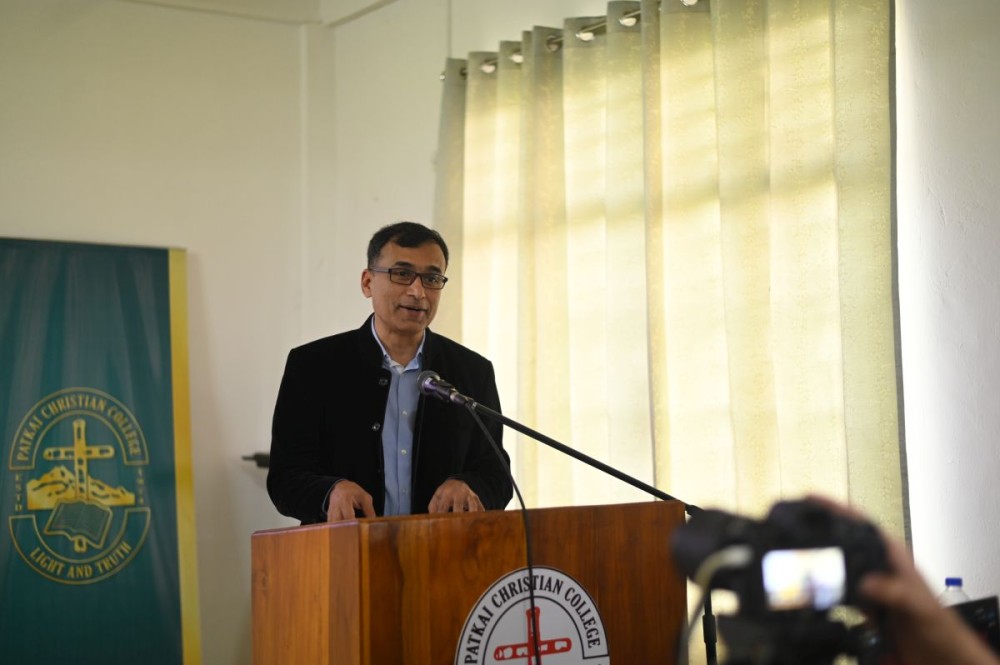
Chümoukedima, May 13 (MExN): Contemporary debates surrounding secularism, religious freedom, and the place of religion in India’s public and constitutional life came under focus during a lecture held at Patkai Christian College on May 11.
Addressing on the topic, “Indian Secularism and Religious Freedom: Mapping the Cross-Pressures,” resource person Dr Aruthuckal Varughese John, Principal of the South Asia Institute of Advanced Christian Studies (SAIACS), Bengaluru, introduced the concept of “cross-pressures.”
Drawing from the work of philosopher Charles Taylor, he explained how individuals and societies often experience competing pressures in matters relating to religion, identity, and public life.
Referring to developments in Karnataka in 2022, he discussed controversies surrounding the azan, hijab, and anti-conversion laws, highlighting the complexities of religious expression and secularism in India.
On the azan controversy, Dr John observed that Indian secularism has not traditionally demanded the complete privatisation of religion. On the hijab issue, he noted that restrictions on visible religious identity in public institutions reflect continuing tensions between religion and politics.
On anti-conversion laws, he raised questions around the interpretation of “forced conversion” and broader debates on religious liberty.
Dr John also reflected on the symbolic significance of Mahatma Gandhi and B R Ambedkar, stating that while the former represented continuity with tradition, the latter symbolised reform and social transformation.
During the interactive session that followed, participants raised questions on the origins of secularism and whether it should be viewed as a Western concept or something organically rooted in Indian history.
Dr John, whose recent book Indian Secularism and Religious Freedom: Mapping the Cross-Pressures explores contemporary debates on secularism and religious freedom, responded by discussing different models of secularism across cultures and the historical distinction between the “secular” and the “sacred” in medieval church traditions.
Earlier, in her opening remarks, Avono Iralu underlined the need to engage with questions of secularism, religious freedom, and the role of religion in contemporary society.
In his welcome address, Vichükho Ngukha, chaplain of the college, said issues of secularism and religious freedom remain central to India’s constitutional and democratic framework and as a pluralistic society, it continues to negotiate the intersections of faith, identity, governance, and democracy.