Education has long been regarded as “the most powerful weapon which you can use to change the world,” a reminder from Nelson Mandela that captures its extraordinary ability to transform lives. It challenges limitations, expands opportunities, and reshapes the trajectory of individuals and communities. For those who confront economic hardship, education remains one of the very few forces capable of disrupting inherited cycles of struggle and opening pathways toward dignity, stability, and progress.
Poverty creates boundaries that are often invisible yet deeply restrictive. It narrows ambitions, limits exposure, and traps individuals within patterns that continue from one generation to the next. Despite these constraints, education possesses the unique power to confront and dismantle them. It equips learners with the knowledge, confidence, and intellectual tools needed to envision a life beyond their immediate circumstances. In doing so, education transforms survival into aspiration and vulnerability into capability.
Yet, within today’s rapidly shifting generation, the value of education is gradually diminishing. Many young people now view learning as slow, demanding, or less rewarding compared to earning a quick income. The pursuit of immediate results overshadows the long-term growth that education provides. This shift is not merely a personal choice; it is strongly influenced by the digital culture that surrounds modern youth.
Social media plays an especially influential role in this decline. These platforms continuously display images of individuals who appear to gain fame, wealth, or recognition overnight, seemingly effortlessly. This creates an illusion that achievement does not require effort, discipline, or education. Young people begin to compare themselves to these carefully curated portrayals and, in doing so, question the relevance of academic commitment. What is often forgotten is that such online images are constructed, edited, and far removed from reality.
This culture of instant gratification has troubling consequences. It encourages impatience, weakens focus, and promotes the belief that shortcuts can replace genuine effort. When young people start to perceive education as outdated or unnecessary, they risk exchanging long-term security for temporary satisfaction. The foundational skills that education nurtures, critical thinking, resilience, creativity, and informed judgment, become overshadowed by the pursuit of online visibility and fleeting attention.
The attitude of undervaluing education deepens existing socio-economic divides. Without strong educational foundations, career opportunities shrink, decision-making becomes shallow, and the cycle of poverty becomes even harder to escape. Education is not merely a means of obtaining a degree; it shapes the way individuals understand the world and empowers them to transform both their own lives and the lives of those around them.
Despite these challenges, the power of education remains enduring and undeniable. It continues to stand as the great equaliser, a force that allows individuals to rise above their circumstances and overcome systemic barriers. In a world increasingly dominated by distraction and digital illusions, reaffirming the importance of education becomes even more essential. It teaches patience in an era that values speed, builds character when society rewards appearance, and offers genuine opportunity when trends eventually fade.
In a generation that often prioritises immediacy over depth, it is essential to reclaim the true value of education. Education is not an inconvenience, nor is it a burden; it is an investment with lifelong returns. While it demands time, effort, and resilience, it offers something far more enduring than instant popularity or quick earnings. It provides individuals with the capacity to think critically, to understand complexity, and to navigate a world that is increasingly shaped by uncertainty. It empowers people to rewrite their own stories, challenge generational limitations, and build a future grounded in purpose rather than impulse.
If society hopes to progress, it must recognise that the strength of a community lies not in viral success or digital illusion, but in the depth of its learning and the empowerment of its people. Education remains the pathway through which individuals rise above circumstance, reclaim agency over their lives, and contribute meaningfully to the world around them. As trends shift and technologies evolve, the importance of education does not diminish; instead, it becomes even more urgent. To preserve opportunity, dignity, and aspiration for the future, education must once again be understood not as an option, but as a vital foundation for human growth.
Moreover, reclaiming the value of education requires collective responsibility. Families, educators, institutions, and policymakers must work together to reinforce the idea that learning is not disconnected from real life but deeply embedded within it. Education must evolve to remain relevant while preserving its core purpose: fostering understanding, ethical awareness, and social responsibility. When young people are shown how education directly shapes livelihoods, strengthens communities, and promotes justice, its relevance becomes undeniable. By nurturing curiosity rather than competition and purpose rather than pressure, society can help restore education’s rightful place as a transformative force rather than a neglected obligation.
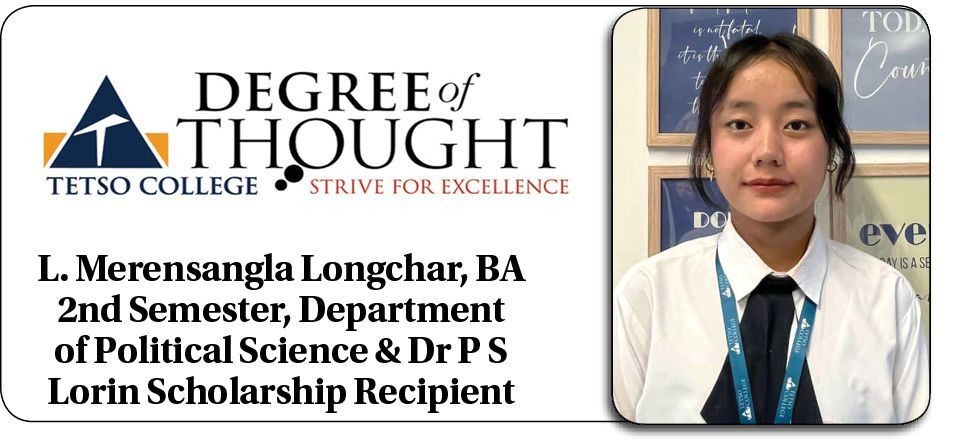
Degree of Thought is a weekly community column initiated by Tetso College in partnership with The Morung Express. Degree of Thought will delve into the social, cultural, political and educational issues around us. The views expressed here do not reflect the opinion of the institution. Tetso College is a NAAC Accredited UGC recognised Commerce and Arts College. The editorial team includes Chubamenla, Asst. Professor Dept. of English and Rinsit Sareo, Asst. Manager, IT, Media & Communications. For feedback or comments please email: dot@tetsocollege.org