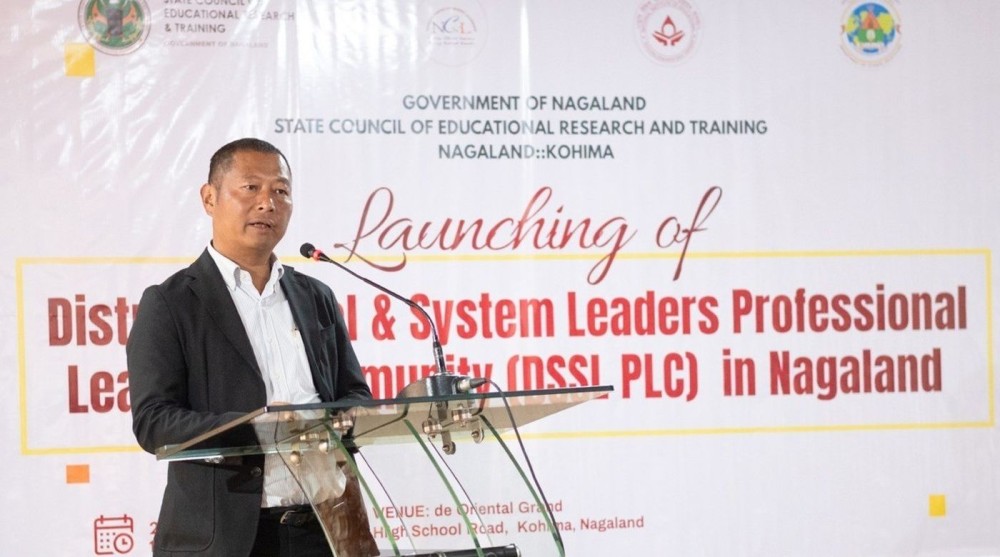
Advisor Dr Kekhrielhoulie Yhome speaking at the launching of the DSSL PLC in Kohima on March 24. (DIPR Photo)
Nagaland School Education Advisor asks if welfare reaches every child, launches DSSL PLC
Morung Express News
Kohima | March 24
Even as the ecosystem of finances in Nagaland indicates that, the Department of School Education has consumed Rs 600 crore, Dr Kekhrielhoulie Yhome, Advisor for School Education & SCERT asserted that, looking at India as a welfare state, “it is our job to give free education to every child and no child should be left behind.”
Addressing the launching of the District School & System Leaders Professional Learning Community (DSSL PLC) in Nagaland at De Oriental Grand Kohima on March 24, he questioned, “Are we actually able to give proper welfare to our children? Are we able to build characters, build our future around our government public schools?”
Consumes 8.5% of state allocation, yet system in ‘mess’
On the profitability of what the state is investing, he highlighted that School Education alone is consuming about 8.3 to 8.5 of the state allocation, which, he added is “huge and very healthy.”
However, while looking at these things, he also underlined that “a lot of all these resources are wasted because we have an impeccable strength of teachers, as well as a lot of challenges ahead.”
Pointing out that the school education system is in a mess because they have inherited a lot of unwise planning, and done a lot of things, for which ultimately they are suffering today, he reiterated that there are a lot of challenges.
DSSL PLC aims to rebuild trust in government schools
In this context, he said that the launching initiative of DSSL PLC in Nagaland is very important as it aligns very well with their policy of rebuilding public schools. Terming Nagaland as a poor society, where, most of our people and households are very poor, he said, “and yet people send their children to private schools because they do not understand or trust the government school system.”
However, through the initiative, he hoped that they would be able to regain the erstwhile years where everybody trusted government schools, including all public leaders in all sectors, and walks of life.
“We are all graduates, we are all alumni of our government schools,” he cited in this regard.
Leadership, pedagogy and administration
He further highlighted that a lot of vision for government schools are aligned on three pillars including school leadership, pedagogy and administration. Elaborating on these pillars, Yhome said that there are issues especially with government teachers in the area of professional growth, motivational level and perception issues. However, he exuded hope that they would regain all these things, rebuild infrastructure, and bring world-class curriculum into classrooms in alignment with the NEP'S vision.
Emphasising that the quality of the state’s education has become very important today, he underlined the importance of school leadership and the “need to rebrand ourselves so that the public trusts us.”
“The system is perfectly right but the design which created the system is technically flawed,” he articulated and reiterated that the “initiative is a very huge step towards redesigning our ecosystem in school education.”
PLC initiative to drive ‘systematic change’
Recognising the profound importance and potential of Professional Learning Communities (PLCs), Mhathung Tungoe, Secretary, School Education revealed that the School Leadership Academy, SCERT in strategic collaboration with the National Centre for School Leadership, National Institute of Educational Planning & Administration (NIEPA), New Delhi and NECTAR, P3 consortium has taken a groundbreaking initiative by launching the DSSL PLC in Nagaland.
Stating that one of the most effective and transformative strategies in the pursuit of educational excellence has been the establishment of Professional Learning Communities (PLCs), he also remarked that, “these collaborative networks have proven instrumental in fostering continuous improvement, shared expertise and collective problem-solving among educational professionals.”
He said that the initiative represents far more than an administrative program and stands as a “landmark achievement with the transformative power to revolutionize schools across our state of Nagaland.”
“Through PLC, we are creating a robust network of educational leaders who will share best practices, innovate collectively and drive systematic change that will benefit countless students and communities,” he stated.
He further highlighted that the DSSL PLC embodies their commitment to collaborative leadership, continuous learning, and sustainable educational reform. He also affirmed that it would serve as a catalyst for positive change, enabling district school and system leaders to work together in unprecedented ways, sharing insights, resources, and strategies that will elevate the quality of education throughout Nagaland.
‘When leaders learn together, schools grow together’
Shashank Pratap Singh, IAS, Principal Director, School Education also dwelt on the importance of training on school leadership while stating that, “what happens in the schools depends on the school heads.”
He further said that this autonomy also comes with accountability of a major responsibility that takes into account the punctuality of teachers, to what extent they are performing their duties, etc.
In the meantime, he stated appreciation for all the concerned officials and staff of NECTAR and SCERT, and their efforts for continuous development of teachers.
Stating that School Leadership Academy (SLA) Nagaland is one of the best performing in the North East, Dr Yogesh Pahariya, Assistant Professor, NCSL, NIEPA, New Delhi, said, “we recognise Nagaland's efforts in taking lead in implementing NEP 2020.”
Observing that the idea of community is not new in Nagaland, he also remarked that, “every community has a culture and so does the PLC (Professional Learning Communities).”
Stating that it is a culture where they can learn from each other, he said, “if this initiative is implemented effectively, it has the potential of building strong leadership across schools in the state.”
He further remarked that Nagaland has emerged as a model for other parts of the country and added, “when leaders learn together, schools will grow together and when schools grow, the entire state moves forward.”
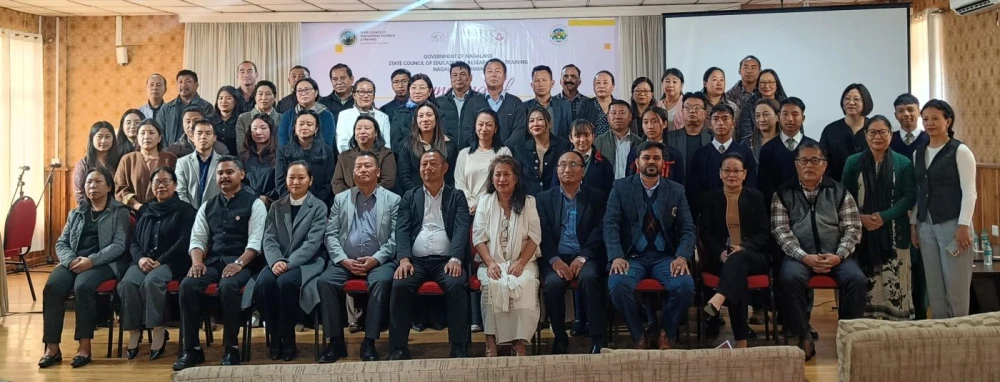
Highlights of the programme included welcome note by Keviraleü Kerhuo, Director, SCERT, Nagaland, journey of SLDP by Benjung Yaden, Deputy Director, SCERT, SLDP Alumni Testimonial by Aluoü Shuya, Vice Principal, GHSS Jotsoma while Aishwarya, Program Manager, P3 NECTAR chaired the programme.
T M Higher Secondary School Kohima also gave a special presentation.
Resource persons for the technical session were Dr Yogesh Pahariya, Assistant Professor, NCSL, NIEPA New Delhi and Spokey Wheeler, Founder & International Director, Adhyayan Quality Education Services Ltd. The topics covered during the technical session were “School Leadership: National Context and Support to the state” and “Importance of Professional Learning Community” besides hands-on activity and discussion.