On being rooted and reaching at the same time
There is a sound many of us carry that no city can drown out: a grandmother’s voice calling our name in a language that has no word for “networking” or “personal brand,” yet holds everything that matters. It belongs to the fields, the fireside, and the long evenings when stories were passed from one generation to the next without a screen between them. And there is another sound, newer and louder: the notification, the reel, and the constant hum of a world saying faster, further, and more. Most students in Nagaland today live between these two sounds, and that is why so many of us are tired in a way that is difficult to name.
It is a strange kind of tiredness, because on the surface, our lives look full. We belong to families, clans, villages, and churches that know us. In our hills, almost everyone knows whose child you are, and that belonging is a gift. But being known is not the same as being understood. A community can know your name, your clan, and your father’s work, yet never ask what you fear when the future feels like a locked door. We are surrounded by people, yet our deepest questions remain unspoken.
Part of what makes those questions heavy is the love that surrounds them. Somewhere behind almost every student is someone who sold paddy, borrowed money, or quietly gave up their own comfort so that fees could be paid. We know this, and we do not forget it. As a result, every grade can feel like repayment and every failure like betrayal. This pressure rarely comes through harsh words; instead, it comes through sacrifice, which is far harder to argue against. Yet we can be deeply grateful and afraid at the same time, and there is no shame in admitting both. Those who sacrificed for us did not do so for a perfect child but for someone who is alive, growing and finding their way. Such a person is allowed to struggle, doubt, and change directions.
The uncertainty grows sharper when we consider what waits after graduation. We study, earn the degree, and meet a market where jobs are few and competition is everywhere. The world suggests this is a personal failure, that if we had worked harder or chosen better, the door would have opened. But that is not an honest reading. We face a difficult season of history we did not create, and a shortage of positions is not a shortage of purpose. Our worth was never the job market’s to assign. Remembering this does not remove the difficulty, but it protects us from the quiet conclusion that we ourselves are the problem.
It helps to remember who came before us. Our ancestors crossed ranges, built villages on ridges, defended them, and kept fire and memory alive through centuries that nobody wrote down. They were not people who refused change. They were people who survived it, who understood what was essential, carried it forward, and adapted everything else. When we imagine that honouring them means standing still, we misunderstand them. To honour them is to carry their courage into rooms they never entered: classrooms, laboratories, studios, offices, and stages. Learning to code does not betray the Morung. It extends its fire into a new age. Our roots were never meant to be a cage. They were meant to be what allows us to grow tall without falling over.
No argument about heritage removes the loneliness, because the pull in both directions is real. Home asks for loyalty, continuity, and gratitude. The wider world asks for ambition, speed, and reinvention. Each makes a claim, and each can make us feel guilty for listening to the other. If we go far, we fear we are abandoning something. If we stay close, we fear we are wasting something. Many of us carry this burden. Feeling divided is not weakness or confusion, but the natural result of belonging to two worlds.
Beneath all of this lies a question older than any of our circumstances. Set aside the tribe, the church, the followers, the marks, and the expectations, and ask yourself quietly: who am I when no one is watching? The answer is not found by choosing between old and new, but by building a self deep enough to hold both. It looks like someone who can pray in the mother tongue and write a business plan in English, who respects the elders yet disagrees with them gently, and who loves home and is not afraid of the horizon.
We are often told that we must choose between tradition and modernity, village and city, the old way and the new. But this is the wrong question. We are not a bridge between two worlds; we are where they meet.
If there is a closing thought, it is a simple one. Be gentle with yourself in the seasons when the weight feels too much. Ask for help, which is a form of courage and not a confession of failure. Tell one trusted person the truth instead of the polished one. The hills have waited for a generation willing to be both rooted and reaching, perhaps one that stops apologising for being both.
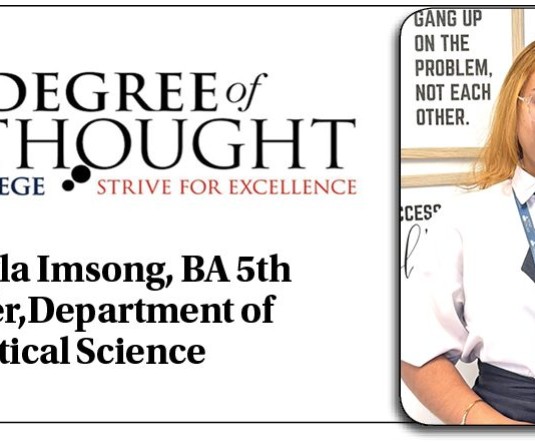
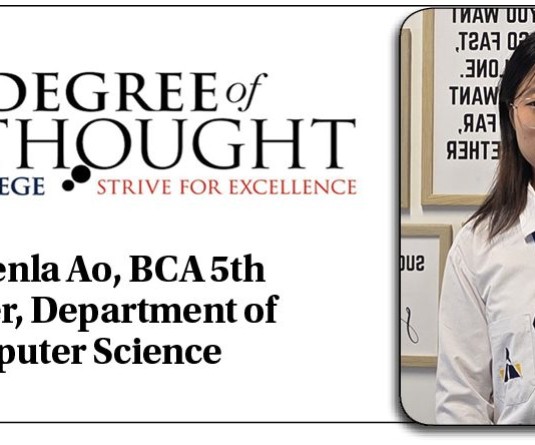
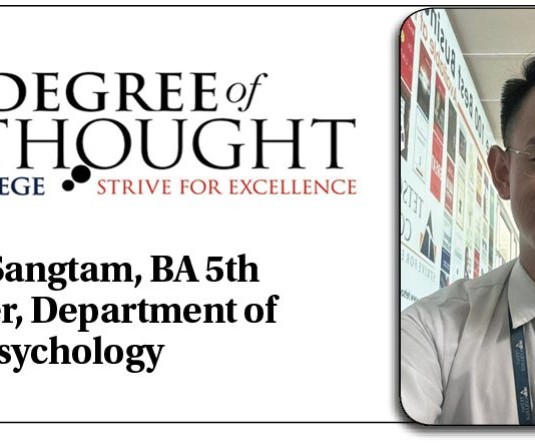
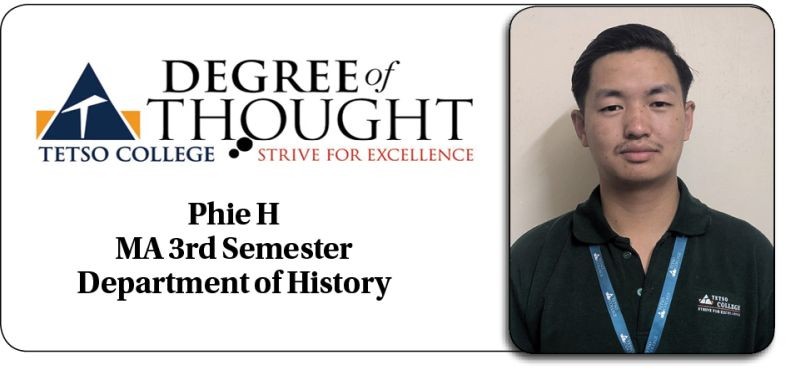
Degree of Thought is a weekly community column initiated by Tetso College in partnership with The Morung Express. Degree of Thought will delve into the social, cultural, political, and educational issues around us. The views expressed here do not reflect the opinion of the institution. Tetso College is a NAAC-accredited, UGC-recognised Commerce and Arts College. The editorial team includes Tenipumei Phom, Asst. Professor Dept. of English, Limajungla Walling, Asst. Professor Dept. of Linguistics, and Munkiri Taro, Multimedia Executive. For feedback or comments, please email: [email protected]