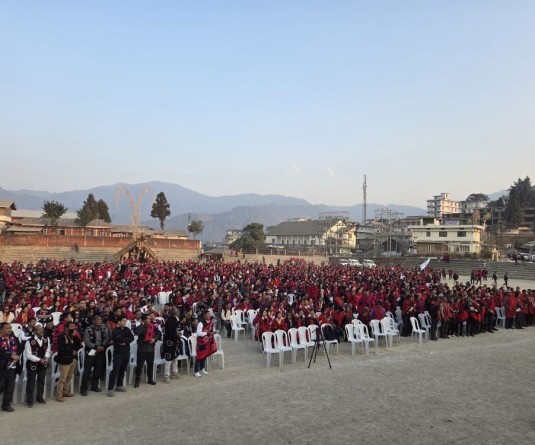
Dimapur, February 3 (MExN): A national level seminar “writing and its interdisciplinary nature” was started today at Tetso College in Dimapur. The seminar is organized by Tetso College in Dimapur and held in collaboration with the Nagaland College Principals’ Forum and sponsored by the University Grants Commission. The two-day seminar is till February 4.
Where have we gone wrong?
Although education in Nagaland for the past 100 years has been imparting English as language, the writing standard of most Nagas have yet to reach the mark of mainstream standards of use, applicability and portent. In a bid to analyse ‘what is wrong’ in the State’s educational system concerning the application of English language, Assistant Professor of English and Foreign Languages University of Shillong, T Temsunungsang presented a discourse on “Writing as an Integral Part of Educational Development: The Scene in Nagaland”.
The assistant professor pointed out that rejoinders or articles written by various organizations and individuals published in the local newspapers demonstrate the standard of writing in Nagaland. “…everyone can write but are we actually writing,” also, teachers will know better as they check assignments or test papers of students, he said.
Analysing the present writers in Nagaland, he claimed that no writers in Nagaland can write like Dr Temsula Ao and Easterine Kire. On which he questioned, ‘what went wrong with the present generation?’
He also read out some paragraphs of an article written by Columnist and Journalist Al Ngullie: ‘Naga is many Bad Words ho, na?’ where Ngullie ridicules Nagas’ butchering English language - from bad grammar to spelling mistakes.
Concerning the educational system in Nagaland, he said the Nagaland Board of School Education has laid down “fantastic objectives” for English as a subject in schools but this standard is not translated in actual work. “…the amount of instructions we receive in our classrooms does not seem to be reflected in our writing.”
The assistant professor added that writing is something that needs to be taught to a child as it is not spontaneous as speaking. Further he pointed out that many youngsters are “neither English proficient nor mother-tongue proficient”.
How the ‘Fourth Estate’ came about…
Editor of Nagaland Page Monalisa Changkija presented the second paper on “Fourth Estate: Providing Leadership to the Public in the Realm of Ideas”. She discussed the origin of the Fourth Estate and how it influenced the history of mankind.
She said man always wanted to know what was happening around him. And the invention of printing press gave a stepping stone to the rise of Fourth Estate. “…Fourth Estate is the consequence of human ideas.” Also, “…Fourth Estate has always been a leader in the realm of ideas,” she said.
Changkija also asserted that newspaper is the medium and what is written on it is the message and the growing strength of the fourth estate is the message and not the medium.
Concerning Journalism, whether as an art or profession, Changkija said it is the first that an individual has to master. She said that Journalism is divided into two categories – Developmental Journalism and New Journalism.
From the chief guest
The seminar was inaugurated by Commissioner & Secretary, Higher & Technical Education FP Solo who was the chief guest. In his inaugural address, the chief guest talked about the need for quality education and introduced job oriented courses.
He challenged academicians to attend seminars, workshops, refresher courses for their progress. He also encouraged the colleges to organize at least one national seminar a year.
In regard to rise of educated unemployed youth in Nagaland, he suggested that colleges impart job oriented courses so students can look to employment opportunities in private sectors. “…the employment in government sector is already reached a saturation point,” he added.