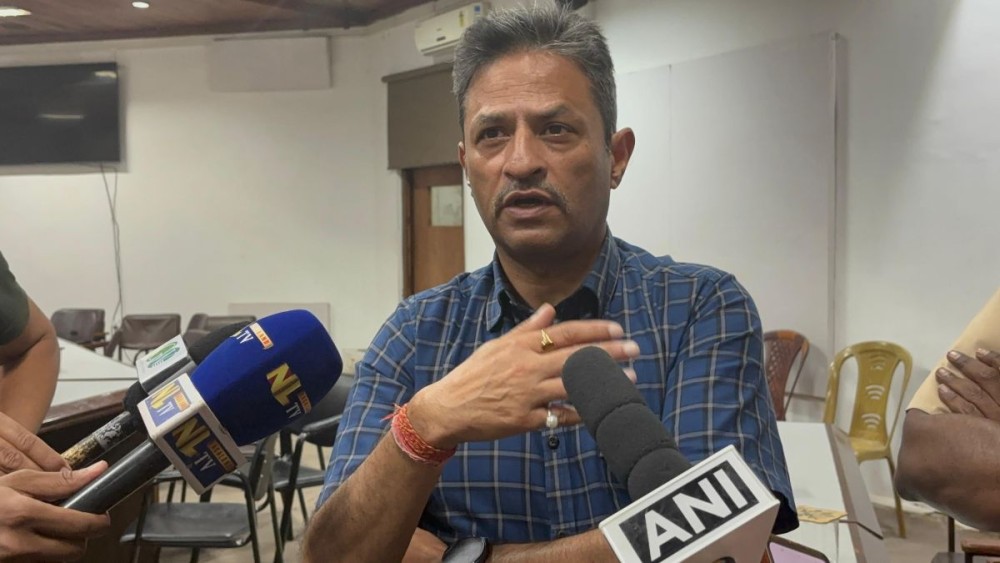
Nagaland DGP Rupin Sharma on September 29.
Morung Express News
Dimapur | September 29
In September, this month, Tuensang and Mokokchung witnessed a series of fatalities linked to consumption of adulterated liquor. While the toll could be more, officially nine lives were claimed in Tuensang and eight in Mokokchung.
Parallel Special Investigation Teams (SIT) has been instituted in both districts but will the Nagaland Police consider instituting a state-level inquiry to get to the bottom of the long-running illicit liquor affair? Nagaland DGP Rupin Sharma was posed this query on the sideline of a police event at the Nagaland Police Complex in Chümoukedima on September 29.
The DGP, while acknowledging the institution of the district-level investigations, told reporters that the police headquarters has not set up a state-level team yet. He said, “We will consider if we can set up an SIT or a higher-level probe so that we can look at the trafficking of liquor throughout the state. No decision as yet has been taken, but we will consider it.”
Close on the heels of the tragic deaths, some 7740 bottles of IMFL were caught in transit in Kohima on September 28. Only one person found driving the truck was arrested. In May, one truckload containing over 15,000 empty bottles of the widely favour McDowell’s rum was intercepted in Mokokchung.
There is a perceived disconnect between the state police and the Department of Excise and Prohibition. Sharma denied there was but said that there is scope for improving coordination and cooperation between the two agencies.
As per the Nagaland Liquor Total Prohibition (NLTP) Act, the Director of Prohibition, who is also the Commissioner of Excise, is vested with authority to implement the NLPT Act. While police officers have delegated powers to search, seize, and detain, there is a catch. ADGP (Law and Order), Sandeep M Tamgadge said, “There is a fundamental legal difference. If the police find liquor stored in a building or a vehicle, we can register an FIR only upon a written complaint submitted by an Excise official.
He claimed that there have been instances when the courts have dismissed earlier cases filed by the police over the technicality. He added that the motu FIRs registered in Tuensang and Mokokchung pertain to the deaths, not offences under the NLTP Act. He disclosed that the police in Tuensang and Mokokchung have identified the places outside the state where the suspected adulterated liquor was procured but need concrete evidence to proceed legally.
On the police seldom catching the kingpins, DGP Sharma said that hardly any complaints are forthcoming, while terming social acceptance as a challenge to enforcement. He admitted that arrests are often retailers, and “have not been able to trace the backward linkages of who is bringing it, where it is being brought, and where it is coming from.” He added that it is a problem that the police will try to address. In Tuensang, post-mortem could not be conducted on a single victim. In Mokokchung, he said that it was conducted on four bodies.
Police Modernisation
The DGP was further asked whether Police Modernisation is only limited to purchasing new transport vehicles. He replied that, in addition to enhancing mobility, modernisation involves acquiring other equipments like deep search metal detectors, forensic equipment, communications data analysers and tools for extracting data from mobile phones and stolen mobile phones, besides others.
According to him, investment in police modernisation is relative to crime incidence. He added that Nagaland averages 1300 FIRs/complaints annually.
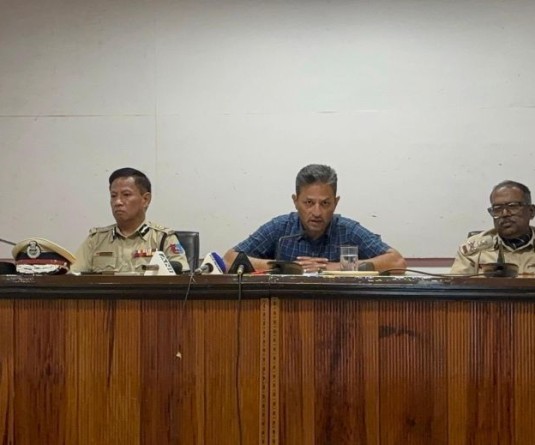
.JPG)