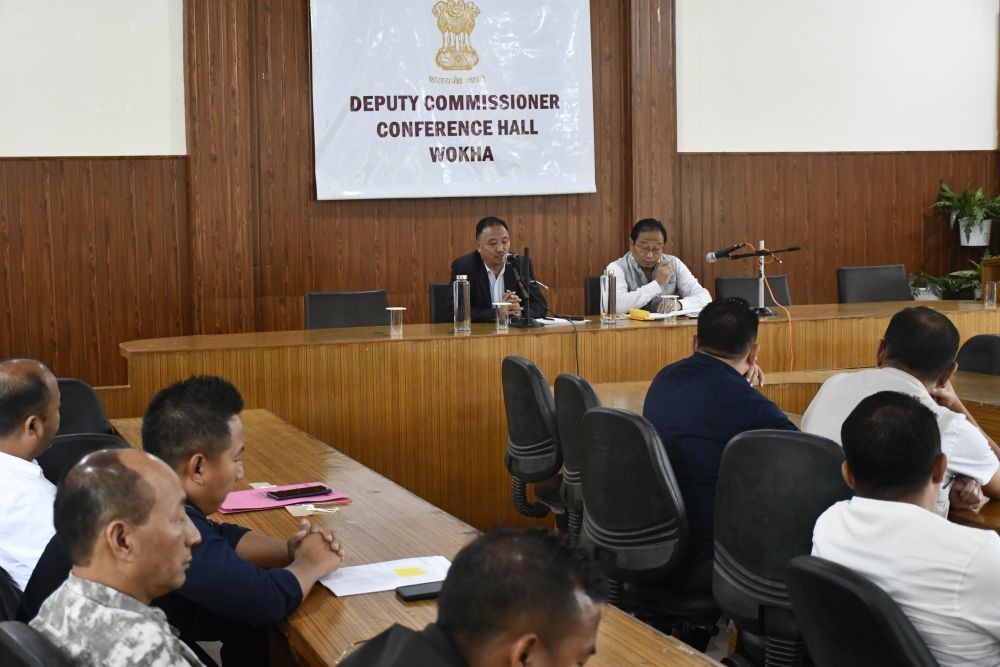
Member of Parliament (Lok Sabha) and DISHA Chairperson Supongmeren Jamir and others during the District Development Coordination and Monitoring Committee meeting in Wokha on July 7. (DIPR Photo)
Wokha, July 7 (MExN): The District Development Coordination and Monitoring Committee (DISHA) meeting in Wokha on Tuesday highlighted the impact of African Swine Fever (ASF), which claimed 374 pigs and caused losses estimated at over Rs 1.04 crore, while officials also pointed to an annual shortfall in local meat production valued at more than Rs 36 crore.
The meeting, held at the Deputy Commissioner's conference hall, was chaired by Member of Parliament (Lok Sabha) and DISHA Chairperson Supongmeren Jamir and co-chaired by Deputy Commissioner K Mhathung Tsanglao, according to a DIPR report.
Chief Veterinary Officer K N Zubemo Humtsoe said Wokha's annual meat requirement is 3,614 metric tonnes against a local production of 1,964.67 MT, leaving a deficit of 1,649.55 MT worth about Rs 36.64 crore.
He informed the committee that ASF outbreaks in Wokha Town, Wokha Village, Pangti, Baghty and Chukitong resulted in the death of 374 pigs, causing losses estimated at around Rs 1.04 crore.
However, Humtsoe also highlighted progress under the Artificial Insemination Technology initiative launched in October 2024 in collaboration with Krishi Vigyan Kendra (KVK), ICAR Wokha. So far, 165 inseminations have produced 1,350 piglets with an 81% success rate. The programme aims to improve the availability of superior piglets and reduce disease transmission.
He also briefed the meeting on the Livestock Insurance Scheme under the National Livestock Mission, implemented from May 2026, under which the department bears 85% of the insurance premium and beneficiaries contribute the remaining 15%. Other initiatives under the Mission, including the Entrepreneurship Development Programme and convergence activities, were also highlighted.
District Agriculture Officer Renathung Kikon presented updates on the National Mission on Natural Farming and the NMEO-Oil Palm scheme, which covers 243 hectares across 14 villages. He also highlighted the lack of a direct road to Ralan Block, forcing field staff to travel via Kohima, Chümoukedima and Niuland districts, and reiterated the need for a separate sub-division. Kikon further said the transition to Aadhaar-based Direct Benefit Transfer payments has made Aadhaar seeding, authentication and NPCI mapping both time-consuming and manpower-intensive.
Assistant Labour Commissioner Neimenuo informed the committee that the Nagaland Building and Other Construction Workers' Welfare Board has registered 1,788 workers, of whom 763 are active. During 2025-26, the Board processed eight death claims, 630 scholarships, five maternity benefits, two medical benefits and distributed 768 tool grants. She also reviewed implementation of the Employees' State Insurance Corporation and Employees' Provident Fund Organisation schemes, citing challenges in expanding coverage due to the predominance of farming occupations and difficulties in reaching beneficiaries.
The meeting also discussed BSNL connectivity issues affecting Census operations, postal infrastructure, vacant Gramin Dak Sevak posts for indigenous Nagas, and the status of agricultural credit presented by the Lead Bank Manager.
As per the State DIPR, Jamir stressed the importance of DISHA meetings in guiding district development and assured departments that issues requiring intervention at higher levels would be pursued. Presentations were made by the Departments of Agriculture, Labour, and Veterinary and Animal Husbandry.