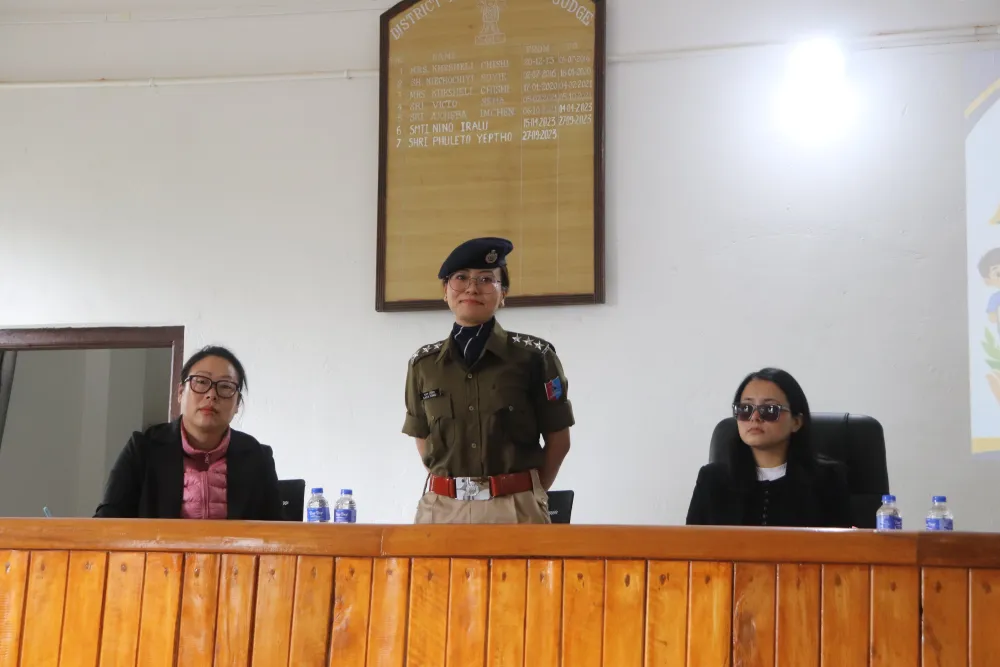
Resource persons (from left) Vesutolu Therie, Judicial Magistrate First Class-cum-Secretary, ZDLSA; Sara Tokiu, Sub-Divisional Police Officer (SDPO), Aghunato; and Easter H Yepthomi, Retainer Lawyer, ZDLSA, during a one-day training programme on child protection, POCSO and digital safety organised by the District Legal Services Authority, Zunheboto, on November 21. (Morung Photo)
Morung Express News
Zunheboto | November 21
The District Legal Services Authority (DLSA), Zunheboto, organised a one-day training programme for teachers under the Surakshit Bachpan Abhiyan, a pan-India school awareness campaign on the Protection of Children from Sexual Offences (POCSO) Act, 2012 at District Court Complex, Zunheboto, on November 21. Around 60 teachers participated.
The programme emphasised awareness, early identification and timely reporting in safeguarding children, and focused on child rights, legal protection, personal safety, mandatory reporting responsibilities and emerging digital threats. Certificates were distributed to participants.
Sessions covered three areas: KNOW Legal Awareness, SAFE Digital Childhood and Online Safety, and CONNECT Legal Aid and Support.
Legal framework
Vesutolu Therie, Judicial Magistrate First Class-cum-Secretary, ZDLSA, explained five key legislations: the POCSO Act, 2012; the Juvenile Justice (Care and Protection of Children) Act, 2015; the Prohibition of Child Marriage Act, 2006; the Bharatiya Nyaya Sanhita (BNS), 2023; and the Bharatiya Nagarik Suraksha Sanhita (BNSS), 2023. She noted that the POCSO Act is gender-neutral and protects every child below 18, irrespective of gender. Consent is immaterial under the Act, and sexual activity involving a person below 18 constitutes an offence.
Therie highlighted the under-reporting of child sexual abuse, which often goes undisclosed due to social stigma, reluctance and the involvement of people known to the child, including family members, relatives and neighbours. She stressed that teachers and other adults have a legal responsibility to report suspected or known cases to the Special Juvenile Police Unit (SJPU) or local police.
She cautioned teachers against investigating or fact-finding when a child discloses abuse. Instead, they should ensure the child’s immediate safety, respond sensitively, avoid detailed questioning and refer the matter to the appropriate authorities. She stressed maintaining confidentiality and avoiding the sharing of photographs, names, addresses or other details that could reveal a victim’s identity.
She urged teachers to watch for signs of abuse, including sudden behavioural changes, withdrawal, isolation or unexplained fear of particular individuals or places, and outlined the child-friendly provisions under POCSO, including legal assistance, medical examination, counselling and rehabilitation.
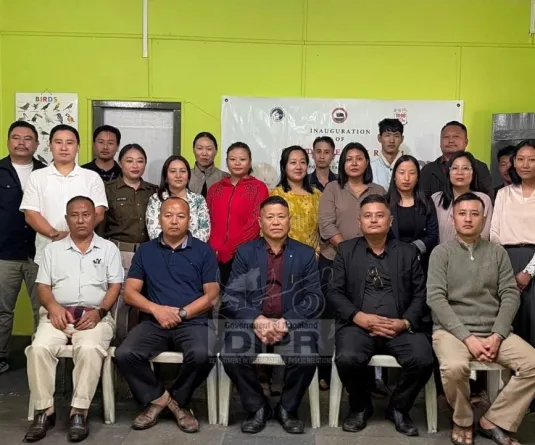
A section of teachers participating in the ZDLSA’s one-day training programme on child protection, POCSO and digital safety at the District Court Complex, Zunheboto, on November 21. (Morung Photo)
Personal safety education
Easter H Yepthomi, Retainer Lawyer, ZDLSA, emphasised educating children about personal safety, safe and unsafe touch, and creating an environment where children feel comfortable speaking about abuse.
She explained that children must be taught to distinguish between safe, unsafe and unwanted touches and to understand that their personal boundaries must always be respected. Unsafe touches include inappropriate contact with private body parts, forcing children to touch another person’s private parts, exposing them to inappropriate images, and taking or sharing their photographs without consent.
Yepthomi encouraged teachers to use age-appropriate language when educating children about private body parts and personal boundaries. Children should be taught that no one has the right to touch their private parts inappropriately and that they have every right to say no when they feel uncomfortable or unsafe.
She outlined three steps children should follow: say no, move away and tell a trusted adult. Children should immediately approach someone they trust, such as a parent, teacher or caregiver and keep seeking help until someone listens and provides support.
Noting that abuse can also be committed by people familiar to the child, she cautioned teachers against assuming children are safe simply because they know the person involved. Children must never be made to feel guilty or responsible for the abuse, regardless of the perpetrator’s identity.
Yepthomi called on educators to create a supportive school atmosphere where children can freely discuss personal safety without fear, embarrassment or judgement, and to carry the lessons into their schools through regular awareness discussions on child protection.
She urged schools to prominently display emergency contact numbers, including Child Helpline 1098 and Cyber Crime Helpline 1930, and stressed that schools should not conduct independent investigations when a child reports abuse. Instead, teachers should respond sensitively, protect the child’s identity and refer the matter to the appropriate authorities.
She called for continued cooperation among schools, parents, legal-aid authorities and other stakeholders to strengthen child-protection awareness and ensure every child grows up in a safe, supportive environment.
Digital safety
Sara Tokiu, Sub-Divisional Police Officer (SDPO), Aghunato, presented on digital safety and cyber-related offences involving children. The session, titled “Safe Digital Childhood-Online Safety,” highlighted growing concerns around cyber grooming, online sexual exploitation, revenge pornography, identity theft, cyber-bullying, phishing, sextortion and sexting.
On cyber grooming, the session explained how perpetrators gradually build emotional connections with children through attention, flattery, gifts, online gaming points and in-game rewards before manipulating them into sharing personal information or engaging in inappropriate activities—interactions that can escalate into blackmail, threats and exploitation.
It also covered online sexual exploitation, including children being manipulated or threatened into performing sexual acts via webcams and the circulation of child sexual abuse material, as well as how cyber-bullying and phishing are used to intimidate children and obtain sensitive information through deceptive communication.
For prevention, Tokiu encouraged teachers to maintain open communication with children about their online activities and promote responsible internet use. Teachers were advised to educate students on verifying suspicious links, checking information before forwarding it, cautiously accepting friend requests and avoiding unnecessary disclosure of personal and location information.
The session highlighted cyber hygiene measures such as multi-factor authentication, securing phones with strong passwords or biometric protection, avoiding untrusted devices, backing up personal data and exercising caution on public Wi-Fi.
Financial safety
On financial safety, participants were cautioned against sharing UPI PINs, with the reminder that a UPI PIN is not required to receive payments. They were advised to verify payee details and QR codes before making transactions.
Support contacts highlighted included Police Emergency 112, Child Helpline 1098, Cyber Crime Helpline 1930 and Women Helpline 181, along with the National Cyber Crime Reporting Portal at cybercrime.gov.in.
The programme concluded with an interactive session and discussion. As part of continued implementation, two teachers from each participating school, preferably one male and one female will be identified and trained as Teachers-in-Charge. They will coordinate with the DLSA, conduct regular awareness activities, facilitate appropriate referrals and strengthen child-safety mechanisms in their schools. The initiative is envisaged to continue until November 2027.